“In the beginning the Word already existed. The Word was with God, and the Word was God. So the Word became human and made his home among us. He was full of unfailing love and faithfulness. And we have seen his glory, the glory of the Father’s one and only Son.” John 1:1, 14 NLT
The term ‘faith’ when referencing Christianity means different things to different people. It is used in a general sense as ‘people of faith.’ Some Christians say, ‘I am a person of faith,’ ‘I have faith,’ and ‘you got to have faith,’ etc… There are more examples we can name, but the point is numerous people speak of their Christian faith in general terms.
Christians who speak specifically of their Christian faith refer to God’s saving plan of salvation. God sent His Son to die on the cross for their sins. It is by grace one is saved through ‘faith’ by accepting Christ as savior.
The keys to the game as referred to in the sports world is, God being holy can only accept a perfect, holy sacrifice in the forgiveness of sin. Another key is we must acknowledge our sin and our need to be forgiven and made right with God. We must repent and confess our sin believing that Jesus Christ is the only perfect, holy sacrifice. We must come to realize Jesus is indeed God the Son able to save us from our sin and eternal death.
World history recognizes a man named Jesus who walked the earth over 2,000 years ago. There are few people who dispute this by agreeing to the content of the historical Jesus in history books. Believing only in the historical Jesus is equivalent to saying you are a person of faith, believing only He was a man who walked the earth doing great things. If your faith carry’s you so far as to admit Jesus was sent from God but far short of believing He is God the Son, your understanding of salvation is distorted. If you think just having faith, believing there is a God, doing good deeds, and learning what you can from Jesus’ example, is enough to get by in this world and into heaven, you’re mistaken.
Jesus was not just a good man, a good teacher, a prophet, or miracle worker, He is God the Son. If Jesus was only good man, His death for the sacrifice of our sin would be meaningless. How specific is your faith? Is your faith in Jesus, God the Son, having accepted Him as your savior, or is your faith in the historical Jesus, a good man who walked the earth.
“……but I focus on this one thing: Forgetting the past and looking forward to what lies ahead. I press on to reach the end of the race and receive the heavenly prize for which God, through Christ Jesus, is calling us.” Philippians 3:13b-14 NLT
You have heard the statement, ‘what’s done is done.’ That statement is very true, yet we try to undo what has already been done, and the fact is we can’t go back. Sure, there are corrective measures we can take to not repeat things we wish were done differently. We call this, ‘learning from our mistakes.’ But what good does it do to dwell on the past. It will only cloud our focus on the future. What’s done is done.
As we head into the New Year, don’t let the past interfere with your plans going forward, or more accurately, God’s plans for you going forward in 2025. Paul, the apostle, gives us his perspective of forgetting the past in writing to the church in Philippi. Paul viewed his Christian life as a race. Every runner knows it is disastrous to look back. Looking back will slow you down and takes your eye off the goal. The goal is the finish line. We often find ourselves looking back to our own demise. If our eyes come off the goal even for a moment, it could prove to be harmful.
Paul was explaining he hadn’t yet achieved the goal of Christlikeness, but he was still running and pursuing that goal. He was looking forward to what lies ahead, the finish line and the end of the race, when the heavenly prize (Christlikeness) is accomplished. Paul did not look back on his sinful past. What’s done is done. He was forgiven and assured of heaven and eternal life, no need to look back. Jesus saved him, and that also is done is done. So, Paul is forgetting all that is behind him and looking forward to that heavenly prize in Christ Jesus, Christlikeness.
May we keep looking forward, forgetting the past in the New Year. Every Christian’s goal in the 2025 should be moving towards Christlikeness. All other goals are secondary. Working towards that goal will set the priority for other goals we have in mind as the Lord leads us to where He is calling us.
“Lord, now you are letting your servant depart in peace, according to your word; for my eyes have seen your salvation that you have prepared in the presence of all peoples, a light for revelation to the Gentiles, and for glory to your people Israel.” Luke 2:29-32 ESV
FreeBibleimages.org
We have come to our 5th and final song of hope for advent. Yes, Christmas is over, but this song takes place after the birth of Christ, some 40 days later. The first male child born to a Jewish couple was to be dedicated to the Lord as required by the Law of Moses. Joseph and Mary, being devout Jews, brought Jesus to the temple in Jerusalem for this purpose. Mary had to wait 40 days until her purification period was over before she could go to the Temple, and she would also go to offer a sacrifice for her purification.
“And when the time came for their purification according to the Law of Moses, they brought him up to Jerusalem to present him to the Lord (as it is written in the Law of the Lord, ‘Every male who first opens the womb shall be called holy to the Lord’) and to offer a sacrifice according to what is said in the Law of the Lord, ‘a pair of turtledoves, or two young pigeons.’” (Lk.2:22-24 esv)
Mary and Joseph made the 6-mile trip from Bethlehem to Jerusalem to offer a sacrifice of two turtledoves or two pigeons which shows the poverty of this young couple, the earthly parents of the Christ-child. This should serve as a reminder to us that Jesus left His heavenly home to come to earth, giving up the luxuries of heaven to live in the lower class of society. We can be sure Jesus understands the plight of the poor in today’s world and cares about them.
The gospel writer Luke introduces us to Simeon in Luke 2:25-26. All we know about him is what is written in these two verses. He is mentioned nowhere else in Scripture. “Now there was a man in Jerusalem, whose name was Simeon, and this man was righteous and devout, waiting for the consolation of Israel, and the Holy Spirit was upon him. And it had been revealed to him by the Holy Spirit that he would not see death before he had seen the Lord’s Christ.” (Lk.2:25-26 esv)
Presumably Simeon was an elderly man. He was a righteous man who was waiting for the consolation of Israel (the comfort the Messiah would bring to the people at his coming). Scripture says the Holy Spirit was upon him and given special insight that he would not die until he had seen the Messiah. One could imagine Simeon going to the Temple every day thinking maybe this will be the day. Finally, the day came when Mary and Joseph entered the Temple area. “….and when the parents brought in the child Jesus, to do for him according to the custom of the Law, (Simeon) took him up in his arms and blessed God….” (Lk.2:27-28 esv)
Simeon’s song begins, “Lord, now you are letting your servant depart in peace, according to your word; for my eyes have seen your salvation that you have prepared in the presence of all peoples, a light for revelation to the Gentiles, and for glory to your people Israel.” (Lk2:29-32 esv)
Simeon’s words here are known as “Nunc Dimittis” the Latin Vulgate translation meaning “You now dismiss.” It is a New Testament hymn celebrating God’s salvation. Simeon was holding in his arms the one who would redeem Israel from their sins and not only Israel but of every nation, tongue, and tribe. Simeon didn’t need to see anything more; he saw God’s promised Messiah. He didn’t desire to live any longer, God rewarded Simeon for his faithfulness. Perhaps there are some things we would like to see before the Lord calls us home. The Lord’s arm is not too short that he cannot reach down and grant that request. But our focus is to be righteous and devout as Simeon. We may be surprised at all the Lord will reveal to us before we leave this earth.
Simeon now focuses his attention on Mary and Joseph and blesses them. “And Simeon blessed them and said to Mary his mother, ‘Behold, this child is appointed for the fall and rising of many in Israel, and for a sign that is opposed (and a sword will pierce through your own soul also), so that thoughts from many hearts may be revealed.’” (Lk.2:34-35 esv) Christ will raise up those who believe in Him, but He will be a stumbling block to those who disbelieve. Simeon’s blessing included a hard truth for Mary. A cost will come to her as Mary will suffer deep anguish at her Son’s rejection and crucifixion. What was going through Mary’s mind at this point? We don’t know, and we don’t know how many times she thought about this during Jesus’ years on earth as she watched Him grow up and become a man. Mary certainly knew that the prophecy had to come to pass. Yes, it was a hard truth.
Simeon is joined by Anna, a prophetess 84 years old, who begins to give thanks to God and tells everyone around her waiting for the Messiah that He is here. “And coming up at that very hour she began to give thanks to God and to speak of him to all who were waiting for the redemption of Jerusalem.” (Lk.2:38 esv)
FreeBibleimages.org
Simeon’s song “Nunc Dimittis” closes these 5 songs of hope for advent, and what better song can we end with but the hope (assurance) of our salvation. We can sing with Simeon, “……my eyes have seen your salvation that you have prepared in the presence of all peoples, a light for revelation to the Gentiles, and for glory to your people Israel.”
“Behold, the virgin shall conceive and bear a son, and they shall call his name Immanuel” (which means, God with us).” Matthew 1:23 ESV
FreeBibleimages.org
There are many religions in the world today. Most of them serve and worship a god in some form or another. Others see this world as all there is and see themselves as gods. Most religions work towards entrance into the afterlife, whatever that looks like even though they can’t be sure if they’ll make it. There is only religion that I know of where God came to be with us and made it possible for us to be with Him forever in the afterlife. That religion, if you allow me to use the term, is Christianity.
The gospel writer Matthew quotes from Isaiah the prophet concerning the birth of Christ. “Therefore, the Lord himself will give you a sign. Behold, the virgin shall conceive and bear a son and shall call his name Immanuel.” (Is.7:14 kjv) Matthew confirms the meaning of ‘Immanuel’ as ‘God with us.’ Christianity is also the only religion where God is a ‘triune God,’ three persons in one. God the Father, God the Son, and God the Holy Spirit. Three in one. God the Son, Jesus Christ, left His heavenly glories to be with us and take on sin at the cross of Calvary. The apostle Paul says it best, “(Jesus) emptied himself, by taking the form of a servant being born in the likeness of men. And being found in human form, he humbled himself by becoming obedient to the point of death, even death on a cross.” (Ph.2:7-8 esv)
No other religion on earth has a God who came down to rescue sinners paying the penalty for their sins against Him. But Christ did just that, and like John 3:16 says, “For God so loved the world, that he gave his only begotten Son, that whosoever believeth in him should not perish, but have everlasting life.” (kjv) God’s plan of salvation is spelled out for us in the Bible, and it started with God with us. Christ came to us on Christmas. If you haven’t gone to Him for salvation what better day is there than today! It will be a Merry Christmas!!
“But as for you, Bethlehem Ephrathah, Too little to be among the clans of Judah, From you One will go forth for Me to be ruler in Israel. His goings forth are from long ago, From the days of eternity.” Micah 5:2 NASB
FreeBibleimages.org
Many families have Christmas Eve traditions they keep year after year. Some go by the wayside over the years, being replaced by new ones for the next generation and so on. There are fond memories of that first Christmas Eve you can remember as a child. Memories of the first Christmas Eve you had with your spouse or that special loved one are not forgotten. Baby’s first Christmas is cemented in your mind, along with so many memories of the ‘first’ Christmas Eve occurring during special events in your life. Memories are good for the soul and should be cherished, and remembering the first Christmas Eve, that very first Christmas Eve 2,000 years ago, should be cherished most of all.
Mary and Joseph had their baby’s first Christmas cemented in their minds. Their baby, Jesus, was Christmas. He was the Christ-child who came into the world. Jesus would save His people from their sins. It would be a Christmas Eve they would never forget. It began days before as Mary and Joseph traveled to Bethlehem under orders from Caesar Augustus to register in their hometown for taxation. Mary, about to give birth, had the ride of her life on a donkey which she would never forget. Joseph scrambling to find a place to stay in an overcrowded small town would make for good conversation years down the road. Their accommodation for the night would be a memory they both would like to have forgotten, but I’m sure they didn’t.
While we think back and treasure our memories of a special Christmas Eve, a special Christmas Eve long ago was remembered by two willing servants of God who trusted Him in the birth of His Son. Over the years those memories for Mary and Joseph grew sweeter and sweeter, covering any smell of a dirty stable that night. For the Son of God, the savior, was born that night. That first Christmas Eve was a night to remember.
The winter solstice arrived here in the northern hemisphere this past weekend on Saturday, December 21, at 4:20 AM EST. It is the day with the shortest amount of daylight. For those who dread shorter daylight hours and the winter season, there is good news, from this day forward the days will be getting longer. The winter solstice has been celebrated for centuries in various forms influenced by pagan festivals.
The three most famous are Saturnalia in ancient Rome, the Norse Yule traditions from Scandinavia from where we get our ‘yule log,’ and the celebrations of the Druids. Winter solstice celebrations are still held all over the world. Some follow the early pagan festivals, and others adapted from within their various cultures. Perhaps the most notable today is the thousands of visitors who will make their way to Stonehenge in Wiltshire, England, just to take in what they believe it to be. All these festivals have one thing in common, the darkest day giving way to rising light in the future days.
Just a side note; it is true that some of our Christmas traditions were picked up from some of these pagan festivals, such as the ‘yule log,’ since Christmas was first recognized on December 25, 336. The truth is, no one can be certain what time of the year Christ was born, most likely it wasn’t December 25th. The good news is, we know He came to earth being born of a virgin in Bethlehem.
It may not be a bad thing that Christmas is celebrated around the winter solstice. The world is anticipating the coming light to end their darkest days. What greater light is there for the world than the light of Jesus Christ and the hope of salvation for those who believe in Him. The amount of Christmas lights displayed around the world during the season adds to that hope. We do not know if Christ was born around the winter solstice, but it is fitting we celebrate His birth by shining His light in winter for all the world to see.
“And suddenly there was with the angel a multitude of the heavenly host praising God and saying, ‘Glory to God in the highest, and on earth peace among those with whom he is pleased!’” Luke 2:13-14 ESV
FreeBibleimages.org
A common thread that ran through the last two songs of hope we have looked at, Mary’s song and Zechariah’s song, is they both give glory to God. Mary said, “My soul magnifies the Lord,” and Zechariah exclaimed, “Blessed be the Lord God of Israel.” And the angels continue the theme this week with “Glory to God in the highest.” Indeed, the birth of Christ is reason to rejoice in praising God and giving Him all the glory. This week in our 4th Song of Hope for Advent we sing along with the angels, “Glory to God in the highest, and on earth peace among those with whom he is pleased!” (Lk.2:14 esv)
The greatest birth the world has ever known, the incarnation of God embodying human flesh, occurred in the most humiliating of circumstances. But God saw it was noted as the most glorious event that it was. R.C. Sproul describes it in this manner, “At the very moment the babe is wrapped in the cloth of humiliation, God is not satisfied that the circumstances of the Son’s birth be only humiliation. God desired that shame be balanced with glory and exaltation.” (1) And it was glory with a host of angels preceding down from heaven in a chorus of praise.
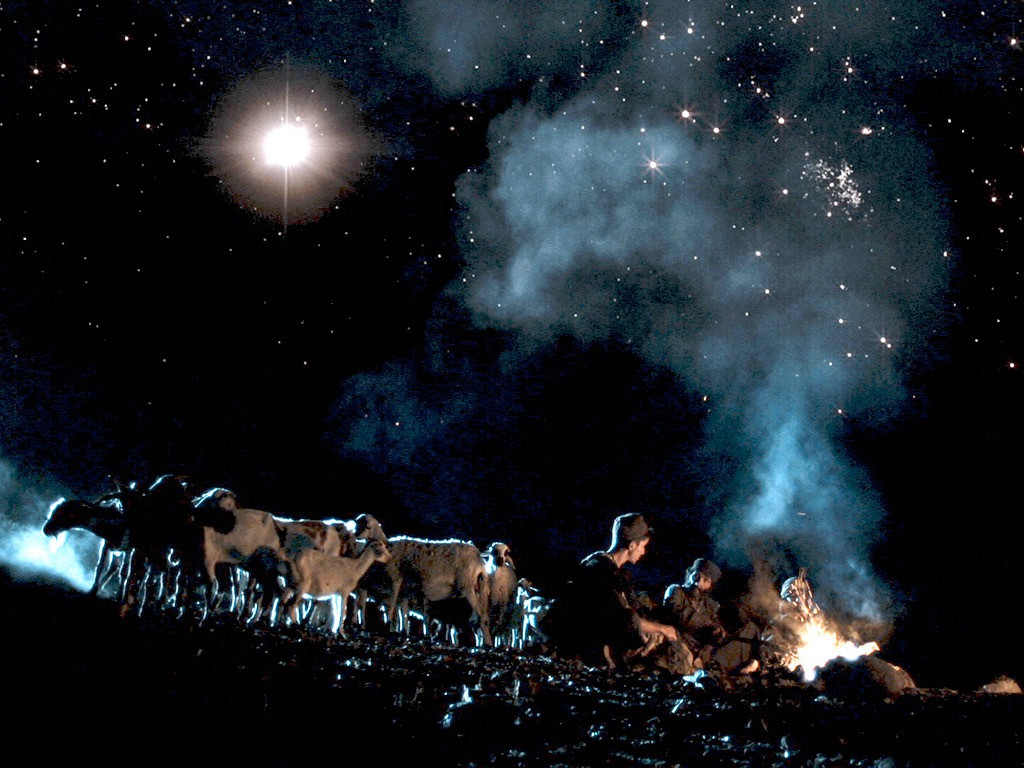
The first ones to receive the glorious news were the shepherds working the night shift out in the fields overlooking Bethlehem. Theirs’ was a busy occupation with the Temple in Jerusalem only six miles away. They provided many of the animals for sacrifice, including sheep. Shepherds worked day and night 365 days a year. They were also on the lower cast of society. The smell of the fields and animals was just as unattractive as their occupation for most people. Nevertheless, God chose them as the first ones to hear the good news. The news of Christ’s miraculous birth is for all people willing to come to Him and accept Him for salvation. The shepherds didn’t waste any time after the angels left them, “(they) said to one another, ‘Let us go over to Bethlehem and see this thing that has happened, which the Lord has made known to us.’” (Lk.2:15, esv)
The shepherds were filled with joy and hurried to see the Christ child, but when the angels first appeared, they were frighten to death. In fact, it was only one angel that got them all worked up. “And an angel of the Lord appeared to them, and the glory of the Lord shone around them, and they were filled with great fear.” (Lk.2:9 esv) Fear would have been a natural reaction when on a dark, quiet night of the same-old, same-old work an angel appears with the glory of the Lord shining all around them. But the angel quickly calms their fears with good news. “Fear not, for behold, I bring you good news of great joy that will be for all the people. For unto you is born this day in the city of David a Savior, who is Christ the Lord.” (Lk.2:10-11 esv)
This was good news for the shepherds. They would know ‘Christ’ was the Messiah that the Jews were waiting for. The angel referred to the city of David where the Messiah was prophesied to be born. This was a declaration of the birth of the one who would save the world from sin and death. Notice, the angel gives three titles to the Christ-child; Savior, Christ (Messiah, anointed one), and Lord (Yahweh, or God.) He was both God and man. The angel then gives them a sign of what to look for when they go to into Bethlehem to look for the savior, and then the song begins.
“And suddenly there was with the angel a multitude of the heavenly host praising God and saying, ‘Glory to God in the highest, and on earth peace among those with whom he is pleased!’” (Lk.2:13-14 esv) A heavenly host of angels came down and joined their colleague in singing their song ‘Gloria in Excelsis Deo.’ Here again, as in Mary’s and Zechariah’s songs, we get the name from the Latin Vulgate translation. The first words in the Latin Vulgate are ‘Gloria in Excelsis Deo’ meaning ‘Glory to God in the highest.’ The angels know of the glory and majesty of God and have just witnessed perhaps the greatest event they have seen and can’t hold back in giving praise and glory to God.
We will have the opportunity to sing along with angels this Christmas season whether singing in church, or caroling, singing at home, or in your car. This song of hope this week is giving glory to God for His plan of salvation coming to realization in the birth of Christ and the peace we can have by accepting Him as savior. What better song to sing.
The most familiar verse in all of Scripture is John 3:16. “For God so loved the world, that he gave his only begotten Son, that whosoever believeth in him should not perish, but have everlasting life.” (kjv) God’s love came down to the world when He sent His Son to be born of a virgin over 2,000 years ago. The world was and is still in need of a savior. The angels announced to the shepherds on that first Christmas Eve, “For unto you is born this day in the city of David a Saviour, which is Christ the Lord.” (Lk.2:11 kjv) Yes, God’s love came down. His plan of salvation from eternity passed, for you and me, had taken another step closer to its completion.
Jesus came into this world as the God-man to save sinners. His love for us is such that He left heaven’s glories to come here and live on this earth. Jesus lived and worked among us until His time came for the purpose of His coming. He would make the ultimate sacrifice dying on the cross of Calvary for our sins showing His love for us. Yes, Christ’s love for us came down thirty-three years earlier in the city of David, and it never wavered, even on the cross. His love that came down for us, kept Him up on the cross and this time did not come down.
We are incapable of reaching up to God for salvation. There is nothing we can ever do to save ourselves. So, love came down. ‘For God so loved the world.’ It is God’s desire that no one perishes into eternal damnation due to their sin. (2Pt.3:9) Christ’s coming to earth is proof of God’s love for us. Yes, love came down; in Jesus’ birth, in His death, in His resurrection, in sending us His Holy Spirit, and in His coming back again. Have you received God’s love that came down and accepted Christ as your savior?
“For you have been called to live in freedom, my brothers and sisters. But don’t use your freedom to satisfy your sinful nature. Instead, use your freedom to serve one another in love.” Galatians 5:13 NLT
Charles D. Meigs wrote, “The old Quaker was right: ‘I expect to pass through this life but once. If there is any kindness or any good thing I can do to my fellow beings, let me do it now. I shall pass this way but once.’” (1) Yes, the old Quaker understood there is only one life, and it is short. The Quaker’s mind was set on not passing up an opportunity to help his fellow beings while he had the chance. A humble attitude of caring for others more than ourselves is at the heart of the old Quaker’s service. “Do nothing out of selfish ambition or vain conceit. Rather, in humility value others above yourselves,” (Ph.2:3 niv)
Many of us today think the same way as the old Quaker. We know the brevity of life and there is only one, but we try to grab all we can for our own enjoyment. It is sad, but it is too often we help our fellow beings only when tragedy strikes, and we’re shamed into it. As Christians we are to show the love of God through what Christ has done for us. He has freed us from sin and eternal death. Christians are free in Christ to live in a way that draws others to Himself, and free to serve one another in love.
The apostle Paul tells the old Quaker and us, in writing to Christians in Galatia, we have the freedom to serve one another in Christ. The old Quaker took him up on the offer. What about us? This season is a good time to start. We are called to live in freedom and to serve.
(1) Cowman, Mrs. Charles E. Stream in the Desert 2. Grand Rapids: Zondervan Publishing, 1966. Pg. 342
“Since therefore the children share in flesh and blood, he himself likewise partook of the same things, that through death he might destroy the one who has the power of death, that is, the devil.” Hebrews 2:14 ESV
FreeBibleimages.org
The image of a baby boy in a manger is precious in our sight during the Christmas season. As Christmas Eve draws closer, the thought of that silent night fills our hearts and minds with great anticipation. The sounds of ‘Away in the Manger, ‘Silent Night,’ and ‘O Holy Night’ fill the air. Little thought is given to the image of the Christ child 33 years later suffering on the cross at Calvary. But that is why Christ came, and why He came as flesh and blood.
The writer of the book of Hebrews says that it was through Christ death on the cross that He destroyed Satan who has the power of death. Jesus conquered death by His resurrection three days later. He could only do that if He became like us and took on our physical nature of flesh and blood. Jesus not only conquered death, but He satisfied God’s required payment for our sins by His death. The apostle John tells us “He is the propitiation (appeasement or satisfaction) for our sins, and not for ours only but also for the sins of the whole world.” (1Jn.2:2 esv) “For without the shedding of blood, there is no forgiveness.” (Heb.9:22b nlt)
A third reason why Christ came as flesh and blood is He can help us in our time of need when tempted. “For because he himself has suffered when tempted, he is able to help those who are being tempted.” (Heb.2:18 esv) It is hard for us to imagine how Jesus was tempted in the same way we are today, but Scripture records it. We need to take it by faith. Matthew records Satan tempted Jesus with ‘the lust of the flesh, the lust of the eyes, and the pride of life.’ (Mt.4:1-11) And Jesus withstood the temptations. By coming in the flesh and taking on our physical nature Jesus can sympathize with our struggles and is there to help us through the Holy Spirit.
“For we do not have a high priest who is unable to sympathize with our weaknesses, but one who in every respect has been tempted as we are, yet without sin.” (Heb.4:15 esv)






 Word for the Soul