Starting out on a journey, whether a local excursion or an extended trip across the miles requires a knowledge of the way to get to your destination. Whether using your smart phone, a GPS system, or downloaded directions from a maps web site, all will show several ways to get there. That is fine when traveling from here to there in our world. At times more than one option is sometimes desirable and even recommended. Today’s GPS systems will even redirect you if you make a wrong turn. If you see your life here on earth as a journey, which it is, where is your destination at the end of your life and where are you getting your directions? Will your world religions and earthly maps warn you if you made a wrong turn and are going in the wrong direction?
Ultimately if your destination is heaven; there is only one road, only one way to eternal life in heaven with God the Father. In Jesus’ sixth “I am” statement in John’s gospel, Jesus said very clearly the He is the only way to the Father. Of the seven “I am” statements, this one is the most controversial in our day. Why, because Jesus declares there are no other roads or religions, no short cuts, no long way around, no alternative route to heaven except through Him.
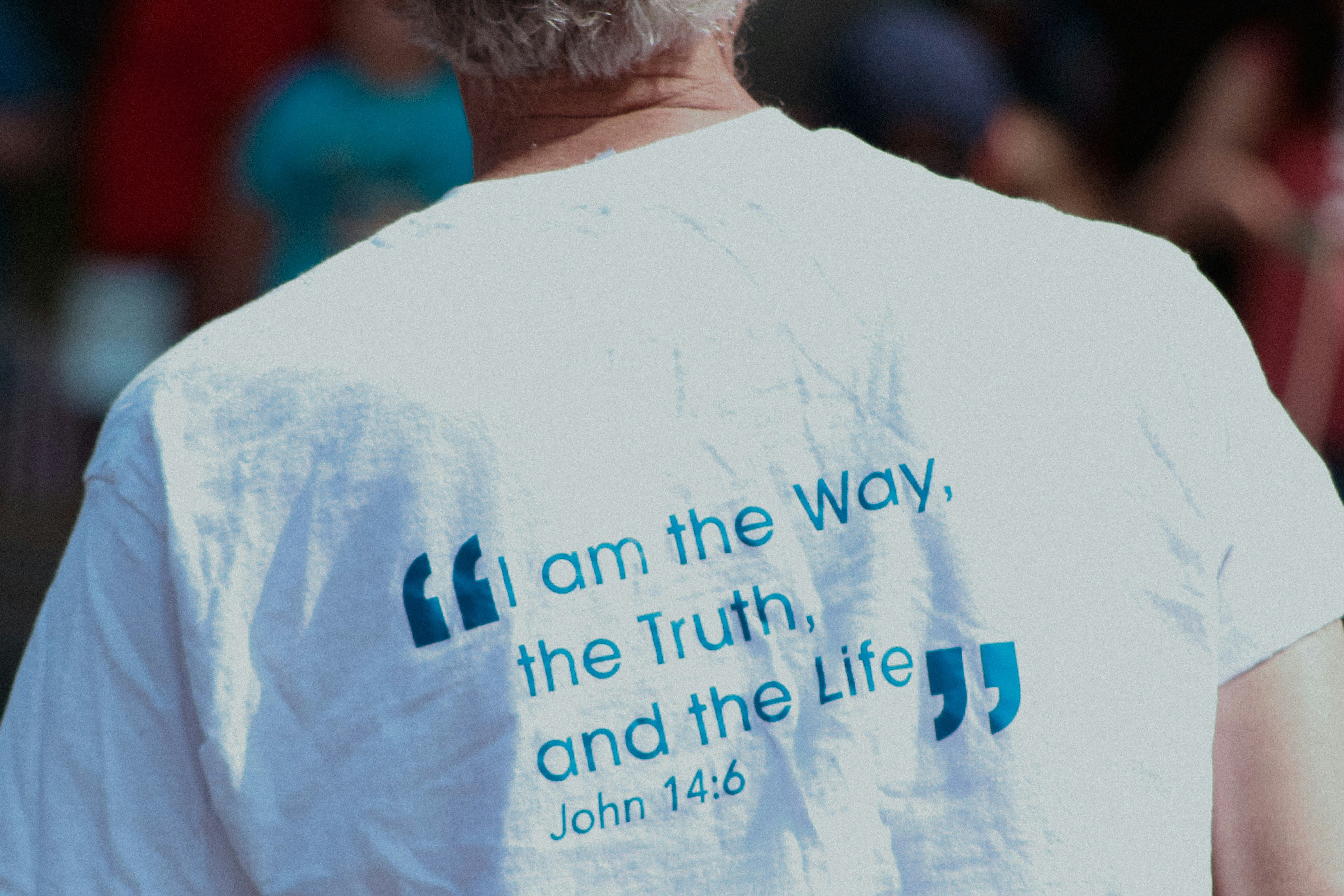
If what Jesus said is not true, then He would be a liar, and if He is a liar, He could not be God the Son, and if he is not God the Son, then He could not save us from our sins. All roads do not lead to heaven, only one does, Jesus! If there are other ways to eternal life except through Jesus, then Jesus’ death on the cross was in vain. No, “Jesus said to him, ‘I am the way, and the truth, and the life. No one comes to the Father except through me.’” (Jn.14:6 esv)
In the world today as in centuries past there is much debate as to who Jesus is. To many He is a historical figure of great significance in the likes of Plato, Socrates, Aristotle, and other Greek philosophers. Jesus is considered to be one the prophets of old, the greatest of prophets by some. He is the teacher of all teachers. Jesus is the example of how we are to treat and love each other. He is all about love and kindness. Jesus is considered to be the greatest the person who has ever lived.
During Jesus’s ministry on earth the same debate was taking place. Some said He was a political figure who had come to overthrow Rome. Mostly were those who said He was a prophet. Jesus was even named as one the prophets of old and even the recent John the Baptist. Naming Jesus as one of the prophets had Messianic significance, but they missed it equating Jesus as one of the prophets and not the true Messiah.
When Jesus asked His disciples, ‘who do you say I am,’ Peter answered, “You are the Messiah, the Son of the living God.” (Mt.16:16 nlt) Peter recognized Jesus as the Messiah by being with Him and carefully watching His every move and not getting caught up with the excitement of the crowds. The Wycliffe Bible Commentary notes, “The statement by Peter here is not the product of early enthusiasm but of studied reflection and solemn faith.” Jesus commends Peter for his faith by saying to him, “You are blessed, Simon son of John, because my Father in heaven has revealed this to you. You did not learn this from any human being.” (Mt.16:17 nlt)
So we as today Christians who have put our faith and trust in Jesus recognize Him as the Messiah, the Son of God. Be careful of those who claim Jesus as anything other than God the Son. He certainly is a great teacher, an example on how to live compassionately, and He can debate victoriously with any philosopher past and present, but Jesus is more than all that, He is God the Son. Let us be mindful that those who err on Jesus’s true identity also are mistaken in their teaching even though they may appear sincere, loving, and kind. Our salvation is not according to the good deeds we have done, but by our faith in Jesus Christ, God the Son, who says to the repenting sinner, ‘who do you say I am?’
Our church is currently in the middle of a summer series on ‘AI-artificial intelligence.’ As AI seems to be advancing faster than the speed of sound we will never catch up or understand it completely. That is why we have been focusing first on what it means to be human. AI no matter how advanced will never replace humanity as God has designed it. Human beings have an advantage over AI. We are uniquely created in the image of God in which AI could never relate to. Our Lord and Savior Jesus Christ is fully human and He is fully God. No match for AI.
In John’s gospel we see the both the human side of Jesus and His deity. At the grave of His friend Lazarus we read the famously quoted shortest verse in the Bible, ‘Jesus wept.’ It may be the shortest verse in Scripture but it speaks volumes. Jesus in His humanity expressed sorrow over the lost of His friend. Jesus also wept over Mary and Martha, Lazarus’ sisters, as they grieved the passing of their brother. And Jesus wept over the sin of the world that causes death among us all. Jesus is indeed fully human.
But, the good news is, Jesus is fully God. As we know the story, Lazarus did not remain in the grave, Jesus raised him up from the dead. Only Jesus God the Son could do that! Jesus knows of all our sorrows in life for He is ‘a man of sorrows.’ Jesus experience temptation as we do being tempted by Satan in the wilderness. Jesus knows what it is like to be cold, hungry, and not having a place to lay His head. He knows what it is like to be fully human and Jesus knows what it is like to be fully God, because He is. As AI advances we have a model to follow on what it means to be human. Let us follow Him for He is fully human and fully God.
This week’s daily devotions on ‘Word for the Soul’ will feature the 23rd Psalm. This is the most recognized Psalm of all 150 psalms in the psalter. Most people can recite it in its entirety, or least some portions of it. So, an assignment for this week, if you have not memorized it yet, now is your chance. (There are only six verses)
David, the author, begins with these famous words, “The LORD is my Shepherd; I shall not want.” (Ps.23:1 esv) David being a shepherd as a boy and young man knew the job of shepherding and the responsibilities it entailed. Number 1 on the list was the protection of the sheep under his care. David spent many long hot days and cold nights watching over the sheep. We do not know how David got paid or if he ever received compensation for his work, but he did his work flawlessly and at the risk of his own life.
The Lord Jesus not only risked His life for His sheep but gave up it up on the cross at Calvary. “I am the good shepherd. The good shepherd lays down his life for the sheep.” (Jn.10:11 esv) David was able to see the relationship between his protecting and providing for his sheep and God doing the same for him, but in a much larger capacity. The Lord God providing for David all his life prompted him to write, ‘I shall not want.’ He was never lacking anything he needed. David’s shepherd provided for him.
David could call the Lord God his shepherd because he knew Him, followed Him, and obeyed Him. As you read the 23rd Psalm and attempt to memorize it this week can you say, ‘the Lord (Jesus) is my shepherd’? Do you know Him? Have you accepted Him as your savoir? Is the Lord your shepherd?
Summer has officially arrived in the northern hemisphere as the summer solstice arrived early Sunday morning here in the northeastern United States. We had our longest day of sunlight on Sunday as the days will slowly become shorter as summer wears on. With the extended sunlight there are many pleasurable summer activities taking place. Emergency management crews, fire departments, and rescue teams are warning of the dangers in accessing the local rivers this time of year as many people take advantage of the warm days for recreational activity. The day before summer arrived local rescue teams issued warnings as they conducted water rescue drills on the rivers. Sadly, on the very first day of summer a person was pulled from the river and died. It was the second fatality in four days.
Every accident has its own circumstances and all the facts are not always clear, but what is clear are the warnings and caution needed when entering moving waters. Precautions must be taken by heeding the warnings. Each one of us has been given a spiritual warning concerning our eternal existence after this life is over. That warning is given to us by the Lord Jesus Himself when He says, “I tell you the truth, unless you are born again, you cannot see the Kingdom of God.” (Jn.3:3 nlt) You may have heard that many times from preachers, family members, and friends choosing to ignore it as religious babbling, but they got it from Jesus’ own words recorded in the Bible.
Jesus does not issue false warnings. He is preparing us for what is ahead and warning us of the dangers of not being born again by accepting Him as savior. The warning continues to be given today as to where you will spend your eternal life. Rescue teams are out spreading the good news of Jesus Christ and eternal life. Don’t get caught by not heeding the warning!
‘“God will provide a sheep for the burnt offering, my son,’ Abraham answered. And they both walked on together.” Genesis 22:8 NLT
FreeBibleimages.org
We do not know how much time had lapsed from last weeks story of Abraham’s and King Abimelech’s agreement with each other. Notably it is at least a few years. Chapter 22 begins with the words, ‘Some time later.’ Abraham is well over one-hundred years old and his son Issac could now be in his late teens or early twenties. Abraham had been faithful in believing God’s promise to him concerning the Promised Land and the many descendants he will have that will begin with his son Issac. That is why the events in this chapter can only be considered as an ultimate test of faith for Abraham. Let’s begin.
“Some time later, God tested Abraham’s faith. ‘Abraham!’ God called. ‘Yes,’ he replied. ‘Here I am.’” (Gen.22:1 nlt) Here again we see Abraham’s willingness to hear and respond to whatever God asks of him. What Abraham heard was the last thing he thought he would ever hear. “Take your son, your only son—yes, Isaac, whom you love so much—and go to the land of Moriah. Go and sacrifice him as a burnt offering on one of the mountains, which I will show you.” (Gen.22:2 nlt) The Lord is testing Abraham’s love for Him over Issac. Notice the progression for effect when God says, ‘your son, your only son—yes, Isaac, whom you love so much.’ This is not going to be easy. A father’s love for his son is emphasized as is only natural. This is also the first time the word ‘love’ is used in Scripture and it is used here in this text. This portion of Scripture is a foreshadowing in several ways of Jesus’ sacrifice for us on the cross at Calvary. First we note God’s love for His Son as noted at Jesus’ transfiguration, “But even as he spoke, a bright cloud overshadowed them, and a voice from the cloud said, ‘This is my dearly loved Son, who brings me great joy. Listen to him.’” (Mt.17:5) God the Father loved Jesus as much as Abraham loved Issac.
Abraham wasn’t hesitant, as was his mode of operation, but prepared to set out the next day. He chopped the wood and saddled his horse which he could have had his servants do, but Abraham chose to do it himself. Abraham took two of his servants with him on this three-day journey to Moriah. The land of Moriah is the Jerusalem area. Mount Moriah is where Solomon’s Temple was built and the present-day Temple Mount is occupied by the Muslim Dome of the Rock. Abraham had plenty of time to digest and reflect on God’s instructions for him. I am sure he did not understand it but he knew God was faithful and always kept His promises. The Lord often tests us through adversity and hardships, although not in the same sense as Abraham, but He knows what is best and is looking for us to trust Him when those days come upon us.
As they arrived near the place Abraham said to his servants, “Stay here with the donkey…..The boy and I will travel a little farther. We will worship there, and then we will come right back.” (Gen.22:5 nlt) Abraham did not know what was ahead of him, but what he did know was that both he and Issac would be coming back after worshiping the Lord. Another first is found here as it is the first mention of the word worship in the Bible. Abraham must have had it in his mind and had the faith that God was able to raise Issac from the dead or that God would provide a substitute for Issac. With that, Abraham placed the wood on Issac’s shoulders, he took the fire and knife and the two walked together the rest of the way.
Along the walk as they came closer to the site something occurred to Issac. “Isaac turned to Abraham and said, ‘Father?’ ‘Yes, my son?’ Abraham replied. ‘We have the fire and the wood,’ the boy said, ‘but where is the sheep for the burnt offering?’” (Gen.22:7 nlt) Again, Abraham does not hesitant even though he is not sure how God will act says, “God will provide a sheep for the burnt offering, my son,” (Gen.22:8 nlt) Upon arrival the Bible says Abraham built an altar, he arranged the wood, tied his son and laid him on top of the wood.
FreeBibleimages.org
Abraham’s faith is on full display but let us not overlook Issac’s faith. Seeing Abraham’s faith led Issac to have great faith in his father and in the Lord God. Issac did not seemed to resist. He certainly could have overpowered the aging Abraham. But he did not, and willing submitted to his father Abraham. Here is another foreshadowing of Christ’s sacrifice in this passage. Jesus willing laid down His life for us. Issac is seen as a prefiguration of Christ. “And Abraham picked up the knife to kill his son as a sacrifice. At that moment, the angel of the LORD called to him from heaven, ‘Abraham! Abraham!’ ‘Yes,’ Abraham replied. ‘Here I am!’ (Gen.22:10-11 nlt) The Lord was about to provide a substitute.
Abraham passed the test. He proved his faith through obedience and trusting in God to keep His promises. “Then Abraham looked up and saw a ram caught by its horns in a thicket. So he took the ram and sacrificed it as a burnt offering in place of his son.” (Gen.22:13 nlt) Another first here is the first mention of a sacrifice substitution of one life for another. God still required the sacrifice, but a substitute was needed. He supplied a ram for Issac. A sacrifice was needed for our sin and God provided a substitute for all who believe in His name, Jesus, God the Son. Abraham then called the place ‘Yahweh-Yireh’ (which means “the LORD will provide”) Yes, the Lord will provide.
tim ildsmith on unsplash
“For this is how God loved the world: He gave his one and only Son, so that everyone who believes in him will not perish but have eternal life.” (Jn.3:16 nlt)
Lately there has been a coordinated effort to discredit Jesus’ words in John 14:6. I am sure it is not by chance. Video clips are hitting social media on this same subject form various churches, pastors, and denominations. All interpretating their view of what Jesus said. They claim that verse has been misused as a ‘my way or the highway’ theology that excludes people not ‘in the club.’ Some are in and some are out! One pastor explained the meaning as ‘Jesus is the embodiment of God revealing particular expression of the divine that is fully present and dwelling with us.’ These are words of promise according to this pastor that do not drive people out but invites everyone in. The pastor goes on and says these are not words of exclusion but of promise in love and relationship. What this pastor is saying is that all religions are accepted because Jesus’ revealing that God is with us no manner what we believe. That is not what Jesus, God the Son, is saying.
Another Pastor condemns churches throughout history that used this verse as ‘a doctrinal statement requiring a belief in Jesus as a prerequisite into heaven.’ This pastor said it is not that but it is the life Jesus lived and the life we live of joy and sorrow. It is saying if you live a good life like Jesus of joy and sorrow you will get in. We all know none of us are able to live our lives like Jesus. So, that can’t be true. And as another pastor noted Jesus is not ‘a gate-keeper at the Celestial gates verifying your ID in order to get in.’ But I am sorry, yes He is, because He Himself said, “I am the way, the truth, and the life. No one can come to the Father except through me.” (Jn.14:6 nlt)
Christians who hold to Jesus’ words of truth in John 14:6 without wavering and believing them as He spoke them are criticized as being intolerant. That’s OK. We should expect that from a world under the influence of Satan, who is a master coordinator of influencing people away from God and adapting to a worldview of Holy Scripture. Well-known author C. S. Lewis commented on this verse by saying, if this isn’t true there are only three choices that can be made. They are either ‘Jesus was lying, or not in His right mind, or Jesus was telling the truth.’ The choice is yours to make. No deep philosophical reasoning is needed with fancy words to convey the truth. It’s simple. Just believe it. If you are called out for ‘religious intolerance’ in believing Jesus’ words as He spoke them do not fret, you are in good company. C. S. Lewis and Jesus said the same thing.
“Simon Peter replied, ‘Lord, to whom would we go? You have the words that give eternal life. We believe, and we know you are the Holy One of God.’” John 6:68-69 NLT
The New Testament book of John chapter 6 records the story of Jesus feeding the 5,000. Most of those people followed Him back to Capernaum for what Jesus said of them, “I tell you the truth, you want to be with me because I fed you, not because you understood the miraculous signs.” (Jn.6:26 nlt) The people were content to have their stomachs full. They could not look past their concern for their physical needs. Jesus told them not to be concerned about the food that perishes but for the food that leads to eternal life. (Jn.6:27)
Jesus then explained that He was the bread of life coming down from heaven giving life to the world. Salvation is granted to all who eat His flesh and drink His blood. (Jesus is using a spiritual analogy here-Jn.6:53-59) It represents Christ’s physical death on the cross and His shed blood as necessary for eternal life. Those who accept Christ as savior receive (His flesh and blood) as payment for their sins and have everlasting life. This is hard for people today to grab hold of and understand and even more so in Jesus’ day as he spoke these words. And the Scriptures say many left Him after these words.
The story above is not the only one used in our day to refute Christianity. There are many which orators take out of context to explain away the truth of the gospel that Jesus is the only way to the Father. Sadly, many people are taken in and led amiss by these teachers, and yes pastors, with their false words. The disciples were asked by Jesus if they were going to follow the crowd away from Jesus and Peter spoke up and said, “Lord, to whom would we go? You have the words that give eternal life.” (Jn.6:68 nlt) Peter’s words are still true today, ‘to whom will you go?’
“No one has ever seen God, but the one and only Son, who is himself God and is in closest relationship with the Father, has made him known.” John 1:18 NIV
Do you know God? Not about God, but do you know Him? Do you know Jesus, again not about Jesus, but do you know Him? The apostle John begins his gospel by explaining that the ‘Word’ in verse one always existed. ‘In the beginning was the Word.’ The ‘Word’ was with God in the beginning and the ‘Word’ was God. So, what does that tell us? The ‘Word’ is God.
John goes on to explain the ‘Word’s’ incarnation in verse fourteen. “The Word became flesh and made his dwelling among us. We have seen his glory, the glory of the one and only Son, who came from the Father, full of grace and truth.” (Jn.1:14 niv) The ‘Word’ (Jesus) lived among us. We saw the glory of the Son (Jesus) who came from the Father. John later writes, “No one has ever seen God, but the one and only Son, who is himself God and is in closest relationship with the Father, has made him known.” (Jn.1:18 niv) The truth is, if you know Jesus, you know God. He has made Him known. Jesus is God the Son.
This is vital for Christians to understand. Our salvation depends on a perfect sacrifice being made to pay for our sins and reconcile us back to God. Jesus was not a prophet, a teacher, or an angel sent from God to show us the way; He is the way. He is God the Son. Early Christians in the New Testament were known as people of ‘The Way.’ There are several religious in the world who claim to know Jesus and follow His ways and teachings, even calling themselves Christians, but do not believe Jesus is God the Son. They are sincerely wrong! If Jesus were not God the Son, His death would be meaningless and we would still be in our sins. Know for certain who Jesus is. Your salvation depends on it!
What is your greatest need? Have you ever thought about it? This question is often asked in light of the current moment in time. We do live in the present. Have you ever considered there is one need that is supersedes all other needs in our lives? This need, when met, will assist us with dealing with all other needs because it is our greatest need, our need of a savior. Our greatest need in this life is to make sure our greatest after this life is met. Along with the fulfillment of that need comes help from above in our everyday walk in this life.
The Puritan writer in the ‘Valley of Vision’ collection of Puritan devotions writes, “O let me never lose sight of my need of a saviour, or forget that apart from him I am nothing, and can do nothing.” (1) We can get so tangled in our present needs we lose sight of the bigger picture. What is important and what should be our primary priorities are overshadowed by current troubles. Yes, our pressing needs are a concern and need to be dealt with and the provider of our greatest need is there to help us through them.
Our greatest need must be met first. All of us are alienated from God due to our sinful nature and must be reconciled to Him. That reconciliation was made possible by Jesus’ sacrifice on the cross for our sins. “For if, while we were God’s enemies, we were reconciled to him through the death of his Son, how much more, having been reconciled, shall we be saved through his life!” (Ro.5:10 niv) When we accept Christ as savior our greatest need in this life and more importantly in eternity has been met. So, have you taken care of your greatest need? Once you are assured of that, the rest of this life with all its needs will be met by the one who solved your greatest need, your need of a savior.
(1) Arthur Bennett Ed. The Valley of Vision. East Peoria: Versa Press, 2023. Pg. 32