The seasons have changed once again; this time the warm days of summer have given way to the cooler temperatures of autumn. Along with the change in temperature comes the changing of the leaves depending on which part of the country you live. It is also harvest time for the professional farmers, home garden enthusiasts, and the novice like me. A sure thing even a novice knows is the law of sowing and reaping, what you plant in the spring is what you get in the fall. If you plant peppers, you will get peppers, if you plant tomatoes, you will get tomatoes. Guaranteed, what goes into the ground will come up at harvest time.
Our lives are much like the seasons of the year that are consistently changing. You have heard of such expressions as, ‘this is but for a season’ and ‘seasons of change.’ We have all experienced the dark, cold days of winter only to have it birth anew into the warmth of spring. The heat of the summer sun brings joy, and the fall seasons reveal God’s rich blessings upon us. In each season of our lives, if we look closely, we will see God’s faithfulness in bringing us through each one. As He is faithful in the changing of the earth’s seasons, He is faithful and with us as we go through seasons of change.
Referring back to the law of sowing and reaping, sometimes our lives reach a dark and unpleasant season due to what we planted a season ago. What is being harvested today is bitterness, hatred, jealousy, selfishness, financial difficulties, broken relationships, addictions, and all the consequences of planting ill fruit. The apostle Paul writes in Galatians 6:7, “Don’t be misled—you cannot mock the justice of God. You will always harvest what you plant.” (nlt)
An advantage to the seasons changing is they always come around again. If you did not have a bumper crop this year or you miss-planted a section of your garden, there is always next year. And whatever season you are in spiritually it is not too late to start planting good seeds of love, joy, peace, patience, kindness, goodness, faithfulness, gentleness, self-control, and all those that will yield a spiritual bounty. It’s harvest time.
Have you ever felt tested by the Lord? Have you experienced something that is going on in your life driven by a divine nature? Is this a test you ask yourself, more precisely is this a test from God Himself? There are times in our lives where the Lord will test us, never tempt us, but He will surely test us. The results of our testing is either a pass or fail grade. God does not grade on a curve or allow for extra credit for going over and above what He requires of us, our faithfulness. So how are you doing when tested? Do you pass each test with excellence, or do you fail miserably or even miss it by the skin of your teeth? How can you live in faithfulness to God throughout all your trials and testing in your life, even those of a divine nature by the Holy One.
In Matthew chapter 4, we read the account of the temptation of Jesus by the devil. As previously mentioned, God will never tempt us, but the devil certainly will. What is noticeable is the fact that “Jesus was led up by the Spirit into the wilderness to be tempted by the devil.” (Mt.4:1 nkjv) Jesus was indeed tempted by the devil, but it was through the leading of the Spirit that Jesus submitted to a forty day and forty night’s stay in the wilderness. Jesus being tempted by the devil for forty days without food or drink is presented with three more challenging temptations. It is through these last three temptations, the lust of the flesh, the lust of the eyes, and the pride of life that Jesus “was in all points tempted as we are, yet without sin.” (Heb.4:15 nkjv)
We may find it hard to understand how Jesus was tempted in every way we are today. How could He be tempted in the same way? We find the answer in He is fully God and also fully man. The temptations were real. He withstood every one of them by relying on the Word of God.
We are never beyond being tempted in our world. The devil and his cohorts are active and pursuing. In all our temptations we are to look to the Word of God. Let us not confuse the testing of God with the temptation of the evil one, but to understanding the Lord’s desire to lead us to faithfulness and all righteousness. May we look to our example Jesus Christ who being led by the Spirit into the wilderness to be tempted by the devil, overcame ‘in all points tempted.’ .
“This is the genealogical record of their ancestor Perez: Perez was the father of Hezron. Hezron was the father of Ram. Ram was the father of Amminadab. Amminadab was the father of Nahshon. Nahshon was the father of Salmon. Salmon was the father of Boaz. Boaz was the father of Obed. Obed was the father of Jesse. Jesse was the father of David.” Ruth 4:18-22 NLT
When we began our look at the book of Ruth six weeks ago it was noted that the story of Ruth is much more than her story. Ruth is an Old Testament book having three major theological themes. God’s redemption plan is for both Jews and Gentiles. God’s sovereignty and providential care, and Boaz, Ruth’s kinsman redeemer, as a type of Christ. Redemption being the key word is found over twenty times in various forms throughout the book. Boaz was Ruth’s kinsman redeemer who married her and restored the land of her late husband and preserved the family line in her husband’s name. God not only provided for Ruth but also for her mother-in-law, Naomi, through Boaz. But the most important underlying theme of the book is God’s redemption plan of salvation that came through His Son Jesus, a descendant of Ruth and Boaz.
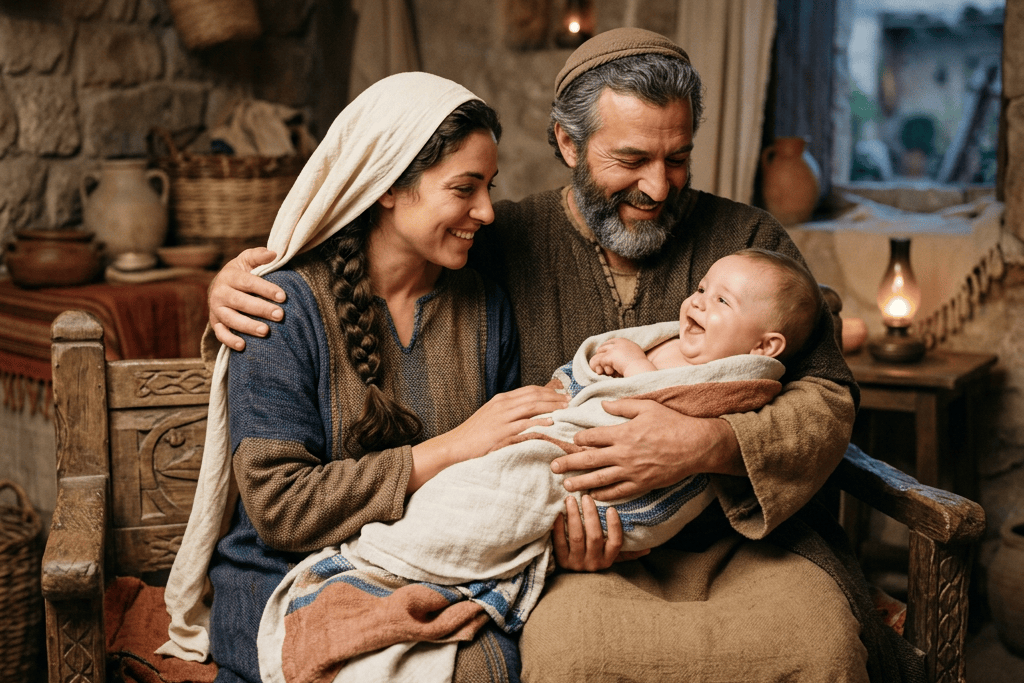
“So Boaz took Ruth into his home, and she became his wife. When he slept with her, the LORD enabled her to become pregnant, and she gave birth to a son.” (Ruth 4:13 nlt) The Lord bless Ruth and Boaz for their faithfulness to Him. Ruth became a convert and trusted in the true God of Israel and Boaz fulfilled his obligation of Ruth’s kinsman redeemer. A son was born to them. It was a happy beginning for them both and a happy ending for Naomi. It was also noted in the beginning of our study that Naomi could be considered the main character. She is just as important in this story as Ruth and Boaz. The theological theme of God’s sovereignty and providential care is seen in Naomi’s well-being. The family name will go on, the land was restored, and there will be grandchildren to help support Naomi in her old age. In returning to Bethlehem after her stay in Moab Naomi said to her friends, “I went away full, but the LORD has brought me home empty.” (Ruth 1:21 nlt) The Lord God watched over her and now she is full once again. The Lord brought her from emptiness to fullness.
Concerning the child born the women said, “May he restore your youth and care for you in your old age. For he is the son of your daughter-in-law who loves you and has been better to you than seven sons!” (Ruth 4:15 nlt) The women named him Obed which means ‘a servant who worships.’ This is the only time in Scripture where someone other than the parents or family have ever named a child. Obed became the father of Jesse, and Jesse became the father of King David. Scripture is clear that the Messiah would be a descendant of King David and would be called the Son of David.
God had this all planned in His sovereignty. God uses those who He chooses for His own purposes. There are both Jews and Gentiles listed in the genealogy of the Messiah. This shows salvation is open to all people who accept Christ as savior. Jesus came to redeem all people, both Jew and Gentile. (Gentile meaning anyone not Jewish) Jesus came for all people. In God’s kingdom there will be representatives from every nation, of every language, and every ethnicity and race. This is part of the story of Ruth the Moabitess, born as a gentile woman in a heathen nation, Ruth went on to trust God having faith in Him proving salvation is open to all people.
Finally, Boaz is seen as a type of Christ in our story. Boaz redeemed Ruth. She became his bride and married her. Jesus redeems those who accept Him as savior and Christians become the bride of Christ. And there will be a day when the wedding will take place. “Let us be glad and rejoice and let us give honor to him. For the time has come for the wedding feast of the Lamb, and his bride has prepared herself. She has been given the finest of pure white linen to wear. For the fine linen represents the good deeds of God’s holy people.” (Rev.19:7-8 nlt)
There are many things to glean from the book of Ruth, the story of Ruth the Moabitess. Just as Ruth gleaned the grain that had fallen there is plenty for us to feast on when we read the Bible but let us pay attention to what is intentionally pulled out as Boaz’s men pulled out extra grain for Ruth. The entire Bible is about Jesus Christ and God’s plan of redemption. Every book has additional grain to be pulled out and noticed about Christ. May the book of Ruth be good training ground for us to see Christ as we read all of Scripture.
Solomon wrote, ‘a wise person is hungry for knowledge.’ A desire to learn all you can is wise and beneficial in life. Educational institutions from pre-school through college must continually provide opportunities for those with an inquiring mind to advance and grab as much knowledge as possible. But they do not always succeed, and we have been seeing the results of their failure throughout society. When hunger for knowledge is not met or redirected by school administrators a failed education system is guaranteed. Soloman also wrote, the opposite of the wise person who is hungry for knowledge is the fool who feeds on trash. Unfortunately, there is a lot of trash being passed off as education through schools and so-called educating the public venues through biased journalism and news broadcasts, and the ever-expanding social media.
If anyone should be interested in increasing knowledge and having a complete understanding of the world it is every Christian. Christians should have the desire to increase learning and keep up with current events. The problem is where do we go to get current, trustworthy news and information. Which institutes of higher learning would provide the best non-biased education. These decisions will not come easily, but the place to start is with the Bible, the Word of God.
Our hunger for knowledge begins with our hunger for God. Psalm 42:1-2 says, “As the deer longs for streams of water, so I long for you, O God. I thirst for God, the living God. When can I go and stand before him?” (nlt) We can be sure what we learn from God is true knowledge and it is His holy agenda. The Bible is trustworthy, the very words of God Himself. Immersing ourselves in scripture daily will give us insight as we seek sources for our continued education. Looking for a reliable platform to research and learn more about the current events in our world will come through observing through God’s eyes. You will start to analyze and know the difference between true and false information. Satisfy your hunger for knowledge with the Lord through His Word. He will teach you through His Word and will guide you to make the right decisions in increasing your knowledge.
“At that moment their eyes were opened, and they suddenly felt shame at their nakedness. So they sewed fig leaves together to cover themselves.” Genesis 3:7 NLT
Having eyes wide open is usually a good thing. Operating a motor vehicle requires having both eyes on the road. Keeping your eye on the ball in any sport is crucial if you want to have success. A surgeon must have keen vision while performing a delicate operation. There are countless other examples of needing both eyes open in our daily lives, but sometimes what is not seen is just as beneficial.
Adam and Eve were living in a perfect environment. Last Friday we referred to it as ‘paradise.’ They were also perfect in every way. Adam and Eve had perfect 20/20 vision and had their eyes wide open. They saw the beauty of God’s creation, the garden He had placed them in, and the attractiveness of each other. Everything was perfect and holy. The Lord was their constant companion in the world He had just created. All was good.
The story of Adam and Eve eating the forbidden fruit is well-known to most people either through sermons, Bible stories, or references made to it in a jest manner. The truth is when they ate the fruit something changed forever. Their eyes were opened, wide opened. Their perception of things had changed. They saw the same things, but something was wrong, it did not feel right. They saw sin for the first time in the way they felt, naked and ashamed in front of holy God. When we sin that feeling comes over us, or at least it should. Our eyes are wide open to whom we are in front of, a holy God. May we make it a habit to keep our eyes pure and wide open on the road of life in God’s blessings and not have them wide open in revealing our sin before God.
“For God is not unjust. He will not forget how hard you have worked for him and how you have shown your love to him by caring for other believers, as you still do.” Hebrews 6:10 NLT
Sometimes the work we do for the Lord goes unnoticed and that is a good thing. We are not to be doing work for God that draws attention to ourselves, that glory goes to God and Him alone. There are times when people we are caring for react indifferent to the help they receive. This may make us feel indifferent by not being appreciated for the work we do. Again it is important to remember we are not doing it to receive recognition but to help others in the name of the Lord.
The Lord is faithful so as to not forget any work done in His name. There is a tendency to rank work done for God in the size and accomplishments of each, but Jesus said that even giving a cold cup of water will result in a reward. “And if you give even a cup of cold water to one of the least of my followers, you will surely be rewarded.” (Mt.10:42 nlt) Those of you who tirelessly work in food kitchens, clothing drives, food banks, and volunteering to assist the elderly and disabled in Jesus’ name, take heart, the Lord will not forget your work.
The writer of Hebrews encourages us to continue our work for the Lord and loving others all through our lives. (Heb.6:11) In this God’s promises will be presented on those who are faithful and endure. So continue your work, it will not be forgotten.
Jesus tells us in Scripture that His return is certain, He is coming back. He is coming back for His bride, the church. The only drawback is, He does not tell us when that will occur. So, Jesus gives us a warning to “take heed, watch and pray; lest, coming suddenly, he find (us) sleeping.” (Mk.13:33a, 36 nkjv)
Whenever there is an upcoming event in our lives, we get excited, counting the months, weeks, and days. We have a date we can focus on for any preparation needed to be done beforehand. The excitement builds with anticipation of that coming day. The event usually occurs, but there is always a chance that it does not come off or something goes wrong. Anticipation that had been building suddenly falls flat with our disappointment.
The greatest future event you and I will ever have will be the return of Jesus Christ. It will be an event that will not fall flat. We should be anxiously anticipating His return as we follow Jesus’ words to watch and pray. Jesus gives us an illustration of this in the gospel of Mark, “It is like a man going to a far country, who left his house and gave authority to his servants, and to each his work, and commanded the doorkeeper to watch.” (13:34 nkjv) The Lord has given us work to do in His absence which we are to be engaged in. He also commands us to keep watch for His return for we do not know when it will be.
Keeping watch for Jesus’ return is a challenging thing to do with our busy lives. Even in our quiet moments we could lose sight of this glorious upcoming event. That is why Jesus tells us to ‘watch and pray.’ Temptations and the activities of the world will dull our senses in the things of God. Jesus had to reprimand His disciples in the garden, “Watch and pray, lest you enter into temptation. The spirit indeed is willing, but the flesh is weak.” (Mk.14:38 nkjv)
We must keep our hearts and minds on Christ and His return. Distractions and temptations are part of this world we live in, that is why we must watch and pray with anticipation for Jesus’ return.
The world’s most expensive perfume is ‘Passant Guardant’ by Clive Christian at $7,600 per ml or $228,000 a bottle (30ml). To be a recipient of such a gift would be an honor of the highest regard. To be the giver of such an expensive gift would be symbolic of the love towards the one receiving it. The sacrifice made in presenting the gift is on display whether intended or not. The giver cares not about the exposure, but only about presenting a gift of love in the most exquisite means possible.
Jesus received such a gift just a few days before His crucifixion. Mary, the sister of Martha and Lazurus, presented this fragrance of loving service by pouring it over His head. The pouring of oil over the head in the Old Testament is referred to as anointing oil. It was poured over the head of the high priest and his descendants to mark them as holy and set apart unto the Lord. Mary, in this case, anointed Jesus as an act of worship. She was aware who Jesus was, the Messiah. It is also possible she believed in Jesus’ words when He spoke of His impending death, even more than His disciples who seemed to struggle with it. Jesus speaks to Mary’s actions, “She has poured this perfume on me to prepare my body for burial.” (Mt.26:12 nlt)
The perfume or oil Mary poured on Jesus came from Northen India and was made of pure nard. The cost is noted as 300 denarii or about a year’s wages. (Mk.14:5) Today’s value would be about $40,000-$50,000. It was not only a fragrance of loving service, but a loving sacrifice. But Jesus’ disciples complained this act was wasteful and could have been used more wisely. “But Jesus, aware of this, replied, ‘Why criticize this woman for doing such a good thing to me?’” (Mt.26:10 nlt) Charles R. Erdman writes, “No gift to him can be too great if made in grateful love, an act may be morally beautiful even though not practically useful.” (1)
Jesus is pleased with our gifts of service to Him whatever the cost. We can never give too little or too much according to our ability to give. Our motives will determine the value of the gift and our Lord will recognize its true value; may it always be a fragrance of loving service.
(1) Erdman, Charles R. The Gospel of Matthew. Grand Rapids: Baker Book House, 1983.
“He said to them, The Scriptures declare, ‘My Temple will be called a house of prayer,’ but you have turned it into a den of thieves!” Matthew 21:13 NLT
For centuries theologians have debated the authenticity of Jesus Christ. Is he truly God in the flesh, the God-man, or is he just a good-man? Whichever side one is on all would agree that he was a good man. More would go on to say he was a mighty prophet, a great teacher, and one who could do great things. We still have the debate going on today in the 21st century. I find it amazing for those who say they believe the Bible is the word of God, yet doubt many portions of it such as Jesus’s own words in John 8:58, “…….I tell you the truth, before Abraham was even born, I AM!” (NLT) Jesus declared Himself to those who doubted Him to be Yahweh, the Lord of the Old Testament who eternally self-existed.
During Jesus’ three years of ministry before He went to the cross He made several references to God being His Father and being equal to Him. When questioned by the rulers of the Jews in order to accuse and attack Him, Jesus told them, “The Father and I are one” (Jn.10:30 nlt) They knew what He meant proclaiming to be equal with God picking up stones in order to stone Him for blasphemy. Another occasion occurred the day after Jesus’ triumphal entry into Jerusalem when He went into the temple. Jesus had witnessed the buying, selling and exchanging of money permitted outside the temple area for travelers but it had made its way inside the temple sacred courts. Not only was business being conducted, but deceptive means were being used to cheat the pilgrim travelers.
Scripture tells us Jesus drove out those desecrating the temple with authority. “He said to them, The Scriptures declare, ‘My Temple will be called a house of prayer, but you have turned it into a den of thieves!’” (Mt.21:13 nlt) Jesus had the authority to do so because He is the Lord of the temple. In the same respect scripture also tells us, “Don’t you realize that your body is the temple of the Holy Spirit, who lives in you and was given to you by God? You do not belong to yourself, for God bought you with a high price. So you must honor God with your body.” (1 Cor. 6:19-20 nlt) May we be careful not to desecrate our bodies, the temple of the Holy Spirit, and remember who is the Lord of the temple.
“Then Naomi said to her, ‘Just be patient, my daughter, until we hear what happens. The man won’t rest until he has settled things today.’” Ruth 3:18 NLT
Last week in Biblical Insights Ruth followed her mother-in-law’s instruction to approach Boaz and request he marry her and be her kinsman-redeemer through the Levirate law. Ruth had gone to where Boaz had laid down for the night after the celebration of the completion of the barley harvest. Ruth laid herself down at his feet and removed the cover from his feet. “After Boaz had finished eating and drinking and was in good spirits, he lay down at the far end of the pile of grain and went to sleep. Then Ruth came quietly, uncovered his feet, and lay down.” (Ruth 3:7 nlt) As Boaz woke up around midnight he noticed a woman at his feet and asks who it was. ‘“I am your servant Ruth,’ she replied. ‘Spread the corner of your covering over me, for you are my family redeemer.’” (Ruth 3:9 nlt) (see last week’s Biblical Insights ‘The Story of Ruth….part 4’ for further explanation and the exchange between Ruth and Boaz)
Boaz is willing to do this as he is aware of the situation and has noticed Ruth’s loyalty to Naomi along with the respect she has earned from all who have watched her. He told her he would take of it first thing in the morning. “So Ruth lay at Boaz’s feet until the morning, but she got up before it was light enough for people to recognize each other. For Boaz had said, ‘No one must know that a woman was here at the threshing floor.’” (Ruth 3:14 nlt) Rising early in the morning was wise so she could leave before the morning light and anyone finding out that she was there. Now again, nothing immoral happen, but Boaz did not want any misunderstanding or gossip going around about her as this was an innocent visit. Boaz then went the extra mile and scooped out six portions of barley for her to take back to her mother-in-law. Arriving back home Naomi asked her what had happened and Ruth told her everything. Naomi knowing what kind of man Boaz was knew the matter would be settled quickly. Boaz would not procrastinate and let it drag on. It happens so often in our day when important matters are left undone because we do not see the urgency of getting them done. Boaz knew this was important and he had an obligation to see to it quickly. He did not wait.
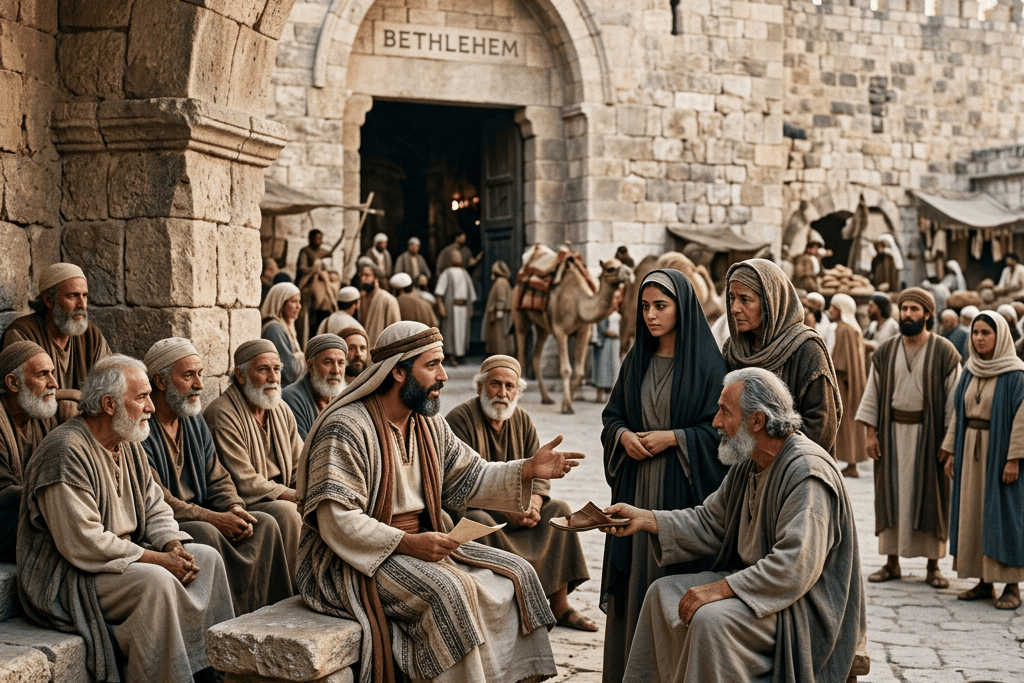
Boaz went right into town and sat at the city gate. The gate was not only the main entrance way into the city but it functioned as the place where legal transactions and commercial business took place. Soon Boaz noticed the closer family redeemer approaching and he called him over. “Then Boaz called ten leaders from the town and asked them to sit as witnesses.” (Ruth 4:2 nlt) Boaz explained the situation to him concerning Naomi needing to sell the land that was in her late husband’s name for financial reasons. The man had the first right as he was closest kin. Boaz explained that if he (the closer relative) did not purchase it that he would. The man said he would redeem it, but there was more to the purchase.
“Then Boaz told him, ‘Of course, your purchase of the land from Naomi also requires that you marry Ruth, the Moabite widow. That way she can have children who will carry on her husband’s name and keep the land in the family.’” (Ruth 4:5 nlt) This was something the man would not or could not do. He may have already been married, which would have caused a problem, and furthermore it made cause complications in his own inheritance passed down to his children, The man declined saying, “Then I can’t redeem it, because this might endanger my own estate. You redeem the land; I cannot do it.” (Ruth 4:6 nlt)
The transaction is about to be made official. We have come a long way in binding legal transactions through paper trails and endorsing signatures, we even have electronic signing in our day, but not back then. “Now in those days it was the custom in Israel for anyone transferring a right of purchase to remove his sandal and hand it to the other party. This publicly validated the transaction.” (Ruth 4:7 nlt) So, the man took of his sandal and handed to Boaz. The transaction was completed and was now official.
Boaz then said to the ten official witnesses and those standing around that he purchased all the property belonging to Elimelech and his sons Kilion, and Mahlon. “And with the land I have acquired Ruth, the Moabite widow of Mahlon, to be my wife. This way she can have a son to carry on the family name of her dead husband and to inherit the family property here in his hometown. You are all witnesses today.” (Ruth 4:10 nlt) The Levirate law of marriage was enacted. Ruth would have a husband. The family name and inheritance of her late husband, Mahlon, would continue in the birth of her first son. And all the people around rejoiced asked for blessings on their home and for Ruth to be as fruitful as Rachel and Leah. There is much more in this story for us to glean from. It is not just a happy ending of a family name restored, a widow married and Naomi being full again as we will see next week as we conclude with the Story of Ruth the Moabites.