Finding comfort through mourning sounds like an oxymoron. They fit perfectly together as Jesus spoke in the second beatitude, “Blessed are they that mourn: for they shall be comforted.” How can mourning bring me comfort, you ask? It all depends on your relationship with Jesus Christ.
The late John R. W. Stott, theologian and evangelical Anglican preacher had written; “The truth is that there are such things as Christian tears, and too few of us ever weep them.” Weeping tears over the sins and conditions of the world, including our own before a Holy God brings about true mourning. It also brings about the reality of who God is and who we are before Him. It brings about true repentance as we see ourselves before God. Confessing our sins, turning away from them, and living a life pleasing to Him result in immense joy and comfort.
The question becomes how often have you been comforted by our Lord through mourning? I need to ask myself the same the question. Do we truly mourn and weep as the Old Testament prophets, the apostle Paul and even Jesus did over the sins of people? Do we shed tears over our own sins? Do we come clean before God, admitting our sin before Him through mourning? Confessing our sins by shedding tears will open the door to true comfort of forgiveness, grace, and mercy. Jesus said, “Blessed are they that mourn (those who shed Christian Tears) for they shall be comforted.”
“For Herod had arrested and imprisoned John as a favor to his wife Herodias (the former wife of Herod’s brother Philip). John had been telling Herod, ‘It is against God’s law for you to marry her.’” Matthew 14:3-4 NLT
“I mind my own business and I do not judge others, after all who am I to judge? Didn’t even Jesus say, ‘Judge not, that you be not judged?’ I am a sinner just as the rest of the world; therefore I am in no position to point out the sins of others. Also there’s an old saying that goes something like this, ‘Be careful when you point your finger at someone for you have three fingers pointed back at you.’”
Do the above quotes sound familiar to you? Have you used them yourself, living your life in line with them? Is your attitude towards others ‘live and let live’ not concerning yourself with what is right or wrong in God’s eyes? Do you accept the sinful things of the world due to the fact that you do not have the courage to call sin what it is? After all you do not want to hear, ‘who are you to tell me how I should live!” You are not alone in this, I am in this with you, but we have an example of one who was not afraid to call sin a sin and to call it out in high places, John the Baptist.
We should not be surprised that a man who lived in the wilderness clothed in camels hair and whose diet consisted of locusts and wild honey would have the nerve to call out the king for his sin. But John the Baptist was much more than what his image portrayed. He was Jesus’s forerunner preparing his Jewish brethren for the coming Messiah. John the Baptist was called of God for this ministry before his birth and carried it out flawlessly which included calling out the Pharisees and Sadducees naming them ‘brood of vipers!’ The Baptizer was one called of God to conduct God’s plan for his life, a forerunner who baptized and called out sin.
Every Christian is also called of God to conduct His plan for us. Part of that plan is to call sin what it is. We may not be baptizers, pastors, teachers, or elders, but every Christian is responsible to recognize sin wherever it is and call it out. The first place to start is with our own lives. We need to deal with our sin before the Lord confessing and repenting. There is no joy in standing before a holy God and confessing what He already sees in us, but may we see that sin for what it is. May we thank the Lord for those who call out our sin to us, and may we be able to call sin what it is in the lives of others, even ‘rebuking sin in high places.’
“Even though I walk through the valley of the shadow of death, I will fear no evil, for you are with me; your rod and your staff, they comfort me.” Psalm 23:4 ESV
Life is not easy. Sometimes it is downright hard and difficult to manage. Have you ever thought why it is this way? So many of us cannot except the fact that bad things happen to good people, and it is true that bad things do happen to ‘good’ people. But how do we define ‘good’? Let’s see how God defines good. It says in Psalm 14, “The LORD looks down from heaven on the children of man, to see if there are any who understand, who seek after God. They have all turned aside; together they have become corrupt; there is none who does good, not even one.” (Ps.14:2-3 esv) It looks like the word ‘good’ does not define any of us.
The reason ‘good’ does not define us is that we all have a sin nature. Like it or not we have inherited this nature from our first parents, Adam and Eve. There is no changing it. The punishment for our sin is death, physical death separation from the body and spiritual death separation from God for all eternity. There is no comfort that can be found in the punishment for our sin.
When David the shepherd, later a warrior, and then king wrote the 23rd Psalm he wrote of the Lord’s (David’s shepherd) comfort all through life. David knew life was hard. He was aware of his sin many times as several of his psalms reflect. When David wrote, ‘even thought I walk through the valley of the shadow of death,’ it was not only his death he was referring to, but of the trials and tribulations that come upon all of us in this life. The rod and staff of his shepherd provided him with protection and safety.
David knew that physical death was the result of his sin as we should also realize. But more importantly is to know the results of our sin concerning the second death if not dealt with in this life. Jesus came to protect us from that second death and bring us to safety in eternal life Him and God the Father. It is not just physical death, or the struggles of this life in which we need a comforter, it is to save us from eternal separation from God and Jesus Christ in eternity. That is why we need a comforter.
“You have heard that our ancestors were told, ‘You must not murder. If you commit murder, you are subject to judgment. But I say, if you are even angry with someone, you are subject to judgment! If you call someone an idiot, you are in danger of being brought before the court. And if you curse someone, you are in danger of the fires of hell.’” Matthew 5:21-22 NLT
Our judicial system in the United States measures the punishment for a crime by determining what is appropriate according to the severity and circumstances of the crime. Obviously, a murder conviction would bring on a much stiffer penalty than an assault charge or shoplifting. More recently in the 21st century the law now includes “hate crimes.” According to the United States Department of Justice a “hate crime” is “a crime plus the motivation for committing the crime based on bias equals a hate crime. In the simplest terms, a hate crime must include both “hate” and a “crime.” (1) The FBI’s definition is “A hate crime is a traditional offense like murder, arson, or vandalism with an added element of bias………Hate itself is not a crime—and the FBI is mindful of protecting freedom of speech and other civil liberties.” (2)
Our Lord Jesus also had something to say about hate crimes 2,000 years ago. The scribes and the Pharisees in Jesus’s day had an external view of the law. The outward deeds that were seen and committed such as murder would never have be done by these religious leaders. They reasoned they had never broken the sixth commandment, “You shall not murder.” Jesus corrects their misguided thinking, “But I say, if you are even angry with someone, you are subject to judgment! If you call someone an idiot, you are in danger of being brought before the court. And if you curse someone, you are in danger of the fires of hell.” The real issue is the heart.
Anger, hate, and verbal abuse are the internal seeds of destruction that lead to murder. Jesus was pointing out the guilt of murder and inward sinful seeds resulting in abusive behavior are the same. Hate crimes are not only a product of our current society, but a product of a sinful heart since the fall of man in need of a Savior.
Beginning next week the world will celebrate another ‘Pride Month,’ the recognition of the LGBTQIA+ community. While ‘pride flags’ and colors of this revolution will be hard to miss in public venues as sporting events, concerts, playground activities, retail establishments, restaurants, libraries, and sadly many churches, a much larger community must witness and absorb what they consider offensive and immoral. They are not alone because God Himself is offended and He has a few things to say about pride and ‘Pride Month.’
“The fear of the LORD is to hate evil; Pride and arrogance and the evil way And the perverted mouth, I hate.” (Pr.8:13 nasb)
“There they cry out, but He does not answer Because of the pride of evil men.” (Job35:12 nasb)
“In pride the wicked hotly pursue the afflicted; Let them be caught in the plots which they have devised.” (Ps.10:2 nasb)
“On account of the sin of their mouth and the words of their lips, Let them even be caught in their pride, And on account of curses and lies which they utter.” (Ps.59:12 nasb)
“When pride comes, then comes dishonor.” (Pr.11:2 nasb)
‘“Proud,’ ‘Haughty,’ ‘Scoffer,’ are his names, Who acts with insolent pride.’” (Pr.21:24 nasb)
“ For even though they knew God, they did not honor Him as God or give thanks, but they became futile in their speculations, and their foolish heart was darkened……Therefore God gave them over in the lusts of their hearts to impurity, so that their bodies would be dishonored among them…….For this reason God gave them over to degrading passions; for their women exchanged the natural function for that which is unnatural, and in the same way also the men abandoned the natural function of the woman and burned in their desire toward one another, men with men committing indecent acts and receiving in their own persons the due penalty of their error.” (Ro.1:21, 24, 26-26 nasb)
“Abraham introduced his wife, Sarah, by saying, ‘She is my sister.’ So King Abimelech of Gerar sent for Sarah and had her brought to him at his palace.” Genesis 20:2 NLT
FreeBibleimages.org
Abraham, the man of faith, the one known as a friend of God, becomes Abraham a deceiver once again. The story of Abraham should bring us all comfort to see one of the great icons of faith in the Bible had their failures too. Abraham was human and being human had a sin nature and having a sin nature would fall into sin on occasion. Today’s story is such an occasion.
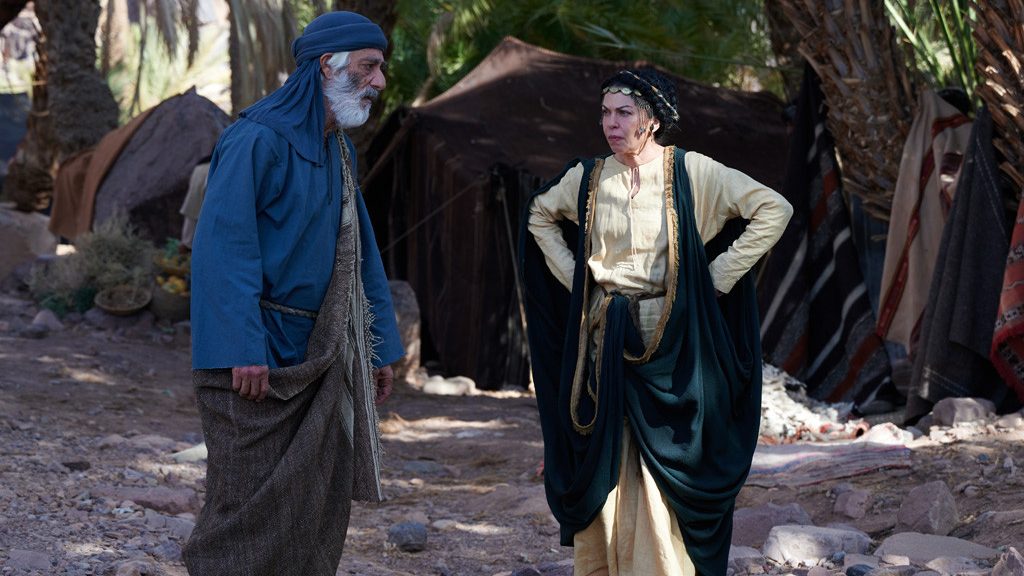
After the destruction of Sodom and Gomorrah, Abraham knew his nephew Lot was spared and he decided to move towards the south and dwell between Gaza and the Mediterranean coast settling in the town of Gerar. Abraham did not learn his lesson from twenty-five years earlier repeating his same sin of deception. “While living there as a foreigner, Abraham introduced his wife, Sarah, by saying, ‘She is my sister.’ So King Abimelech of Gerar sent for Sarah and had her brought to him at his palace (Gen.20:1-2 nlt) We sometimes today find ourselves as time passes either forgetting or disregarding our past sins that got us into trouble. Abraham’s in good company, but of course it doesn’t excuse it.
Abraham’s main problem was his moment of faithlessness in God’s protection. He had just witnessed God answering his prayer in saving Lot but failed to recognize He could do the same for him. He was afraid as he was in Egypt that he would be killed for his wife. What Abraham told King Abimelech was partly true meaning it was also partly false. As in Genesis 12 Abraham told Pharoah the same half-truth. Abraham and Sarah were siblings who had the same father, but different mothers.
The expected did happen. Abraham did not die and Sarah was taken. But God intervened and came to King Abimelech in a dream telling him that Sarah is a married woman. God said that he would die along with all his people if Sarah was not return to her husband. Abimelech earnestly pleaded his innocence which the Lord was already aware of and He said, “Yes, I know you are innocent. That’s why I kept you from sinning against me, and why I did not let you touch her.” (Gen.20:6 nlt) God was the one who kept Sarah pure by His hand of grace keeping the king at bay. The promised child of the covenant that was to come through Abraham could have been compromised, a thought that should have come to Abraham’s mind when Abimelech took her.
Abimelech didn’t waste any time. “Abimelech got up early the next morning and quickly called all his servants together. When he told them what had happened, his men were terrified.” (Gen.20:8 nlt) The people of the Near East, although heathen, considered adultery a great sin. They wanted this problem rectified as soon as possible. King Abimelech acted with integrity, more so than Abraham, in this matter. He moved quickly and called for Abraham. ‘“What have you done to us?’ he demanded. ‘What crime have I committed that deserves treatment like this, making me and my kingdom guilty of this great sin? No one should ever do what you have done! Whatever possessed you to do such a thing?’” (Gen.12:9-10 nlt) It is an embarrassing situation when a heathen king rebukes a prophet of God. Equally embarrassing are the rebukes we Christians get today from our friends and family when we are on the wrong side of honesty.
Abraham offered his three flimsy excuses; the people of Gerar did not fear God, they would kill him for his wife, and Sarah was actually his half-sister. The Bible doesn’t record a spoken response from the king, but records Abimelech’s action to make things right. “Then Abimelech took some of his sheep and goats, cattle, and male and female servants, and he presented them to Abraham. He also returned his wife, Sarah, to him. Then Abimelech said, ‘Look over my land and choose any place where you would like to live.’” (Gen.20:14-15 nlt) It seems strange that despite Abraham’s sin of deception he is lavishly given gifts. Of course this is not a license to sin, but an example of the enormous riches and blessings God bestows on His children in spite of their sin. It seems that King Abimelech gave these gifts in a way to honor God.
Abimelech topped it off by giving Abraham 1,000 pieces of silver, the price of a slave in those days, to restore any honor Sarah may have lost before others. “This is to compensate you for any wrong I may have done to you. This will settle any claim against me, and your reputation is cleared.” (Gen.20:16 nlt) Abraham, the prophet, then prayed for Abimelech and the people for their afflictions to be gone, because God had prevented the women from becoming pregnant because of Sarah.
FreeBibleimages.org
Abraham repeated his sin of twenty-five years earlier in Egypt and the Lord delivered on His promise He made to Abraham twenty-five years earlier. “The LORD kept his word and did for Sarah exactly what he had promised. She became pregnant, and she gave birth to a son for Abraham in his old age. This happened at just the time God had said it would.” (Gen.21:1-2 nlt) The wait was over. God’s promised was fulfilled. Abraham named him Issac, meaning ‘laughter’ and circumcised him on the eighth day, according to the covenant.
God’s promised blessings continue throughout our lives. They will always be there in His timing despite our failures. Praise God for that!
“Abraham got up early that morning and hurried out to the place where he had stood in the LORD’s presence. He looked out across the plain toward Sodom and Gomorrah and watched as columns of smoke rose from the cities like smoke from a furnace. But God had listened to Abraham’s request and kept Lot safe, removing him from the disaster that engulfed the cities on the plain.” Genesis 19:27-29 NLT
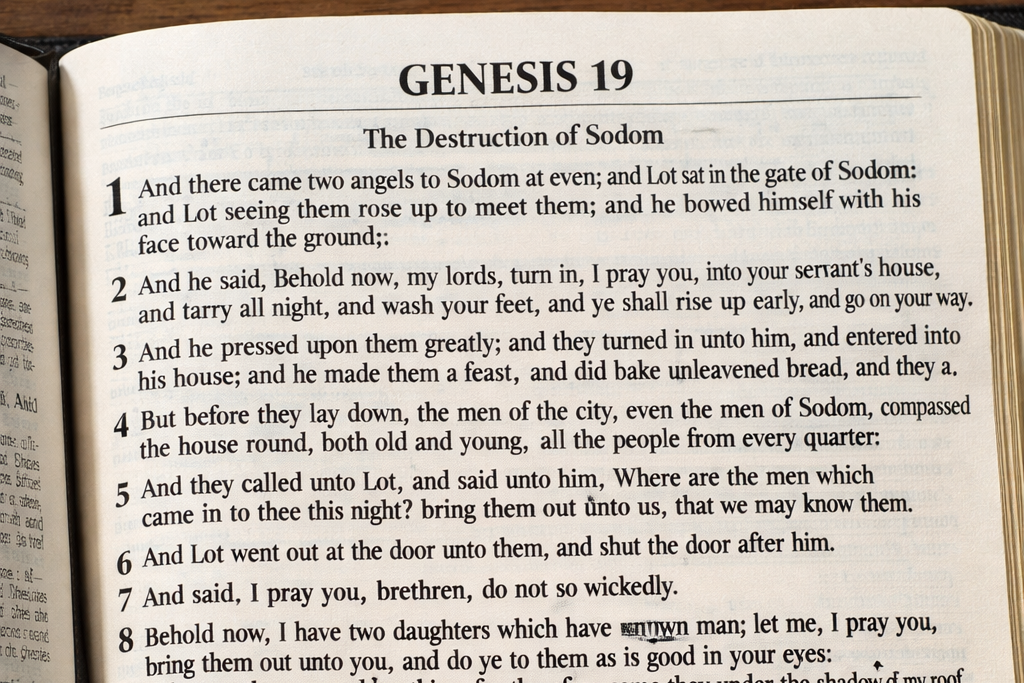
The opening verses of Genesis 19, detailing the events in Sodom
Last week in our ‘Story of Abraham,’ Abraham was told of the coming destruction of Sodom and Gomorrah. Abraham knew his nephew Lot and his family were living in Sodom and he petitioned the Lord to save the city if He found any righteous people living within its boundaries. Abraham started at fifty and stopped asking the Lord to spare the city if He found ten righteous people. The Lord said He would spare the city of Sodom if ten were found, but there were only four. Lot, his wife, and two daughters escaped the destruction of Sodom. God answered Abraham’s prayer for Lot’s safety.
Genesis chapter 19 is vivid description of mankind living under the evil influence of sin at its worst. It is an example of the consequences of those sins as a Holy and Righteous God pronounces His judgement on unrepented sinners. A sad commentary is also included in this chapter of failing to influence those around you to the righteous things of God. It serves as a warning for our day and age of the influence society has on us when we compromise our beliefs and are accepting of sin by remaining silent.
The two angels who visited Abraham with the Lord have now arrived in Sodom. Lot was sitting in the gate as an official of the city. He had moved up in the ranks of influence and now oversees in judicial matters as part of the city council. Lot stood up to welcome them and invited them as was customary into his home for the evening. ‘“My lords,’ he said, ‘come to my home to wash your feet, and be my guests for the night. You may then get up early in the morning and be on your way again.”’ (Gen.19:2 nlt) But the angels said no thank you, we will spend the night in the town square. Lot knew that would be extremely dangerous for them and insisted they spend the night under his roof.
Lot prepared a meal for them and they ate, “But before they retired for the night, all the men of Sodom, young and old, came from all over the city and surrounded the house. They shouted to Lot, ‘Where are the men who came to spend the night with you? Bring them out to us so we can have sex with them!’” (Gen.19:4-5 nlt) The total depravity of this city is seen by ‘all the men’ were there. The young and the old came from every corner of the city to fulfilled their lust. Lot tried to persuade them not to commit these horrible acts but to no avail. Here is where we see the effects of compromising and remaining silent.
Lot does a horrible thing. To save face and honor the obligation to protect those you have as a guest in your home Lot says to the men, “Look, I have two virgin daughters. Let me bring them out to you, and you can do with them as you wish. But please, leave these men alone, for they are my guests and are under my protection.” (Gen.19:8 nlt) Lot’s action is totally unjustified. An insight for us to consider today is how far compromising with the world, enjoying power, money, and influence will corrupt our minds and thinking. Lot had bought into what was accepted by the culture. The crazed men lunged at Lot but the two angels were able to pull him safely back into the house and then struck the men with blindness or mental confusion.
The angels now state their purpose for being in the city. Lot did not recognize them as angels but as travelers stopping for the night. “The angels questioned Lot. ‘Do you have any other relatives here in the city?’ they asked. ‘Get them out of this place—your sons-in-law, sons, daughters, or anyone else. For we are about to destroy this city completely.’” (Gen.19:12-13 nlt) Lot tried to convince his daughters’ fiancés but they didn’t believe him. Lot had lost his moral influence.
The following morning at dawn the angels were insisting Lot and his family hurry. But “When Lot still hesitated, the angels seized his hand and the hands of his wife and two daughters and rushed them to safety outside the city, for the LORD was merciful.” (Gen.19:16 nlt) The love of possessions (Lot was a rich man) and life in a big city with power and influence almost cost Lot and his family their lives. But God is a merciful God.
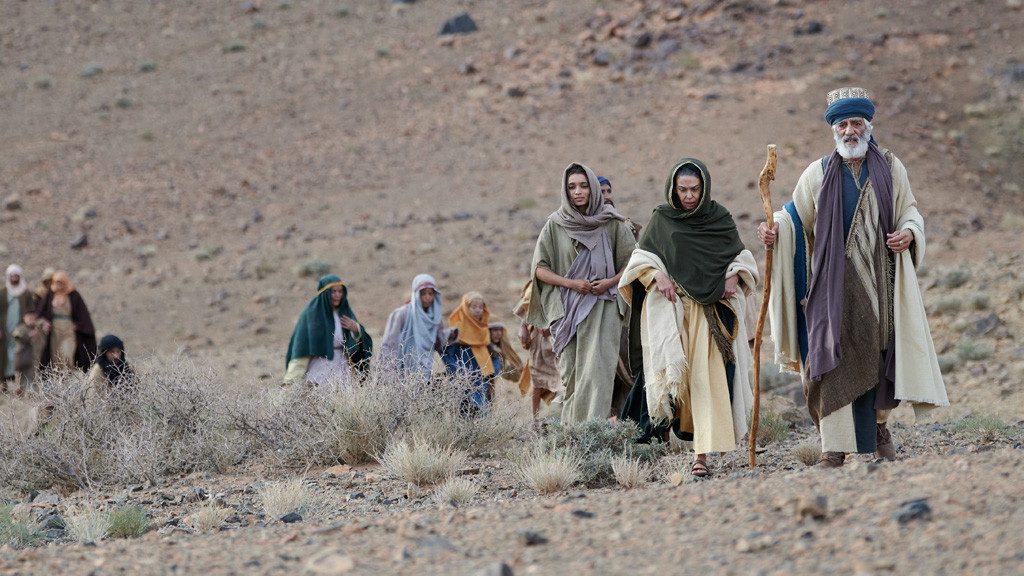
The angels told them to run up into the mountains to escape, but Lot didn’t think he could adapt to mountain living and asked if he could escape to the small town Zoar which was nearby. He was granted permission and once they got there the destruction of Sodom and Gomorrah began. “Then the LORD rained down fire and burning sulfur from the sky on Sodom and Gomorrah. He utterly destroyed them, along with the other cities and villages of the plain, wiping out all the people and every bit of vegetation.” (Gen.19:24-25 nlt) God’s judgment is swift, precise, and justified.
There is a final warning here in not looking back, especially if the Lord has rescued us from some disaster created by our own sinful desires. A desire to return to what you have just been released from will result in something far worse. “But Lot’s wife looked back as she was following behind him, and she turned into a pillar of salt.” (Gen.19:26 nlt) Looking back to what once was caused the blowing salt from the devastating destruction to surround her encasing her permanently. It was disobedience to the warning of not looking back. So, may we not look back.
God answered Abraham’s prayer and saved Lot for He is a merciful God. How tragic it is only three people may it to safety. It could have been four. If God today were to judge your city how many righteous would He find there due to your influence. Something for all of us to think about.
Early on that first Easter morning the Bible says the women appeared at the tomb of Jesus with spices to anoint His body. But Jesus wasn’t there. Two angels who stood by asked them, “Why do you seek the living among the dead?” (Lk.24:5 nkjv) The message was clear; Jesus was not there. Why would He be in a place reserved for dead people? It was a dead place. Jesus was alive and not with the dead.
As I read this passage of Scripture this morning those words jumped out at me. ‘Why do you seek the living among the dead?’ I thought of it in a spiritual sense. Some things we may participate in, calling them vices or not so bad, is Jesus there? Those sins that easily entangle us (Heb.12:1), is Jesus there? I would think not. It is a dark place among the dead. Jesus is not there. But those of us who know the Lord as Savior have His Spirit living in us, so, when we engage in that vice or activity we bring Jesus along with us.
The world today has many dead places of sin in which our Lord would never go. It is true He is the creator of the world and ever-present. The world has also been corrupted by sin and is dead, but Jesus is alive. When a person turns to Christ in repentance for their sin they become alive in Him. Once dead, now alive! We cannot get away from the temptations of our sinful dead world, but we have the Christ’s Spirit in us to help us through it. Remember Jesus is not there, don’t bring Him along with you.
“That is why the Israelites are running from their enemies in defeat. For now Israel itself has been set apart for destruction. I will not remain with you any longer unless you destroy the things among you that were set apart for destruction.” Joshua 7:12 NLT
The Lord God has led Israel out of slavery in Egypt and into the Promised Land. Israel was assured of victory in every conquest. All they needed to do was to obey God. Christians today can also be certain of victory for it is the Lord who fights our battles. All we need to do is obey. When we fail to obey God, we will suffer defeat when we were assured of victory because sin became a hindrance as in story presented to us Joshua chapter 7.
After the successful battle of Jericho, Joshua sends men to spy out the city of Ai. The report is highly favorable concluding that a smaller number of warriors were needed to conquer it and not the entire fighting force. Ai was a town small in number and would easily be defeated. Without hesitation Joshua sent about 3,000 men on the mission only to be defeated being driven back and losing thirty-six men in the process. Distraught over the results, Joshua and the elders of Israel tore their clothes bowing down before the Ark of the Lord until evening. “Then Joshua cried out, ‘Oh, Sovereign LORD, why did you bring us across the Jordan River if you are going to let the Amorites kill us? If only we had been content to stay on the other side! Lord, what can I say now that Israel has fled from its enemies?’” (Jos.7:7-8 nlt) It sounds like Joshua is having buyer’s remorse for having bought in to the Lord’s plan for them to enter the Promised Land. The Lord would reveal to Joshua what he did not know on why Israel was defeated. Israel had sinned against the Lord.
The first insight for us to learn is the consequences of our sin does not affect us alone. The Lord tells Joshua, “Israel has sinned and broken my covenant!” (Jos.7:11 nlt) One man, Achan, had disobeyed God’s command in the previous battle of Jericho by coveting, stealing, hiding, and lying about the things that were to be set apart for the Lord. The sin led to his family to being complicit in helping cover up the disobedience to the Lord and breaking His covenant. Achan and his family were part of God’s chosen people Israel. Sin had been committed by having disregard for God’s commands and directly disobeying them. God is a holy God having instructed Joshua and the nation of Israel to have faith, courage, and to be obedient. Israel as a nation did not do so completely in the battle of Jericho. God had said, “Israel has sinned and broken my covenant!”
Our second insight; as God is holy, He cannot deal with sin in His presence. God will not deal with us as we go our own way but will put the brakes on us as He did with Israel’s defeat at Ai. The Lord told Joshua, “I will not remain with you any longer unless you destroy the things among you that were set apart for destruction.” (Jos.7:12 nlt) We must do the same. If we expect to see the Lord’s continued blessings we need to be obedient to Him and destroy (get rid of) any sin that is causing a major hindrance to that end.
Finally, the Lord’s blessings were seen by Achan and his family in the victory at Jericho. They witnessed the Lord fighting their battle and achieving victory; however, they were not content and wanted more. The Lord helps overcome major battles in our lives. His blessings continue to flow through our lives as we obey Him. If suddenly a small inconvenience becomes a major battle and wipes you out perhaps there is a ‘sin of Achan’ that needs to be destroyed. Being obedient to God and getting rid of that persistent sin will lead to God’s blessings.
“So Sarai said to Abram, “The LORD has prevented me from having children. Go and sleep with my servant. Perhaps I can have children through her.” And Abram agreed with Sarai’s proposal. So Sarai, Abram’s wife, took Hagar the Egyptian servant and gave her to Abram as a wife.” Genesis 16:2-3 NLT
FreeBibleimages.org
Abram had received a promise from God sealed with a covenant that his descendants would outnumber the stars in the sky. The Lord said a son would be born to him and his wife Sarai in their old age. God also promised Abram that the land where he stood would be his descendants possession. Abram was called to leave his home country for this purpose. The Lord had watch over, protected and led Abram and Sarai since they first journeyed out from Ur and He was not about to leave them on their own now. Abram’s and Sarai’s timetable was causing them to become impatient, but God works on His schedule. Running ahead of God and taking matters into our own hands is never a good idea and Abram and Sarai will soon find that out.
Ten years after God’s call to Abram, Sarai still had not borne a child. We are not sure who was more impatient, Abram or Saria, but perhaps it was Sarai. The Bible says Sarai suggested to her husband to take her servant, Hagar, as a wife or concubine and she could have a child through her. Hagar, an Egyptian, was one of the servants Pharoah gave to Abram when he was told to leave Egypt. Hagar had become Sarai’s personal servant. Another custom in those ancient days, as we saw last week where Abram asked God if his servant Eliezer could be his heir, was a custom that a female servant in the home could a bear child for a couple. Even though this was the custom of the day, it was not God’s design and certainly not for Abram and Sarai.
Abram should have recalled that God said no to his request for his servant to be his heir. There was nothing wrong with Abram asking about Eliezer, but this action he was about to take with Sarai’s servant was definitely wrong. We do not read where Abram and Sarai asked God about this. The Lord would have said no to this request as well. Sometimes in our own lives we do not ask God because we know the answer is no. So, we just move ahead and Abram did just that. Scripture says, “So Sarai, Abram’s wife, took Hagar the Egyptian servant and gave her to Abram as a wife. So Abram had sexual relations with Hagar, and she became pregnant. But when Hagar knew she was pregnant, she began to treat her mistress, Sarai, with contempt.” (Gen.16:3-4 nlt)
FreeBibleimages.org
Immediately after Hagar became pregnant things started to fall apart. No doubt Abram sinned by taking Hagar as a wife and having relations with her. He also sinned by running ahead of God and not having faith in the covenant promise God gave him. This great man of faith had failed, and it will now have mass consequences for thousands of years. The first harsh reality was the broken relationship between Sarai and Hagar. Hagar began to despise her mistress. Sentiments of contempt by looking down on Sarai for not being able to become pregnant had become visible, causing problems in the home. Sarai turns to Abram and blames him for the crisis. “Then Sarai said to Abram, ‘This is all your fault! I put my servant into your arms, but now that she is pregnant she treats me with contempt. The LORD will show who’s wrong—you or me!’” (Gen.16:5 nlt)
Although Sarai is not innocent in all this, she does have a point. Abram being the spiritual head of the family and God’s servant should have refused his wife’s solution to her barrenness. Abram knew of God’s faithfulness and His ability to do what He had promised but gave into his wife’s wishes from his own impatience. Sarai wanted her husband to fix the problem. But Abram added to the problem by granting Sarai the freedom to oversee it herself by saying, ‘“Look, she is your servant, so deal with her as you see fit.’ Then Sarai treated Hagar so harshly that she finally ran away.” (Gen.16:6 nlt)
It is thought that Hagar was reduced back to her servant status or lower. Her harsh treatment she received could have been extremely hard, heavy burdened continual tasks. The Wycliffe Bible Commentary notes, “Passionate jealousy and bitterness set the two women against each other. And Abram was not much help to either of them. Conditions grew worse by the moment.” We will see how worse they get when we continue next week…….














 Word for the Soul