“For God saved us and called us to live a holy life. He did this, not because we deserved it, but because that was his plan from before the beginning of time—to show us his grace through Christ Jesus.” 2 Timothy 1:9 NLT
Every Christian has come to faith in the same way. The Lord calls us by the nudging of His Spirit leading us to realize our sin before Him. Sin that needs to be confessed and repented of, leading us to accept Christ’s payment for our sins, for there is nothing we can do to save ourselves. When we accept Christ as our savior, our sins are forgiven. God declares us righteous through Christ’s righteousness. Paul says, God saved us and called us to a holy life, and Peter writes, “But now you must be holy in everything you do, just as God who chose you is holy. For the Scriptures say, ‘You must be holy because I am holy.’” (1Pt.1:15-16 nlt) But do we always feel holy. No! In fact, far from it most of the time.
Not feeling holy is not an indication you are not saved. Your salvation does not depend on how you feel. If we monitored our feelings every day to see where we stand on the holiness scale, we would do nothing but continually doubt if our salvation is real and try to make sure that it was. Scripture is clear, we have been saved by grace through faith in Christ. (Eph.2:8) We did nothing to earn it. We did not make ourselves holy, God made us holy in Christ.
Understanding the biblical definition of ‘holy’ or ‘holiness’ may help us to see this in a better light. In the Old Testament, ‘The Hebrew word for holy is “qodesh” which means “apartness, sacredness,” or “separateness” showing that God is altogether holy, sacred, set apart or separate from His creation.” In the New Testament, “The Greek word used for holy or holiness is “hagios” and means much the same thing that the Old Testament word “godesh” means, which is “pure, morally blameless” or “set apart” as in set apart for holy use, which is what the saints of God have been called to.” (1) Having been ‘set apart’ for God’s use, we are to be separate from the things of the world.
This helps explain why at times we don’t feel holy. We don’t always set ourselves apart from the world and unto God. But that feeling is not the status of your salvation. The Holy Spirit is working in us to become more like Christ (holy) overtime. That process is called sanctification, being set apart for holy use. It is a journey every Christian goes through and none of have arrived yet, but one day we will. So, keep striving to be holy as God is holy and enjoy the journey.
“Jesus and his companions went to the town of Capernaum. When the Sabbath day came, he went into the synagogue and began to teach. So he traveled throughout the region of Galilee, preaching in the synagogues and casting out demons.” Mark 1:21, 39 NLT
FreeBibleimages.org
The Good News of Jesus Christ is about to be told from Jesus Himself, for that is why he came. “We must go on to other towns as well, and I will preach to them, too. That is why I came. For even the Son of Man came not to be served but to serve others and to give his life as a ransom for many.” (Mk.1:38, 10:45 nlt) Jesus’ ministry is now in in full operation after His baptism, forty days in the wilderness being tempted by Satan, and choosing four fishermen to be His disciples. “Jesus and his companions went to the town of Capernaum. When the Sabbath day came, he went into the synagogue and began to teach.” (Mk.1:21 nlt)
Jesus begins His first of three tours through Galilee. The first stop Jesus made was to visit the local synagogue in Capernaum. It was where the Scriptures were read and studied, and God was worshiped. Jesus took advantage of the custom of having a visiting teacher speak and participate in teaching. As He began to speak, the people were amazed at His teaching compared to the local Rabbis. Jesus taught not as the other Rabbis who referred to and quoted previous Rabbinical teaching, but Jesus taught with authority, His own authority. It was not only His authoritative style, but the content of His teaching that impressed those in attendance. Jesus, the Son of God, certainly knew the Scriptures.
Satan and his demons also knew the Scriptures and who Jesus is as was evident by the demon-possessed man among them. “Suddenly, a man in the synagogue who was possessed by an evil spirit began shouting, ‘Why are you interfering with us, Jesus of Nazareth? Have you come to destroy us? I know who you are—the Holy One of God!’” (Mk.1:23-24 nlt) This demon-spirit knew Jesus was God the Son and was terrified at Jesus’ power. Jesus stopped the demon’s ranting immediately and ordered him to come out of the man. He didn’t want His identity known at this time. The demon left the man, and the people were yet in more amazement to what they just witnessed. They reasoned among themselves, ‘what kind of teaching is this, that even the demons obey Him?’ At this point, the news about Jesus spread quickly throughout Galilee.
Jesus’ act of confronting the evil spirit drew much attention which is now going to escalate even further as He is beginning to heal all those who are sick and diseased. Jesus begins by healing Simon’s mother-in-law after the meeting at the synagogue. Jesus and His disciples go to Simon’s and Andrew’s home. Finding Simon’s mother-in-law sick with a high fever, Jesus touched her, healing her. After sunset when the Sabbath was over many people from all over converged on Simon’s and Andrew’s home. “That evening after sunset, many sick and demon-possessed people were brought to Jesus. The whole town gathered at the door to watch.” (Mk.1:32-33 nlt) Jesus is ministering as He predicted, ‘the Son of Man came not to be served, but to serve.’
As is often the case today, we call upon Jesus to help us in our time of need. He will not deny our request but will hear us and answer in accordance with His will. How sad it is so many of us only call upon the Lord only in the case of an emergency. He is our Lord and savior when things are bad and when all is well. Jesus came to sacrifice His life to give us the ultimate healing, a soul set free, and eternal life with Him. He desires for us to have constant fellowship with Him throughout our lives here on earth and not wait until we’re with Him in glory.
Jesus valued His time in prayer with His heavenly Father. After a long day of teaching, healing, and casting out demons, Jesus rose early the next morning, probably between 3-4 am going to a secluded place to pray. It was where Jesus, the man, met His spiritual battles. Satan and his demons constantly opposed Jesus all throughout His ministry. It was also where Jesus prepared Himself with conversations with His Father for the day’s work in ministry. If Jesus needed to do this, do we have any excuse for not doing it? We need it a lot more.
While traveling through Galilee preaching in the synagogues Jesus is met by a leper who knelt before Him begging to be healed. ‘“If you are willing, you can heal me and make me clean,’ he said. Moved with compassion, Jesus reached out and touched him. ‘I am willing,’ he said. ‘Be healed!’” (Mk.1:40b-41 nlt) Leprosy was one of the most dreadful diseases during Jesus’ day. We should take note of the leper’s faith in Jesus that He could heal him. This is a testimony in Jesus’ power to heal such a terrible disease. Jesus then instructed the man to show himself to the priest to be declared clean so he could resume social contact. The priest could not deny the man was healed, and that only God had the power to cure leprosy. Afterward the man went out and told everyone about his healing. Quickly it was impossible for Jesus to continue His ministry in the towns but needed to move out into the nearby fields around the cities. Jesus’ ministry is off to a fast start and will continue at a fast pace, for His time in preaching, teaching, healing, and casting out evil spirits is relatively short, three- and one-half years. We will pick it up next week.
“So, God created human beings in his own image. In the image of God, he created them; male and female he created them. Then God blessed them and said, ‘Be fruitful and multiply. Fill the earth and govern it.’” Genesis 1:27-28a NLT
This Wednesday January 22, 2025, is the annual observance of the National Sanctity of Human Life Day in the United States. The third Sunday each January is also noted as Sanctity of Life Sunday in many churches across America. On Friday January 24, the annual March for Life Rally will be held in Washington, D.C. (1) Each year pro-Life supporters gather in the nation’s capital to celebrate life and to urge federal legislators to draft and pass laws protecting the unborn in the womb. These faithful pro-Life advocates have been organizing these rallies since the Roe v. Wade decision in 1973.
There has been lot of noise on the other side by pro-Abortion advocates since the overturning of ‘Roe’ in June of 2022. Cries about not having access to abortion when the life of the mother is at stake are most repeated. An article on the Cincinnati Right to Life website says the following, “Medical science has progressed to the point where an abortion is never necessary to preserve the life or the health of the mother. This has been true for more than half a century.” (2) And the Charlette Lozier Institute reports that 0.3% of abortions are performed due to risk of the women’s life. (3)
The overturning of ‘Roe’ bringing the issue back to the states has resulted in some states passing legislation to restrict abortion, but despite these advances abortions have not decreased overall in the United States. According to a report from CNN Health, “Despite restrictions and bans that have taken effect in the two years since the US Supreme Court’s Dobbsdecision revoked the federal right to an abortion, the average number of abortions provided each month in the United States continues to rise, a new report shows. There were an average of 98,990 abortions each month in the first three months of 2024, according to the latest data from #WeCount, a research project from the Society of Family Planning. That’s about 14% higher than the average from the same period last year, or about 12,000 more abortions each month.” (2)
There is still much work to do in limiting and bringing abortion to an end. This upcoming week is a reminder of that. The National Sanctity of Human Life Day will continue until our nation respects and protects human life from conception in the womb, and in addition recognizes “God created human beings in his own image (and) then God blessed them and said, ‘Be fruitful and multiply. Fill the earth and govern it.’” (Gen.1:27a, 28a nlt)
Peace is hard to come by. Total peace is unthinkable in our day and is reserved for Utopia. But every Christian can have their utopia in the here and now. Utopia is described as ‘any idealized place of perfection.’ The prophet Isaiah writes, “You will keep in perfect peace all who trust in you.” (Is.26:3a nlt) The word ‘perfect’ in Scripture has the meaning of ‘completeness.’ So, it is possible to have ‘total’, ‘complete’ perfect peace in this life.
Perfect peace has been evaded from many Christians by the cares of this world. Granted, there are many things we should care about, but not to the extreme. Besides, our cares and worries should be handed over to God. There is no need for us to put excess stress on ourselves for those things God is in control. He will guide us and give us wisdom in handling our daily concerns.
A more important aspect of achieving perfect peace is to keep our thoughts fixed on God. The old King James says, ‘whose mind is stayed on thee.’ ‘Stayed’ meaning, ‘to lean, lay, rest, support, uphold.’ When our minds are totally fixed of God, leaning on Him, thinking and resting in His presence we won’t have time to think about what has the potential to take away our peace. We still have many concerns that need dealing with, but when our focus is God, He will give us the peace and strength to see them through in perfect peace.
Corporate Executives in notable positions of authority are subject to an unexpected crisis happening at any time. How they deal with it unveils their character a good bit of the time. Some may panic, but most do not. Some may be quick to assign blame, rather than responding to the situation. Others respond by doing their best work while under pressure. The prophet Daniel in the Old Testament did his best work best while under pressure.
Daniel was one of the Jewish captives brought to Babylon trained to become one of king’s advisors serving in his administration. An unexpected crisis developed within the king’s entire advisory staff. Nebuchadnezzar, the king, had a terrifying dream calling his advisors to tell him the dream and then give it its meaning. The advisors who were known as his magicians, enchanters, sorcerers, and astrologers, would not attempt to answer the king’s order without knowing first what he had dreamt. The king, perhaps wise to their previous inaccuracies and deceptions, demanded they tell him his dream first, and then interpret it. He reasoned if they could reveal his dream, then they would be able to give him its interpretation. Nebuchadnezzar demanded they follow his command and failing to do so will result in their execution. They could not fulfill the king’s command, as a result they were ordered to be put to death.
Meanwhile, back in Daniel’s office, Daniel is confronted by the commander of the king’s guard. We may question why Daniel wasn’t called with the others to interpret the king’s dream. It could have been Daniel willing kept himself away from the heathen practices of his colleagues, or perhaps he wasn’t called due to being a Hebrew, he wouldn’t have knowledge of their pagan gods. People in the Near East during those days believed that gods spoke to human beings in dreams. Whatever the reason, it didn’t matter. Daniel was one of the king’s men, so he was included, guilty by association.
Daniel has a remarkable reaction signifying his ability to work well under pressure when Arioch came to kill him. The Bible says, “Daniel handled the situation with wisdom and discretion. He asked Arioch, ‘Why has the king issued such a harsh decree’?” (Dan.2:14b-15a nlt) Daniel didn’t panic, not even the slightest. If he did it didn’t show. It was just another day at the office for him. What Daniel had was faith in his God who had sent him there and was with him as he worked under the pressure of being an advisor to the king of the Babylonian Empire. Daniel knew the Lord’s hand was on him come what may. He trusted God with the outcome enabling him to concentrate on his work in a professional and godly manner. A valid lesson for us to follow.
“Those who belong to Christ Jesus have nailed the passions and desires of their sinful nature to his cross and crucified them there. Since we are living by the Spirit, let us follow the Spirit’s leading in every part of our lives.” Galatians 5:24-25 NLT
The apostle Paul was not one to mince words in his writings. He gives it to us straight and doesn’t hold back. Writing to the churches in Galatia Paul writes, “When you follow the desires of your sinful nature, the results are very clear: sexual immorality, impurity, lustful pleasures, idolatry, sorcery, hostility, quarreling, jealousy, outbursts of anger, selfish ambition, dissension, division, envy, drunkenness, wild parties, and other sins like these. Let me tell you again, as I have before, that anyone living that sort of life will not inherit the Kingdom of God.” (Gal.5:19-21 nlt) Anyone who is consistently living in one or more of these ways seriously needs to consider if they are truly a child of God. Paul gives this warning, not to lord it over anybody, but to warn them of the serious consequences of living such a lifestyle.
Christians may not be involved in living such a lifestyle, but occasionally those desires spring forth through temptations and our sinful nature. Paul instructs us if we walk by the Spirit, we will not carry out the desires of the flesh. (Gal.5:16) He then goes on to list what we should be desiring, the fruit of the Spirit, ‘love, joy, peace, patience, kindness, goodness, faithfulness.’ (Gal.5:22-23) This is the way we should be living consistently.
The cross of Christ is where all our sins were exposed and dealt with. Christ took on our sins and paid the price for them. Our passions and sinful desires have been nailed to the cross and crucified there. We should not be trying to resurrect what has been crucified. Our sins have been nailed to the cross. Let us leave them there.
“The sons of Esau were Eliphaz, Reuel, Jeush, Jalam, and Korah. The descendants of Eliphaz were Teman, Omar, Zepho, Gatam, Kenaz, and Amalek, who was born to Timna. The descendants of Reuel were Nahath, Zerah, Shammah, and Mizzah.” 1 Chronicles 1:35-37 NLT
This year in my daily Bible reading I chose to use ‘The One Year Chronological Bible.’ I recommend it for those who are adamant about having things in order. The Bible can be difficult to understand, especially when related passages of Scripture are not in sync chronologically. A chronological Bible, as its name says, puts events in order of their occurrence. Even if you’re not concerned about the order of events, it is still a worthwhile read to understand history as recorded in Holy Scripture.
One important note; there are repetitive verses that are combined from several different books of the Bible to keep it in chronological order. These passages can dig deep into our souls as we read them to get a clearer understanding of Scripture. But then there are those verses as above, names of individuals in the genealogies which we cannot pronounce, let alone have a hard time reading them. That same passage above is found in Genesis 36. But it is chronologically correct.
I share this to say that if their names weren’t important, God would not have it repeated in His Word or record it at all. There are many people whose names are listed in the Bible and never mentioned again. But their names mattered to God, and the names of all individuals made in His image matter to Him. Think of the privilege it would be if you had your name written in the Bible, God’s Word, for all time. It would matter. You may feel like you are just a name written once in the Bible and forgotten. But think of the one who knows your name. You are not forgotten. Your name matters to God. You matter to God, and if you have accepted Christ as your savior, your name is written in the most important book of all, the Lamb’s Book of Life. (Rev.21:22-27)
“Let all that I am wait quietly before God, for my hope is in him. O my people, trust in him at all times. Pour out your heart to him, for God is our refuge.” Psalm 62:5, 8 NLT
Waiting can create anxious moments. The very definition is enough to make you uneasy; (to remain until something expected happens). Some people have the ability to wait patiently, and others need it to happen instantly. Depending on what you are waiting for will, of course, determine whether you can wait patiently or have some anxiety creep in. As Christians, we have someone to put our hope and trust in while waiting, in addition He will sit with us while we wait.
King David was waiting on God when he wrote Psalm 62. David was in midst of treasonous conspirators either from the family of Saul or from his son, Absalom, during his rebellion against his father. He was waiting on God for the outcome, but David was confident his victory was sure while he waited. “I wait quietly before God, for my victory comes from him.” (Ps.62:1 nlt) David was able to wait patiently and quietly for his hope was in God. He knew God was his refuge. David encourages all God’s people to trust in the Lord, and to pour our hearts out to Him.
The Lord understands our worried waiting moments. He is there by our side while we wait. It may feel as if we are all alone, but we are not. When we earnestly seek Him during these waiting moments through prayer, reading His Word, and waiting quietly, like David, we’ll sense and feel His presence, comforting us during the wait. It may be a long wait, or it may be a short wait. Either way, the Lord is with us, and the victory will be ours as we wait, hope, and trust in Him.
‘“The time promised by God has come at last!’ he announced. ‘The Kingdom of God is near! Repent of your sins and believe the Good News!’” Mark 1:15 NLT
FreeBibleimages.org
The first week of our study in the book of Mark we were introduced to John the Baptist whose mission was to introduce us to the Messiah, Jesus, the Son of God. He encouraged those in his day to clear the road and ‘prepare the way for the LORD’s coming!’ This week we begin to follow Jesus as He began His ministry in 27 A.D. when he was 30 years old. “One day Jesus came from Nazareth in Galilee, and John baptized him in the Jordan River.” (Mk.1:9 nlt)
The question is automatically asked, ‘Why did Jesus get baptized?’ It was His deliberate act of identification with us. Jesus identified with us in all ways as human, except for sin. He was sinless. Therefore, Jesus will bear our sins on the cross at Calvary. The triune God is on displayed in Jesus’ baptism proving His deity. The Father speaks from heaven, the Son is baptized, and the Holy Spirit appears as a dove anointing Jesus for His ministry. (Mk. 1:10-11) The symbol of a dove represents gentleness and purity, which describes Jesus, our meek and mild savior.
Very often when we have a high moment, a mountaintop experience, we’re brought down to reality. The sin of this world and the luring of Satan and his demons drags us down and tempts us. After Jesus had His high moment at His baptism, the Bible says the Spirit compelled (drove) Him into the wilderness to be tempted by the devil. This was a divine action and necessary for us as Jesus suffered the same temptations we face every day. He knows what we go through and can help us in our time of temptation. “For because he himself has suffered when tempted, he is able to help those who are being tempted.” (Heb.2:18 esv)
Jesus’ ministry now begins after defeating Satan by not succumbing to any of the temptations he offered up. This was Jesus’ first step in overthrowing Satan. Jesus then went into Galilee, the northern most region in Palestine, and started preaching God’s Good News, the Good News of salvation. Jesus announced, “The time promised by God has come at last! The Kingdom of God is near! Repent of your sins and believe the Good News!” (Mk.1:15 nlt) Dr. John MacArthur notes, ‘It was time for decisive action on God’s part. An era of God dealing with men had come.’ (1) And Dr. Charles Ryrie comments, ‘The rule of Messiah on earth, promised in the OT and earnestly longed for by the Jewish people, was near, for the Messiah has now come.’ (2) John the Baptist preached a message of repentance, now Jesus adds to it by believing the Good News. The Messiah is here, and He will save you from your sins.
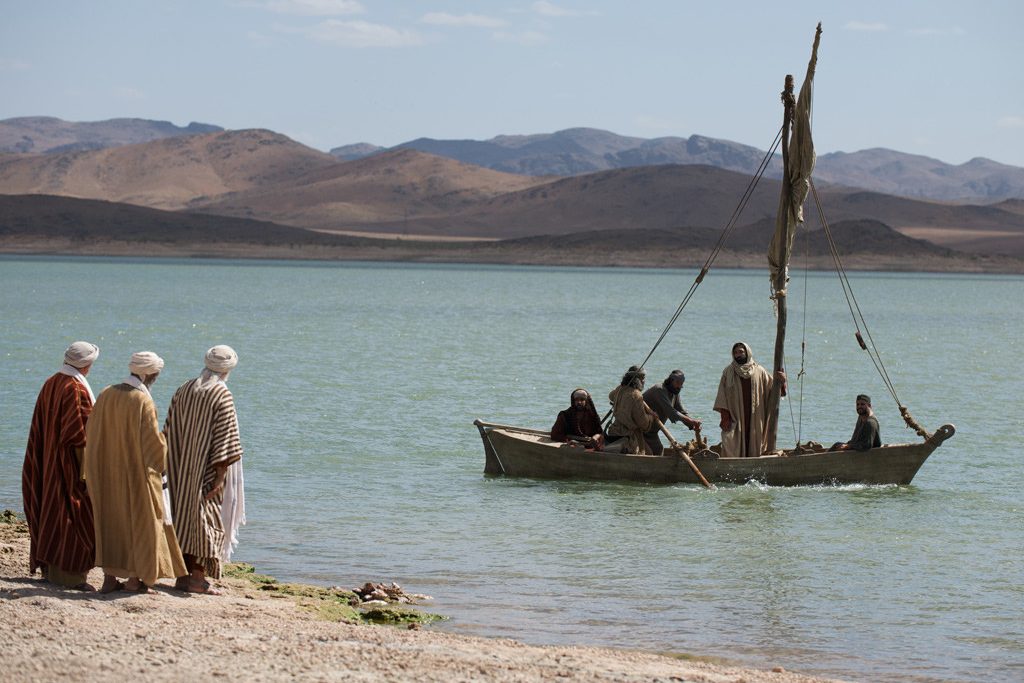
Jesus now calls His first disciples along the shore of the Sea of Galilee, a body of water 700 ft below sea level, 14 miles long and 6 miles wide. It was fed by the waters of the upper Jordan River. Jesus saw Simon and his brother Andrew working at their craft for they were fishermen. Andrew had been a follower of John the Baptist. It is possible that Simon had been also, and they both went back to work fishing after John’s arrest. Jesus calls them to follow Him and be the first Evangelists, fishers of men. They immediately drop what they were doing, making the commitment to follow Jesus.
Further up the shoreline, Jesus and His first two recruits run into fellow fishermen James and John. Fishing was a main source of income for people in the Galilean region. James and John followed suit when Jesus called them to follow Him, leaving their father and co-workers in the boat.
Take note Jesus didn’t look for those to be His disciples from the religious elites, or those with references from well-respected Rabbis, and He didn’t recruit from intellectual scholars of the first century, but He chose ordinary people who fished for a living to carry out the greatest message the world has ever known. With these four and others who will come in time, including you and me, the gospel message will go forth, right up to our current day, for the promised time has come.
MacArther, John. The MacArthur Study Bible. Nashville: Word Publishing, 1997. Pg. 1458
Ryrie, Charles. The Ryrie Study Bible. Chicago: Moody Publishers, 2012. Pg. 1226
“Do you rulers indeed speak justly? Do you judge people with equity? No, in your heart you devise injustice, and your hands mete out violence on the earth.” Psalm 58:1-2 NIV
During a fourteen-month period from January 2024 through February of this year 2025, there will be approximately 90 countries installing new leadership, including the United States on January 20, 2025. There were more national elections held worldwide in 2024 than any year in history, and with that new leadership has been installed. The Bible says in Romans, “The authorities that exist have been established by God.” (13:1b niv) We may not all be pleased with the leaders God has place for us in our country, but it is for His purposes.
Every government leader in the world has the same responsibility towards God to rule righteously. Their authority is given and ordained by God. We all can testify most world leaders are not following through with their obligation. Citizens had the same problem thousands of years ago. David wrote the 58th Psalm as a lament against tyranny, wicked leaders, and judges. He criticized the rulers for being silent in righteous matters. “Do you rulers indeed speak justly?” (1:1a niv) And he questioned their integrity in administering justice. “Do you judge people with equity?” (1:1b niv) The answer to both questions is no. In fact, they were doing just the opposite, devising evil schemes that resulted in cruel injustice. Not much has changed over time.
There have been and still are government leaders who try to do the right thing for the people. But with the current situation the world is in we need a lot more of them. This pass election year was a pivotal point for most countries in the world in how they will govern in the future. People across the globe have expressed their dissent with the violence, chaos, drug cartels, corruption, and instability of their countries. And most voted in that way. These newly elected rulers have their work cut out for them. First and foremost is the recognition that their position is authorized by the God of the universe, and they are accountable to Him. The second is to rule righteously and administer justice according to the one who gave the authorization to govern. Third, and this is for us, to pray for our leaders wherever we reside.
“I urge, then, first of all, that petitions, prayers, intercession and thanksgiving be made for all people—for kings and all those in authority, that we may live peaceful and quiet lives in all godliness and holiness.” (1Tim.2:1-2 niv)