True restoration is only realized when one is truly broken. Brokenness shows itself in various ways. The most common form of brokenness among all of us who breathe is in personal relationships. Here again, these show themselves through various means and circumstances. The longing for a relationship to be restored at times seems an impossibility, but when it occurs is a dream come true. Restorations do occur in accordance with God’s will and timing.
The nation Israel was restored to their land after seventy years of captivity in Babylon due to their gross sin against God. Although it was prophesized that they would return it all seemed like a dream to them when it happened. They almost couldn’t believe it. Psalm 126 is a song of joy for the restoration of Israel to the land. The psalmist wrote that they were filled with laughter and sang for joy. The surrounding nations joined them in acknowledging the amazing things God had done for them. They asked the Lord to restore their fortunes by planting their seeds in tears, but they will rejoice in the harvest to come once again.
God is in the restoration business. No one is more broken than a sinner separated from God because of their sin. We were born with a sin nature, making us all broken and in need of restoration to God. With God being in the restoration business, He made it possible for each of us to be restored to Him through the blood of Christ on the cross of Calvary. There is nothing we could ever do to make things right with God. It is only through our acceptance of Christ as our savior. We can rejoice with the broken people of Isarel in their restoration to their land and our salvation through Christ’s sacrifice for us as we accept Him. A dream come true.
“He never sinned, nor ever deceived anyone. He did not retaliate when he was insulted, nor threaten revenge when he suffered. He left his case in the hands of God, who always judges fairly.” 1 Peter 2:22-23 NLT
FreeBibleimages.org
The American judicial system is based on justice being administered represented on the facts of the case. The defendant is found guilty or not guilty by a judge or jury. The outcome is to ensure that justice was served by not punishing the innocent or letting the guilty go free. The courts, although not perfect, strive to uphold the law as established in the United States Constitution. There have been many cases over the years, even though brought properly through the judicial process, that have clearly not resulted in justice. The innocent is guilty and the guilty go free. It is extremely difficult for one who has been tried and convicted of a crime they did not commit to patiently endure the injustice done to them. But our Lord Jesus did just that on our behalf.
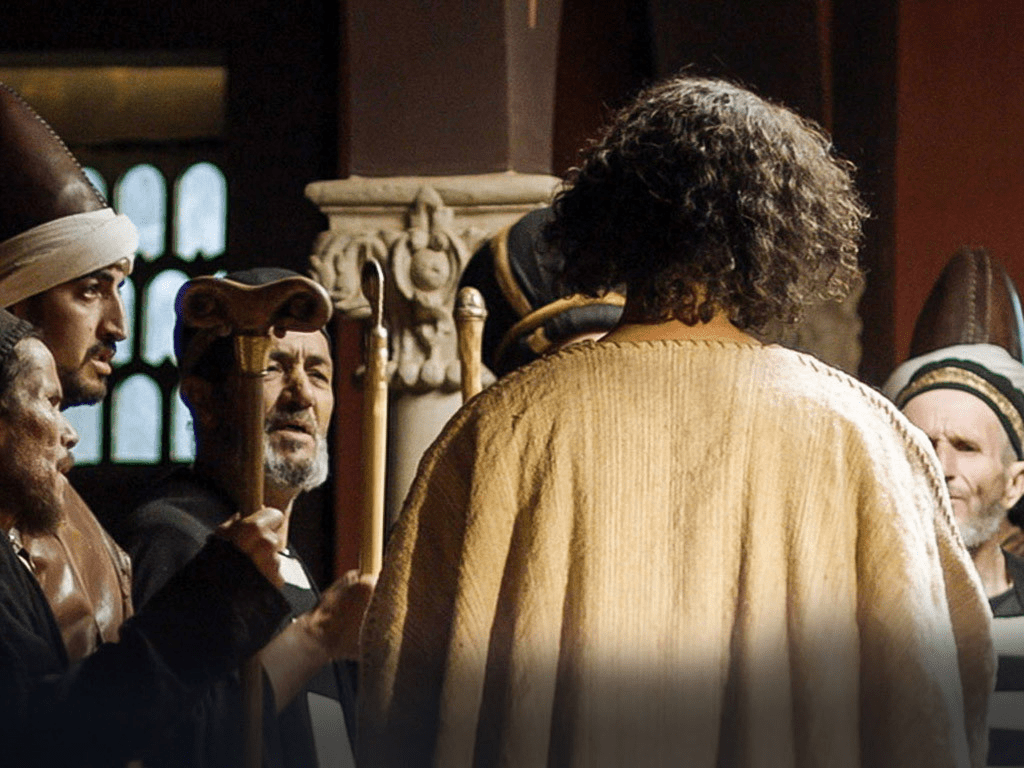
Jesus was arrested by the Jewish rulers for claiming the truth that He is the Messiah and claiming to be God in the flesh, another truth. Jesus was upending the Pharisees and the scribes’ rule over the Jewish people, so they sought to have Him arrested, put on trial, found guilty, and be put to death. Even in Jesus’ day, you need witnesses to confirm a crime was committed. Jewish law demanded at least two witnesses to agree, and after patiently waiting two came forward. “The leading priests and the entire high council were trying to find witnesses who would lie about Jesus, so they could put him to death…. Finally, two men came forward.” (Mt. 26:59-60 nlt) The false testimony they gave along with Jesus’ truthful response satisfied the rulers as to the decision they made.
Jesus went through the mockery of perceived justice in the various trials He went through enduring the injustice done to Him. Peter writes, “He never sinned, nor ever deceived anyone.” (1 Pt. 2:22 nlt) Jesus, God the Son, never sinned. How could He commit a crime? Peter goes on to say, “He did not retaliate when he was insulted, nor threaten revenge when he suffered. He left his case in the hands of God, who always judges fairly.” (1 Pt. 2:23 nlt) God always judges fairly, and in this case, Jesus endured the injustice as God’s plan of justice for the payment of sin. Jesus, the perfect Lamb of God, was sacrificed for our sin making us just and righteous in the sight of God as we accept Christ as our savior. False witnesses may have lied abut Jesus, but it was all part of God’s plan of salvation for all who believe.
“And Jesus cried out again with a loud voice and yielded up his spirit. And behold, the curtain of the temple was torn in two, from top to bottom. And the earth shook, and the rocks were split.” Matthew 27:50-51 ESV
FreeBibleimages.org
For the religious Jews of Jesus’s day, the tearing of the curtain (veil) in the temple should have been a revelation of who Jesus is and His purpose in dying on the cross. Scripture says the curtain was torn at the moment Jesus died, yielding up His spirit. It was torn from top to bottom indicating no human could have done it, it was clearly an act of God. The curtain that was torn was the inner curtain that separated the holy place from the most holy place in the Temple. It separated God who is Holy from sinful man, and it contained the Ark of the Covenant and the law of God.
Entrance into the most Holy place, the Holy of Holies, was only once a year on the Day of Atonement. This was the most solemn holy day of all the feasts and festivals on the Jewish calendar. The High Priest would enter the Holy of Holies after offering a bull sacrifice for his own sins. He would then enter and sprinkle some of the blood on the Ark of the Covenant to atone for the sins of the people. Forgiveness and covering of sin were only through a blood sacrifice and repeated every year on the Day of Atonement.
The events that took place on the first Good Friday are many. They started in the early morning hours past midnight with the unjust trials of Jesus, and after being condemned to die, mocked, beaten, he was finally nailed to a cross later in the morning. Darkness covered the earth from twelve noon until three in the afternoon, the time Jesus died. At that moment, the last event, access to God was made possible to all through Jesus’s sacrifice and shedding of His blood. The curtain was torn down, no more need for a yearly animal sacrifice to cover sin. A permanent sacrifice for sin was made. “For the death he died he died to sin, once for all.” (Ro. 6:10 esv) We have access to God the Father through the blood of our Lord and Savior, Jesus Christ.
Have you accepted the sacrifice of Jesus in not just covering your sins but in taking them away completely? Access to God, Salvation, and eternal life is only made possible through the blood of Jesus Christ as we repent, confess our sins, and accept Him as our Savoir. This Good Friday make sure you have access to God the Father.
Throughout any given day we make hundreds of choices. If our day is not already preplanned, we have the task of deciding how to fill the day. Even in those preplanned days, would our scheduled activities please the Lord? Obviously work, fulfilling family needs, spending time with the Lord, and volunteering in the community would be pleasing to God. It is those gray areas that are concerning for the Christian. Areas of personal conviction between you and God if you participate in them hinders your relationship with Him. It doesn’t need to be outright sin that would displease God, James tells us, “Remember, it is sin to know what you ought to do and then not do it.” (Ja. 4:17nlt) This is especially true in the things you hold in conviction to do or not to do.
Developing convictions between you and the Lord begins with spending time in the Bible and in prayer with Him. During times of confusion in certain areas of your life search the scriptures and ask God for guidance as to what He pleases Him, then go do it or not do it as the Lord placed the conviction on your heart. Not every Christian will have the same convictions. What is a conviction for me may not necessarily be a conviction for you and vice versa. That doesn’t mean that God is not pleased with both of us. He is pleased as we are obedient to His will for us.
There are common denominators for all Christians to agree with convictions in what pleases and displeases God. Paul writes to the church in Ephesus, “Take no part in the worthless deeds of evil and darkness; instead, expose them. It is shameful even to talk about the things that ungodly people do in secret…… Don’t act thoughtlessly, but understand what the Lord wants you to do.” (Eph. 5:11-12, 17nlt) As you plan your day, carefully determine what pleases the Lord.
The third book of the Law of Moses is the Old Testament book of Leviticus. Its theme is God’s holiness, and God’s will for Israel’s holiness. God’s teaching to Israel in Leviticus is how to approach their holy God in worship and in the sacrifices required of them, especially those concerning their sin. Much emphasis is placed on the priests in establishing this reverent and holy approach to God. All animals sacrificed on the altar had to be perfect without defect. “In this way the priest will make atonement for them for the sin they have committed, and they will be forgiven.” (Lev. 4:35niv)
The Lord gave Moses detailed instructions for all the sacrifices the priests were going to perform. The most significant command was that the fire on the altar was to be continuous. “The fire on the altar must be kept burning; it must not go out. Every morning the priest is to add firewood and arrange the burnt offering on the fire and burn the fat of the fellowship offerings on it.” (Lev. 6:12niv) The people of Israel were assured of God’s readiness to always forgive their sin at any time of the day or night.
The same assurance has been granted us today. God is always there waiting for us to come before Him with our confession. “If we confess our sins, he is faithful and just and will forgive us our sins and purify us from all unrighteousness.” (1 Jn. 1:9niv) No need to bring a perfect animal to an altar for sacrifice every time we sin. A perfect lamb was sacrificed on the cross at Calvary to take away our sin. Jesus, the lamb of God paid the penalty for our sin ‘once for all.’ But we still sin and for that there is the perpetual fire of God’s readiness to forgive.
“O my God, lean down and listen to me. Open your eyes and see our despair. See how your city—the city that bears your name—lies in ruins. We make this plea, not because we deserve help, but because of your mercy.” Daniel 9:18 NLT
FreeBibleimages.org
We have come to end of our short study of the book of Daniel covering the historical narrative of chapters 1-6. The rest of the book is apocalyptic material and eschatological in theological content. We will conclude with the main theme of our study ‘Living in Babylon’ a comparison of living in our world today with lessons we can learn from the Jewish captives living in ancient Babylon. In our final lesson we will learn from Daniel’s example of his prayer in chapter 9.
Daniel is in his 67th year of captivity with his Jewish brothers and sisters. Taken captive as a teenager, Daniel is now past eighty years old. He is keenly aware from reading the Old Testament scrolls of Jeremiah’s prophecy the captivity would last 70 years. The time was rapidly approaching for the nation to return to their homeland. Daniel offers up a powerful prayer of repentance not only for himself, but for the whole nation of Israel, fasting, covering himself with sackcloth and ashes. The nation is about to go back to the land they were driven from due to their sin towards the Lord God. Daniel’s pattern of prayer serves as a good model for us to follow in our daily prayers. It is filled with worship to God, humility, confession of sin, and making our requests known to Him.
Daniel begins his prayer by acknowledging how great and awesome God is. He always fulfilled His covenant with Israel keeping His promises as they obeyed Him. But then Daniel confesses, “But we have sinned and done wrong. We have rebelled against you and scorned your commands and regulations.” (Dan. 9:5nlt) The Jewish people refused to heed the many warnings God had given for many years through the prophets He sent them. Daniel furthers acknowledged God was in the right to punish them as He had. The guilty was not just a few or those only living in Jerusalem, but the entire nation was guilty. “All Israel has disobeyed your instruction and turned away, refusing to listen to your voice.” (Dan. 9:11nlt)
The confessions in Daniel’s prayer can easily be applied to the modern-day Babylon we are living in. Referring to ancient Israel Daniel confessed, “O LORD, we and our kings, princes, and ancestors are covered with shame because we have sinned against you.” (Dan. 9:8nlt) All one needs to do is to look around and review the news cycle over the last 50 years to wonder if Daniel wasn’t referring to many countries in our world today with the United States on top of the list. Israel had been warned many times throughout their history of the consequences of their disobedience and even suffered for it before the Babylon captivity, and still they refused to obey God. “Every curse written against us in the Law of Moses has come true. Yet we have refused to seek mercy from the LORD our God by turning from our sins and recognizing his truth.” (Dan. 9:13nlt) I’m afraid if the United States and other countries around the world continue this path of rejecting the Lord God of heaven and earth, a day of judgment is the horizon.
Daniel praises God for His blessings of bringing the nation Israel out of the bondage of slavery in Egypt. “O Lord our God, you brought lasting honor to your name by rescuing your people from Egypt in a great display of power. But we have sinned and are full of wickedness.” (Dan. 9:15nlt) Dismissing the Lord’s past blessings they continued to sin against God bringing judgment upon themselves. The United Staes of America has been richly blessed by God from its founding, but as with the nation of Israel, it has turned its back on God. If God had not spared His people from judgement, the United States and all other countries of the world will not be spared either.
Making his petition to God, Daniel knowing of God’s mercies asks Him to turn His anger away from them as they prepare to return to Jerusalem. Daniel doesn’t want God’s name to dishonored by the surrounding nations as Israel was a reproach to them. Daniel pleas for mercy for their restoration back in the Holy Land. “O my God, lean down and listen to me. Open your eyes and see our despair. See how your city—the city that bears your name—lies in ruins. We make this plea, not because we deserve help, but because of your mercy.” (Dan. 9:18nlt) Daniel is offering a prayer for repentance for the nation because God is merciful. May all of us pray for the country in which we live during our days in Babylon and be praying for each other, not that we deserve it, but because God is merciful.
“You have heard that it was said, ‘You shall not commit adultery.’ But I say to you that everyone who looks at a woman with lustful intent has already committed adultery with her in his heart.” Matthew 5:27-28 ESV
Former President Jimmy Carter in an interview with Playboy magazine during the 1976 Presidential campaign admitted the following; he had “looked upon a lot of women with lust. I’ve committed adultery in my heart many times. This is something God recognizes I will do — and I have done it — and God forgives me for it.” (1) Then candidate Jimmy Carter was brutally honest with himself and the public to his understanding of Jesus’s teaching of the seventh commandment, ‘You shall not commit adultery.’
As in the sixth commanded where Jesus condemns anger and hate aligning it with murder as a matter of the heart; He now equates looking with lustful intent (impure desires) with the act of adultery. Yes, God will forgive us for breaking this commandment as we confess it to Him, but the seriousness of this sin is not to be overlooked. Jesus continues by adding, “If your right eye causes you to sin, tear it out and throw it away. For it is better that you lose one of your members than that your whole body be thrown into hell.” (Mt. 5:29esv) The use of such a graphic illustration by our Lord indicates His desire for us to realize the severity of the consequences of our impure desires. Jesus is not advocating to maim ourselves. But as Charles R. Erdman states, “He warns against allowing any occasion for evil thought. No matter how great the sacrifice involved, one must put out of his life all that might cause him to be tempted needlessly, anything which might endanger the purity of his soul.” (2)
We come across many opportunities every day and every hour to be taken in by temptation permitting impure desires to emerge. What do you need to sacrifice in your daily life to limit unsuspecting temptations? What habits can you form to steer you away from areas where you are vulnerable to impure desires? How might daily reading of God’s Word and private time in prayer with Him help you?
Jesus’s teaching is straight and to the point. He doesn’t mince words and He provides solutions to our reoccurring sin problems including impure desires. May we heed His teaching.
“Moses said to the people, ‘Do not fear, for God has come to test you, that the fear of him may be before you, that you may not sin,'” Exodus 20:20 ESV
“………. By fearing the LORD, people avoid evil.” Proverbs 16:6 NLT
What does it mean to fear God? For those who do not know Him, it could be ‘the fear of the unknown.’ The same could be true of those who say they believe there is a God, but fear exists due to the uncertainty of who He is. For those of you who say you have a relationship with God, believing that He is, what does it mean for you to fear God?
When scripture speaks of the ‘fear’ of God it is referring to the ‘reference’ or ‘awe’ of God. God in all His splendor and glory is to be praised. The God of the universe who spoke it into existence out of nothing should fill us with awe. When we observe the creation of the earth and enjoy its beauty and magnificence, we stand in amazement of how great God is. The Bible tells us this great God thinks of us, “How precious are your thoughts about me, O God. They cannot be numbered! I can’t even count them; they outnumber the grains of sand!” (Ps. 139:17-18nlt) God, as awesome as He is, thinks of us constantly. This should make us pause to thank the God of the universe for His precious thoughts towards us, but also to make us think of how we disappoint Him when we sin. It should cause to come to grips with the fact that a holy God, the creator of the universe, the creator of life, and all powerful has just seen us sin.
After Moses received the Ten Commandments from the Lord, the Israelites stood at the base of the mountain and were extremely frightened by the thunder, lightning, and smoke arising from the mountain. They said to Moses, “You speak to us, and we will listen; but do not let God speak to us, lest we die.” (Ex. 20:19esv) Moses answered them by saying, ‘Do not fear, for God has come to test you, that the fear of him may be before you, that you may not sin.’ (Ex. 20:20esv) The fear the Israelites felt from the presence of the awesome, powerful, holy God is the same fear (reference-awe) God wants us to have for Him that we may not sin. Do you fear God?
There are specific things in our lives we would like to remain secret. Not all these things are of a sinful nature, referred to as secret sins, but also certain matters of embarrassment we rather not be made public. I can recall many dumb and embarrassing things I have done in my life I’d rather be left in the memory of those who have witnessed them. True friends will keep the secret, but others are not so obliged in revealing the episode to others. There is not much you can do after the fact except hope it will not be used against you as a butt of a joke or even worse to make sport of you to harm you.
Some people are good at keeping certain areas of their lives extremely private and secret. This is not to condemn one who does, but for whatever reason you choose not to share and keep secret, there is one who knows everything. God the Father knows every detail and the deep dark secrets of our lives. We are unable to keep any secret from God. He even knows what we are thinking, or what we are about to think. But God will not reveal what He knows about us to anyone. God can keep a secret.
Although God can keep a secret, He will never allow us to get away with any sin in our lives unconfessed. And there will be a day when all Christians will stand before the judgment seat of Christ to give an account of our lives, both public and private. 2 Corinthians 5:10 says, “For we must all stand before Christ to be judged. We will each receive whatever we deserve for the good or evil we have done in this earthly body.” (NLT) May we keep in mind even though God forgives us of our sin, and can keep a secret, “that the day is coming when God, through Christ Jesus, will judge everyone’s secret life.” (Rom. 2:16 NLT)
During our forty-four years of marriage, my wife and I have done some serious parting away from things we have collected over the years. There is always some disagreement on what we should keep and what gets trashed or donated. It usually falls in the category of sentimental value. Admittedly, even though I hold to the rule, ‘if we didn’t use it in a year, we don’t need it’, I find myself desiring to hold on to something I find sentimental. But there are some things despite being sentimental that just must go.
It had been approximately ten years since Jacob and his family left Paddan-aram and his Uncle Laban to the land God promised them. God had instructed Jacob to take his family to Bethel, settle there, and build an alter to the Lord. Before doing so “Jacob told everyone in his household, ‘Get rid of all your pagan idols.’” (Gen. 35:2a NLT) Apparently, they had some items they should have parted with when they left Paddan-aram or at least on the way but still held on to them. Perhaps they were sentimental in nature, but most likely coming from a pagan culture, they were items of superstition and replicas of idol worship. They were about to witness the renewal of the covenant at Bethel and needed to purify themselves and get rid of all remaining traces of idols, sentimental or not. The Bible says they gave Jacob all their pagan idols and earrings and he buried them out of sight.
As Christians we need to be careful that we are not holding on to something from our past we should have buried when we started our journey walking with Jesus. These may be material things of sentiment or habits we keep around finding them hard to part with. There may be other things we have picked up along the way that are displeasing to God. Over time we will begin to realize these things are bringing us down, hurting our walk with God, and hindering our service to Him. So, what do you need to bury? Let us bury our worthless sentimental idols and habits out of sight as Jacob did, ‘out of sight-out of mind.’











 Word for the Soul