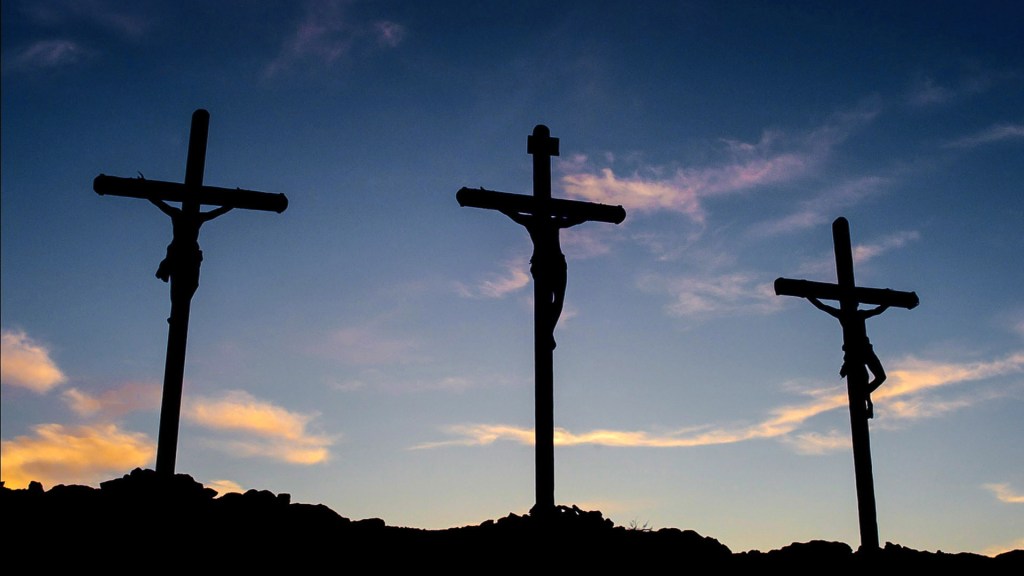
“Then he said, ‘Jesus, remember me when you come into your Kingdom.’ And Jesus replied, ‘I assure you, today you will be with me in paradise.’” Luke 23:42-43 NLT
FreeBibleimages.org
On a spring morning outside Jerusalem three men were sentenced to death by crucifixion by the authority of the Roman government. Crucifixion was the most barbaric and tortuous form of execution known to man. The horrors of the pain involved is accompanied by shame and humiliation all in public view. Of the three crucified that morning, two were clearly guilty of crimes deserving of death. But the man in the middle, Jesus, clearly was not. Although Jesus was not deserving of death, as confirmed by Pontius Pilate, His being on Calvary’s Hill that day with the two criminals is a picture of God’s love, God’s mercy, God’s grace, and a picture of all of us.
We may not want to admit it, but the two criminals are a picture of each and every one of us. All of us are deserving of death due to our sin. Born with a sin nature, we are sinful creatures living in a fallen world and will die physically as a result. The Bible is clear, “And just as each person is destined to die once.” (Heb.9:27a nlt) We deserve to die physically due to our sin. The two criminals on the cross deserved to die physically for their sins and specifically on that day for actions committed against humanity for which they were found guilty.
Another picture we see in the three crosses, pertaining to the two criminals, is a picture of the world in their acceptance or rejection of Christ. The two criminals each had a choice to make about Jesus. One wanted nothing but escape from his present condition, the other acknowledging his sin, realizing his spiritual condition, called out to Jesus in his time of real need asking to be with Him in paradise. It is a true picture of the world today.
God’s love is on full display as He sent His Son to die undeservedly for those who deserve to die. The picture of His mercy and grace is evident by Jesus’ words to the one criminal, “I assure you, today you will be with me in paradise.” The choice is yours and mine. Which one of the three crosses are you on?
“These are the clans that descended from Noah’s sons, arranged by nation according to their lines of descent. All the nations of the earth descended from these clans after the great flood.” Genesis 10:32 NLT
Representatives from 195 countries have arrived in Paris, France for the XXXIII Olympiad. The United Nations General Assembly adopted a resolution for all Member States to observe the Olympic Truce. A pause in hostilities around the globe during the games may act as a catalyst for peaceful resolutions to all worldwide conflicts. The efforts are noble, but the world has been in constant conflict since sin entered it in the Garden of Eden. The nations may be in constant conflict, but we are all one people, one family, one race, the human race.
After the Lord scattered the people from Babel by confusing their language, Genesis chapter 10 gives the breakdown of the first nations in the areas now known as Asia, Europe, and Africa. These nations all descended from Noah’s three sons, Shem, Ham, and Japheth after the great flood. They were few in number, but 7,000 years later there are 195 countries on this planet. Why does this matter? Because all of us are decedents from people in one of those early countries. As the number of nations grew and expanded across the globe our ancestors moved right along with them to our present day.
Knowing the past matters for our understanding of who we are in relation to each other and in the eyes of God. God is our creator and despite our differences in language and culture beginning at the tower of Babel we are all part of the human race. The tragic events that occur around the world creating trauma and chaos are rooted in sin. Sin that was enacted in the beginning with Adam and Eve. “For all have sinned and fall short of the glory of God.” (Ro.3:23 nasb)
There is a small sample of every nation, culture and language in Paris, France the next two weeks. They may be from different nations, but all are part of the human race dating back to the first nations so many years ago. Those in the human race, that’s all of us, are in need of saving grace from Jesus Christ unto salvation whether in Paris or anywhere in the world. That is why the past matters.
There is always hope for those who rebel against God. An example of mass rebellion against the creator God occurred in the early chapters of the book of Genesis. One hundred years after the destructive flood that saved only Noah and his family the people rebelled against God in their pride and refused God’s command to move on and populate the earth. Everyone spoke the same language and they said, “Come, let’s build a great city for ourselves with a tower that reaches into the sky. This will make us famous and keep us from being scattered all over the world.” (Gen.11:4 nlt)
That famous tower they intended to build was the ‘tower of Babel.’ It was to be a symbol of their strength and achievements of what they were capable of without God’s help. They were assigning glory to themselves in building this great tower. It would stand as a monument of how great they were. They quickly forgot God and became their own god. The God of heaven quickly put an end to that by confusing their language. God who created mankind now created multiple languages among the people so they couldn’t understand each other and were forced to separate and move on.
God had caused the separation due to their sin. They wouldn’t scatter across the earth as God told them to. Sometimes we put ourselves in a position of not following God’s instructions and God separates from what is keeping us from serving Him. But there is always hope that follows. After the Lord separated the people at the tower of Babel scripture tells us that through the line Shem, one of Noah’s sons, came Abraham, and through his line came our savior Jesus Christ.
There was a time when the world had one language and although we enjoy the many different cultures and languages today as represented in Paris this week, it came about due to sin. But there is hope, for God sent His Jesus to reconcile all of us back together through Him no matter our language. “After this I saw a vast crowd, too great to count, from every nation and tribe and people and language, standing in front of the throne and before the Lamb.” (Rev.7:9 nlt)
“They kept demanding an answer, so he stood up again and said, ‘All right, but let the one who has never sinned throw the first stone!’” John 8:7 NLT
FreeBibleimages.org
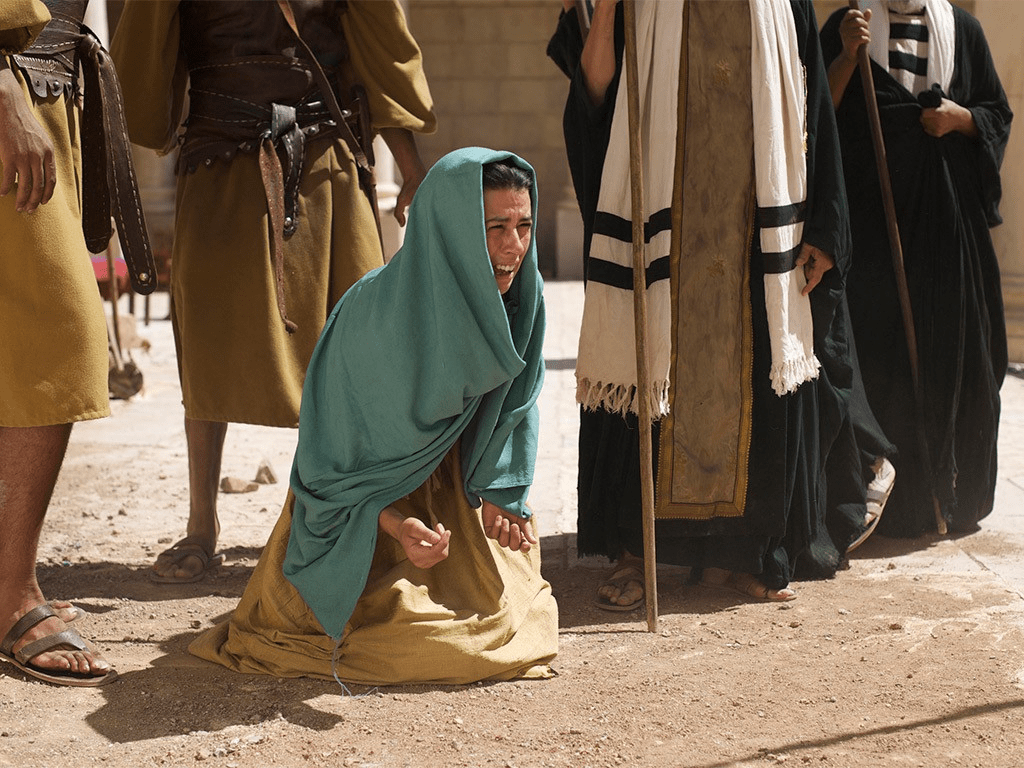
The story of a woman caught in adultery recorded in John’s gospel is a very familiar one with Christians and non-Christians alike. It reveals the hypocrisy of certain religious leaders and those who assumed the role of being one up on everyone else on morality. The main point made by many is Jesus’s words, “let the one who has never sinned throw the first stone!” Admittedly there is not one of us who is able to throw that first stone, “For everyone has sinned; we all fall short of God’s glorious standard.” (Rom.3:23 nlt) That lesson should be applied to every Christian in our daily walk in the world in which we live. But there is also another point that lies underneath the surface of the immediate that reveals the foundation for that exchange with Jesus.
The law in which the accusers wanted evoked would have been the Old Testament law of adultery. But certain facts of the case were not presented in their entirety as only one of the participants was presented. This didn’t seem to bother those who brought the woman for their own interpretation of God’s law. The fact is they weren’t as pious towards the carrying out the law as they were about trying to set up a trap for Jesus. They cared nothing about the law, but only the response from the one who came as a fulfillment of the law.
The religious leaders brought to Jesus a woman, minus the man, caught in the act of adultery. Their intent was to corner Jesus into deciding on whether to stone her according to the Law. Jesus essentially ignored them knowing of their deception. If He agreed to stone her, Jesus would be looked upon as having no forgiveness or compassion. If He did not comply with the Law it would appear Jesus was not who He said He was, the Son of God. They did not give up but kept on asking Him. They wanted Jesus to answer them either way to discredit Him. Jesus was interfering with their authority and their way of life.
There are those today who view Jesus as interfering with their authority and their lives. They demand an answer to the laws they perceive as right and just in their own eyes. They view the commands of God found in scripture as irrelevant today. They have gathered stones in their hands and are willing to throw the first stone, believing they have no sin. But tragically their aim is at God and His Word for interfering with their way of life. Be careful not to pick up stones.
“In the same way, there is joy in the presence of God’s angels when even one sinner repents.” Luke 15:10 NLT
FreeBibleimages.org
We have come to the last week of Jesus’ parables with three more all concerning the lost and found. These parables are all aimed at the Pharisees and the teachers of the Law. They despised the tax collectors and the sinners who always gathered around Jesus to hear Him teach and to eat with Him, but they despised Jesus even more. In telling these stories Jesus would contrast the Pharisees exclusiveness with His love and compassion for all including the outcasts of society. These parables relate to every person who has ever walked this earth and those who will walk it in the future. It is about the lost and found.
“So Jesus told them this story: ‘If a man has a hundred sheep and one of them gets lost, what will he do? Won’t he leave the ninety-nine others in the wilderness and go to search for the one that is lost until he finds it?’” (Lk.15:3-4 nlt) A familiar painting comes to mind which most of us seen with Jesus carrying a lost sheep over His shoulders. That one lost sheep represents you and I lost in our sin before we came to Christ. He calls and looks for each of us individually. It’s not a group thing, it’s you by yourself and it’s me by myself. Jesus says, “…. there is more joy in heaven over one lost sinner who repents and returns to God than over ninety-nine others who are righteous and haven’t strayed away!” (Lk.15:7 nlt) It’s about you and me, the lost and found.
In the next parable, Jesus speaks of a woman who lost one of her ten silver coins. There were many women who followed Jesus, and this would be of considerable interest to them. A silver coin in those days was a day’s wages and she lost it somewhere in her house. She lights a lamp in the dark one room dwelling and sweeps until she finds it. When she finds the coin, she calls her friends to rejoice with her for finding what was lost. Jesus’ heavenly meaning in this earthly story is, “In the same way, there is joy in the presence of God’s angels when even one sinner repents.” (Lk.15:10 nlt) Again there is rejoicing in heaven over one individual who has come to Christ.
Jesus is not yet finished on this subject and to drive the point home, He tells a third parable. “…. Jesus told them this story: A man had two sons. The younger son told his father, ‘I want my share of your estate now before you die.’ So his father agreed to divide his wealth between his sons.” (Lk.15:11-12 nlt) This parable, known as the ‘Parable of the Prodigal Son’, is the most familiar of all Jesus’ parables. It also has more than one heavenly meaning. The younger son was greedy and impatient wanting his share of his father’s estate while he was still alive. This would have been extremely rare but not unheard of. The father would need to sell off part of his property up to a third, which was the portion allotted to a younger son. The father had done that, perhaps unwisely, and his son took the money and ran. “A few days later this younger son packed all his belongings and moved to a distant land, and there he wasted all his money in wild living.” (Lk.15:13 nlt)
The younger son blinded by greed and selfishness failed to remember a few important things about life. Good times don’t last forever. A party life will eventually lead to ruin. Money disappears quickly when spent frivolously. And, of course, everything comes to an end. His end came sooner than expected and during the worst possible time, a serve famine. It is often during these times prodigals of all ages, both men and women, hear from the Lord and come to their senses. The fun-loving partying son finally came to his senses and started his way back home. Upon his return he would confess his foolishness to his father and ask to take a position as one of his father’s hired servants. But the father had other plans. And our heavenly Father has other plans for us when we foolishly run away from Him. “So he returned home to his father. And while he was still a long way off, his father saw him coming. Filled with love and compassion, he ran to his son, embraced him, and kissed him.” (Lk.15:20 nlt) This parable is sometimes referred to as the ‘Parable of the Father’s Love’, and we can see why.
The father demands a celebration be held in honor of his son’s return. All were enjoying the celebration with music and dancing. But there was one who did not celebrate by refusing to join the party. The older brother was furious at his father’s actions that he would welcome his brother back and with a party after what he had done. He looked at his brother as unworthy of such a celebration and forgiveness. A lesson directed right back at the Pharisees who thought those tax collectors and sinners were unworthy to eat with Jesus.
FreeBibleimages.org
These three parables of the lost and found show the Lord’s love for each one of us. We are all lost in our sin, and He and all of heaven rejoices when we turn to Him for salvation and for forgiveness when we go astray. As the father in the parable explained to his other son, “We had to celebrate this happy day. For your brother was dead and has come back to life! He was lost, but now he is found” (Lk.15:32 nlt)
True restoration is only realized when one is truly broken. Brokenness shows itself in various ways. The most common form of brokenness among all of us who breathe is in personal relationships. Here again, these show themselves through various means and circumstances. The longing for a relationship to be restored at times seems an impossibility, but when it occurs is a dream come true. Restorations do occur in accordance with God’s will and timing.
The nation Israel was restored to their land after seventy years of captivity in Babylon due to their gross sin against God. Although it was prophesized that they would return it all seemed like a dream to them when it happened. They almost couldn’t believe it. Psalm 126 is a song of joy for the restoration of Israel to the land. The psalmist wrote that they were filled with laughter and sang for joy. The surrounding nations joined them in acknowledging the amazing things God had done for them. They asked the Lord to restore their fortunes by planting their seeds in tears, but they will rejoice in the harvest to come once again.
God is in the restoration business. No one is more broken than a sinner separated from God because of their sin. We were born with a sin nature, making us all broken and in need of restoration to God. With God being in the restoration business, He made it possible for each of us to be restored to Him through the blood of Christ on the cross of Calvary. There is nothing we could ever do to make things right with God. It is only through our acceptance of Christ as our savior. We can rejoice with the broken people of Isarel in their restoration to their land and our salvation through Christ’s sacrifice for us as we accept Him. A dream come true.
“He never sinned, nor ever deceived anyone. He did not retaliate when he was insulted, nor threaten revenge when he suffered. He left his case in the hands of God, who always judges fairly.” 1 Peter 2:22-23 NLT
FreeBibleimages.org
The American judicial system is based on justice being administered represented on the facts of the case. The defendant is found guilty or not guilty by a judge or jury. The outcome is to ensure that justice was served by not punishing the innocent or letting the guilty go free. The courts, although not perfect, strive to uphold the law as established in the United States Constitution. There have been many cases over the years, even though brought properly through the judicial process, that have clearly not resulted in justice. The innocent is guilty and the guilty go free. It is extremely difficult for one who has been tried and convicted of a crime they did not commit to patiently endure the injustice done to them. But our Lord Jesus did just that on our behalf.
Jesus was arrested by the Jewish rulers for claiming the truth that He is the Messiah and claiming to be God in the flesh, another truth. Jesus was upending the Pharisees and the scribes’ rule over the Jewish people, so they sought to have Him arrested, put on trial, found guilty, and be put to death. Even in Jesus’ day, you need witnesses to confirm a crime was committed. Jewish law demanded at least two witnesses to agree, and after patiently waiting two came forward. “The leading priests and the entire high council were trying to find witnesses who would lie about Jesus, so they could put him to death…. Finally, two men came forward.” (Mt. 26:59-60 nlt) The false testimony they gave along with Jesus’ truthful response satisfied the rulers as to the decision they made.
Jesus went through the mockery of perceived justice in the various trials He went through enduring the injustice done to Him. Peter writes, “He never sinned, nor ever deceived anyone.” (1 Pt. 2:22 nlt) Jesus, God the Son, never sinned. How could He commit a crime? Peter goes on to say, “He did not retaliate when he was insulted, nor threaten revenge when he suffered. He left his case in the hands of God, who always judges fairly.” (1 Pt. 2:23 nlt) God always judges fairly, and in this case, Jesus endured the injustice as God’s plan of justice for the payment of sin. Jesus, the perfect Lamb of God, was sacrificed for our sin making us just and righteous in the sight of God as we accept Christ as our savior. False witnesses may have lied abut Jesus, but it was all part of God’s plan of salvation for all who believe.
“And Jesus cried out again with a loud voice and yielded up his spirit. And behold, the curtain of the temple was torn in two, from top to bottom. And the earth shook, and the rocks were split.” Matthew 27:50-51 ESV
FreeBibleimages.org
For the religious Jews of Jesus’s day, the tearing of the curtain (veil) in the temple should have been a revelation of who Jesus is and His purpose in dying on the cross. Scripture says the curtain was torn at the moment Jesus died, yielding up His spirit. It was torn from top to bottom indicating no human could have done it, it was clearly an act of God. The curtain that was torn was the inner curtain that separated the holy place from the most holy place in the Temple. It separated God who is Holy from sinful man, and it contained the Ark of the Covenant and the law of God.
Entrance into the most Holy place, the Holy of Holies, was only once a year on the Day of Atonement. This was the most solemn holy day of all the feasts and festivals on the Jewish calendar. The High Priest would enter the Holy of Holies after offering a bull sacrifice for his own sins. He would then enter and sprinkle some of the blood on the Ark of the Covenant to atone for the sins of the people. Forgiveness and covering of sin were only through a blood sacrifice and repeated every year on the Day of Atonement.
The events that took place on the first Good Friday are many. They started in the early morning hours past midnight with the unjust trials of Jesus, and after being condemned to die, mocked, beaten, he was finally nailed to a cross later in the morning. Darkness covered the earth from twelve noon until three in the afternoon, the time Jesus died. At that moment, the last event, access to God was made possible to all through Jesus’s sacrifice and shedding of His blood. The curtain was torn down, no more need for a yearly animal sacrifice to cover sin. A permanent sacrifice for sin was made. “For the death he died he died to sin, once for all.” (Ro. 6:10 esv) We have access to God the Father through the blood of our Lord and Savior, Jesus Christ.
Have you accepted the sacrifice of Jesus in not just covering your sins but in taking them away completely? Access to God, Salvation, and eternal life is only made possible through the blood of Jesus Christ as we repent, confess our sins, and accept Him as our Savoir. This Good Friday make sure you have access to God the Father.
Throughout any given day we make hundreds of choices. If our day is not already preplanned, we have the task of deciding how to fill the day. Even in those preplanned days, would our scheduled activities please the Lord? Obviously work, fulfilling family needs, spending time with the Lord, and volunteering in the community would be pleasing to God. It is those gray areas that are concerning for the Christian. Areas of personal conviction between you and God if you participate in them hinders your relationship with Him. It doesn’t need to be outright sin that would displease God, James tells us, “Remember, it is sin to know what you ought to do and then not do it.” (Ja. 4:17nlt) This is especially true in the things you hold in conviction to do or not to do.
Developing convictions between you and the Lord begins with spending time in the Bible and in prayer with Him. During times of confusion in certain areas of your life search the scriptures and ask God for guidance as to what He pleases Him, then go do it or not do it as the Lord placed the conviction on your heart. Not every Christian will have the same convictions. What is a conviction for me may not necessarily be a conviction for you and vice versa. That doesn’t mean that God is not pleased with both of us. He is pleased as we are obedient to His will for us.
There are common denominators for all Christians to agree with convictions in what pleases and displeases God. Paul writes to the church in Ephesus, “Take no part in the worthless deeds of evil and darkness; instead, expose them. It is shameful even to talk about the things that ungodly people do in secret…… Don’t act thoughtlessly, but understand what the Lord wants you to do.” (Eph. 5:11-12, 17nlt) As you plan your day, carefully determine what pleases the Lord.
The third book of the Law of Moses is the Old Testament book of Leviticus. Its theme is God’s holiness, and God’s will for Israel’s holiness. God’s teaching to Israel in Leviticus is how to approach their holy God in worship and in the sacrifices required of them, especially those concerning their sin. Much emphasis is placed on the priests in establishing this reverent and holy approach to God. All animals sacrificed on the altar had to be perfect without defect. “In this way the priest will make atonement for them for the sin they have committed, and they will be forgiven.” (Lev. 4:35niv)
The Lord gave Moses detailed instructions for all the sacrifices the priests were going to perform. The most significant command was that the fire on the altar was to be continuous. “The fire on the altar must be kept burning; it must not go out. Every morning the priest is to add firewood and arrange the burnt offering on the fire and burn the fat of the fellowship offerings on it.” (Lev. 6:12niv) The people of Israel were assured of God’s readiness to always forgive their sin at any time of the day or night.
The same assurance has been granted us today. God is always there waiting for us to come before Him with our confession. “If we confess our sins, he is faithful and just and will forgive us our sins and purify us from all unrighteousness.” (1 Jn. 1:9niv) No need to bring a perfect animal to an altar for sacrifice every time we sin. A perfect lamb was sacrificed on the cross at Calvary to take away our sin. Jesus, the lamb of God paid the penalty for our sin ‘once for all.’ But we still sin and for that there is the perpetual fire of God’s readiness to forgive.