“The Israelites left Succoth and camped at Etham on the edge of the wilderness. The LORD went ahead of them. He guided them during the day with a pillar of cloud, and he provided light at night with a pillar of fire. This allowed them to travel by day or by night. And the LORD did not remove the pillar of cloud or pillar of fire from its place in front of the people.” Exodus 13:20-22 NLT
Wilderness wandering can cause you to lose focus. Managing to think and see clearly in a valley of overwhelming frustration seems impossible. All of us find ourselves in a wilderness at some point in our lives. Not only is our vision blurry, but there seems to be no exit ramp to brighter days.
The children of Israel were just released into brighter days after 400 years in bondage by the Egyptians. The Lord promised He would guide them as they moved from Succoth and on to Etham by a cloud during the day and a pillar of fire at night. After a miraculous escape through the parting of the Red Sea they found themselves on their way to Mt. Sinai. The cloud and pillar of fire never left them and soon they would need them more than ever. (Neh.9:19)
Israel soon found themselves wandering in the wilderness for 40 years after disobeying God in failing to enter the Promised Land when first presented to them. That generation would never see that exit ramp to brighter days again, but it will appear to their children. During those 40 years in the wilderness the Lord still led them and provided for them. The cloud and pillar of fire remained. The future generation saw God’s faithfulness as He led them through the wilderness and eventually into the Promised Land.
Whatever your wilderness journey is, the Lord is there to guide you through it. You may not have a physical cloud or a fire at night as Israel had, but what you have is the same assurance they had of the immediate presence of God. The Lord guided Israel into the Promised Land and He will guide you through your wilderness into the brighter days ahead.
“The LORD had said to Abram, ‘Leave your native country, your relatives, and your father’s family, and go to the land that I will show you.’” Genesis 12:1 NLT
Our story of Abraham begins with God calling him as a pagan and probably a worshiper of the moon-god ‘sin’ His name at this point is Abram and is living in Ur of the Chaldeans, a prosperous commercial city of early the Sumerian kingdom in Mesopotamia, modern day Iraq. We find Abraham’s family and his ancestors in Genesis chapter 11. Abram, whose name means ‘exalted father’ is a descendant in the line of Shem one of Noah’s sons after the flood. His father’s name is Terah meaning ‘delay’ which is significant. Abram had two brothers, Nahor and Haran who had died. Abram adopted his nephew Lot after Haran died. “Abram and Nahor both married. The name of Abram’s wife was Sarai, and the name of Nahor’s wife was Milcah. Milcah and her sister Iscah were daughters of Nahor’s brother Haran.” (Gen.11:29 nlt) Abram’s wife was his half-sister and Nahor’s wife was his brother Haran’s daughter. Prohibition against such marriages were unknown in patriarchal times. Later Mosaic law did not permit such marriages.
“One day Terah took his son Abram, his daughter-in-law Sarai (his son Abram’s wife), and his grandson Lot (his son Haran’s child) and moved away from Ur of the Chaldeans. He was headed for the land of Canaan, but they stopped at Haran and settled there.” (Gen.11:31 nlt) This is Abram on the move obeying God’s call. It sounds as if Terah made the call to move on, but it was God speaking to Abram. The call would be repeated after an unadvised stay in Haran until Terah died. The book of Acts confirms Abram’s original call was in Ur. Steven in speaking to the Jewish council said, “Brothers and fathers, listen to me. Our glorious God appeared to our ancestor Abraham in Mesopotamia before he settled in Haran. God told him, ‘Leave your native land and your relatives, and come into the land that I will show you. So, Abraham left the land of the Chaldeans and lived in Haran until his father died.’” (Acts 7:2-4 nlt) We don’t know why there was a stay in Haran. Some of the reasons for the stay may have been due to Terah’s age. The city of Haran was also a thriving city and also worshiped the moon-god, perhaps Terah felt at home there. An important note to make, Abram was not told to bring the family along, but to “Leave your native country, your relatives, and your father’s family, and go to the land that I will show you.” (Gen.12:1 nlt) We are left with not knowing why Abram stopped and stayed in Haran for he was there for a considerable amount of time. He left Haran with “all his wealth—his livestock and all the people he had taken into his household at Haran.” (Gen.12:5 nlt) Abram is now on his way with his wife, Sarai, and his nephew Lot to the land God has called him.
Abram had great faith that God would fulfil his promises to him. He left his homeland and family twice giving up his familiar way of life. Bishop Ryle notes, “He was to ‘renounce certainties of the past’ ‘face uncertainties of the future’ look for and follow the direction of Jehovah’s will.’” The promises God made to Abraham were seven-fold, 1. ‘I will make you a great nation’ 2. ‘I will bless you’ 3. ‘I will make your name great’ 4. ‘You shall be a blessing’ 5. ‘I will bless those who bless you’ 6. I will curse those who curse you 7. ‘in you all the families of the earth will be blessed’ Abram’s faith started with the very first promise. God promised to make him a great nation. Abram was 75 years old when God spoke this promise to him and Sarai was barren and not much younger. Relating that to us today, can we find it within ourselves to have the same faith? It might be a little hard. But these stories in scripture are put in there for our benefit to find encouragement and to learn from them when and where we live.
Abraham has certainly become famous, he has been greatly blessed by God, Israel has become a great nation, Abraham had been a blessing to others, God has blessed those who bless Israel and the Jewish people and continues to do so until this day. One of the reasons I believe nations are blessed today is they are supportive of the nation Israel. And as we noted last week all the families of the earth will be blessed through Abraham for Jesus, the Messiah, came through the line of Abraham providing salvation to all who accept Him.
Abram’s first stop when entering Canaan was Shechem, a major settlement at the crossroads of two main commercial highways, 40 miles north of Jerusalem. He came into the land God has promised and the Lord appeared to him again. “Then the LORD appeared to Abram and said, ‘I will give this land to your descendants.’ And Abram built an altar there and dedicated it to the LORD, who had appeared to him.” (Gen.12:7 nlt) This is the first of several altars Abram built along the way when encountering a spiritual experience. He knew the land of Canaan belonged to the Lord and he consecrated that Promised Land to God. Abram then traveled south and camped near Bethel where he built another altar and worshiped the Lord God. Abram was no longer a moon-god worshiper. By setting up camp he also declared permanent residence though it was only a tent and wouldn’t be realized for many years. Here is another example of his great faith.
We close this week with Abram continuing to move south pulling up stakes and heading toward the Negev in southern Palestine southwest of the Dead Sea. Next week Abram is forced to go to Egypt as a result of a famine. Even when God is leading us things don’t always go smoothly. How does Abram handle it? Well, we will see this man of faith is just like us.
“So the promise is received by faith. It is given as a free gift. And we are all certain to receive it, whether or not we live according to the law of Moses, if we have faith like Abraham’s. For Abraham is the father of all who believe.” Romans 4:16 NLT
This week we begin a new study in Biblical Insights, ‘The Story of Abraham.’ He is probably the most influential and important figure of all the patriarchs in the Old Testament. Abraham is also mentioned many times throughout the New Testament for his great faith and how that faith affects every Christian. Abraham believed God for all the promises He spoke to him. The Bible says it was counted to him as righteousness. “Abraham believed God, and God counted him as righteous because of his faith.” (Ro.4:3 nlt) Abraham was seen as righteous before the Law was written as to obey it because of his faith in God. Abraham wasn’t righteous because he obeyed and did good deeds, but because he believed God. Christians today are saved and are righteous before God for our belief in God and His salvation plan through His Son Jesus Christ. “So all who put their faith in Christ share the same blessing Abraham received because of his faith.” (Gal.3:9 nlt)
Abraham is not only recognized as the father of the Jews but the father of all who believe. The Lord promised Abraham that all the families of the earth will be blessed through him. (Gen.12:3) Abraham received from God the good news that salvation for all would come through him. Jesus Christ, the Messiah, came through Abraham’s seed. Every person on the earth today is blessed through Abraham by his lineage in which the Messiah came. God’s salvation plan for sinners came through Abraham. The New Testament opens with the ancestors of Jesus, “This is a record of the ancestors of Jesus the Messiah, a descendant of David and of Abraham: Abraham was the father of Isaac. Isaac was the father of Jacob. Jacob was the father of Judah and his brothers.” (Mt.1:1-2 nlt) Jesus was born through the line of Judah one of the twelve sons of Jacob, Abraham’s grandson.
Jacob’s twelve sons comprise the nation of Israel. Abraham is revered as the father of the Jewish people, but Christians can also claim Abraham as a father. Abraham is the father of the Jews ethnically, and the father of both believing non-Jews (Gentiles) and believing Jews. “The real children of Abraham, then, are those who put their faith in God. What’s more, the Scriptures looked forward to this time when God would declare the Gentiles to be righteous because of their faith. God proclaimed this good news to Abraham long ago when he said, ‘All nations will be blessed through you.’” (Gal.3:7-8 nlt)
As we begin to look into the story of Abraham we will find he was much more than the father of the Jewish nation, but the father of all who believe. We will examine details of his extraordinary faith and yes, even his failures. Abraham’s great faith is seen from the beginning. God called him to leave his home and his familiar lifestyle to venture out to a land God would lead him but he knew not where. This step of faith set in motion God’s plan of salvation for each of us. “The obedience of one man was to make possible the beginning of God’s cosmic plan of salvation, which in Christ was to open out into undreamed of riches for all who hoped in Christ.” (1)
“Your love for one another will prove to the world that you are my disciples…. But those who won’t care for their relatives, especially those in their own household, have denied the true faith. Such people are worse than unbelievers.” (Jn.13:35, 1 Tim.5:8 nlt)
What does ‘true faith’ look like? If you were asked to put it into words, how would you describe it? It may help to separate the two words and take each one on its own. ‘True’ is according to fact and not false. It is accurate, correct, and real or (authentic). What is notable is the first definition found in ‘Websters New World Dictionary’ for the word ‘true’ is ‘faithful.’ So, let’s move on to ‘Faith’ as defined in Webster. ‘Faith’ is unquestioning belief, specifically in God. Complete trust or confidence, loyalty.
Combining these two words together we may say ‘true faith’ is ‘our complete trust and belief in God that is authentic based on what is fact and accurate, the Lord God.’ You may come up with other variations, but you get the idea. It is a starting point. We can mix and match these definitions to help us explain ‘true faith’ and most would be within reason of each other, but what does ‘true faith’ look like from God’s perspective?
Christian compassion for one another is a major component of ‘true faith.’ Jesus said our love for each other will show the world we are His disciples. This is especially true of our love for our families. When there is a lack of love and concern for our families it is immediately noticed by unbelievers. Even most unbelievers care for their own families. Paul writes, “those who won’t care for their relatives, especially those in their own household, have denied the true faith.” (1Tim.5:8 nlt) It’s sad, but some Christians have indeed denied the true faith. This ought not to be. May our ‘true faith’ be authentic in the Lord God from His perspective having true love for another, especially those in our own household.
“Then Peter called to him, ‘Lord, if it’s really you, tell me to come to you, walking on the water.’ ‘Yes, come,’ Jesus said. So Peter went over the side of the boat and walked on the water toward Jesus.” Matthew 14:28-29 NLT
FreeBibleimages.org
Consistent faith. Do you have it? Faith in God, the only one to put our faith and trust in. So, again, do you have consistent faith? How about limited faith, do you have that? We tend to think limited faith is better than having no faith at all. Perhaps that is true, but it can lead some disastrous outcomes. Having the faith to go all in with God requires our faith be consistent.
One of the most well-known stories in the New Testament is Jesus walking on the water. Many of us forget the fact that two people are recorded in the Bible for having walked on water. Peter is often forgotten. It could be because it didn’t end very well. We also forget the great faith it took for Peter to step out of that boat in the midst of stormy sea. Peter had faith in Jesus at the outset but when the wind and waves circled around him his faith sunk as did his body when he took his eyes off the object of his faith. Peter had great faith, but it wasn’t consistent when trouble surrounded him.
You may find yourself today struggling with your faith in God. You started out with great faith in the Lord, but things aren’t going as well as when you first stepped out of the boat. Question? Are your eyes still on Jesus or on the surrounding events or problems in the world and in your life? Consistent faith will see you through. God will not abandon you. Jesus didn’t let Peter sink but pulled him up from drowning in his lack of faith. The Lord will do the same for you, but a lot of stress and difficult times can be avoided with a little more consistency in our faith.
“Give the following instructions to the people of Israel. When you enter the land I am giving you and you harvest its first crops, bring the priest a bundle of grain from the first cutting of your grain harvest.” Leviticus 23:10 NLT.
Isn’t it always a pleasure to get that first cup of fresh coffee just brewed. How about that first slice of pizza coming out of a brick oven, or those warm gooey chocolate cookies cooling on the tray. Nothing beats the taste of those fresh products. They are in the freshest and best state they will be in and we appreciate being able to enjoy them before they become day old. They are the first and best.
Have you ever thought about God wanting our first and best? Ancient Israel hadn’t thought of it either until they were about to settle in the Promised Land. God gave them instructions for the festivals they were to celebrate in worship to Him. There were seven in total with the Festival of First Fruits occurring on the second day of the feast of Unleavened Bread. This would be the month of Nisan on the Jewish calendar in the spring of the year. Israel was to dedicate the first portion of the earliest barley crop to God. The first fruits belonged to God. It symbolized consecrating the entire future harvest to the creator God for all things belong to Him. Israel anticipated a successful future crop through faith in the Lord God.
Israel was to bring the first and best to the Lord of their crops during the Feast of First Fruits, but this also filtered down to all that God had blessed them with. They were to give the first and best of their entire substance to support the work of the Temple and the priests. “You must also give to the priests the first share of the grain, the new wine, the olive oil, and the wool at shearing time.” (Dt.18:4 nlt) The Lord is the creator of everything and all that we have is from the hand of God.
The Lord God wants the first and best from all who follow Him. It is a form of worship as it was for ancient Isarel that each of us give back a portion of what God has blessed us with. We need to remember it’s all His anyway, we are only stewards of what he has given us to manage. It’s not just our finances and material goods God wants, he doesn’t need the money, but He also desires the first and best of our time and talents as well. May we give the Lord that first fresh cup of coffee.
“No doctrine is more important to evangelical theology than the doctrine of justification by faith alone—the Reformation principle of sola fide. Martin Luther rightly said that the church stands or falls on this one doctrine.” John MacArthur
“The doctrine of justification by faith is like Atlas: it bears a world on its shoulders, the entire evangelical knowledge of saving grace.” J. I. Packer
We have come to the fourth sola of the ‘Five Solas’ of the Reformation period, ‘sola fide’ or (faith alone.) Simply put, it is by faith alone with nothing added, in Christ Jesus alone, that we enter into a saving relationship with Him securing our salvation. The apostle Paul writes, “For by grace you have been saved through faith. And this is not your own doing; it is the gift of God.” (Eph.2:8 esv) A part of the gift God gives to us is the gift of faith to believe. We would not believe on our own, nor would we have the faith to do so. God grants it to us. Paul goes on further to say, “not a result of works, so that no one may boast.” (Eph.2:9 esv) There is nothing we can do to work our way into heaven. It is all by God’s grace alone to us through faith alone and nothing else.
It is amazing that God sees us as righteous through His Son as we put our faith in Him. Our righteousness and justification comes only through Jesus Christ and what He accomplished in our place on Calvary’s cross. The Devotional series “Heart of the Reformation” notes, “Faith alone preserves the truth that the Lord is our only Savior. Faith looks outside of ourselves and only to Jesus as the Redeemer.” Again, there is nothing we can do to gain righteousness and be justified before God except through Jesus Christ. We are sinful creatures with a sin nature and find it impossible to keep any of God’s commandments. We could never accumulate enough good deeds to be seen as righteous in God’s eyes and earn our way to heaven. Dr. R. C. Sproul notes, “The question is not whether we are going to be saved through works; the question is whose works. We saved through the works of the one who alone fulfilled the terms of the covenant works.” We are to believe in faith the works of Christ on our behalf and believe in faith alone!
In Jesus’s parable of the Pharisee and the tax collector (Lk.18:9-14), Jesus points out to those who thought themselves to be righteous that they were not. The so-called righteous Pharisee in his prayer exalted himself by saying, ‘God, I thank you that I am not like other men, extortioners, unjust, adulterers, or even like this tax collector.’ The tax collector’s prayer was a humbling response, ‘God, be merciful to me, a sinner!’ Jesus explained, ‘I tell you; this man went down to his house justified, rather than the other.’ It couldn’t be clearer; Jesus is stating justification is by faith alone and not by works. “Martin Luther rightly said that the church stands or falls on this one doctrine.”
At the end of the parable of the persistent widow and the unrighteous judge (Lk.18:1-8) Jesus says, “I tell you; he will give justice to them speedily. Nevertheless, when the Son of Man comes, will he find faith on earth?” (Lk.18:8 esv) Jesus is fast forwarding to His second coming and is indicating that a spiritual decline will be in progress. The time will be a time of persistent prayer for true believers similar to the woman in the parable.. This will be a time of mass spiritual decline. True faith will be scarce. False teaches will be leading people away from the gospel, and persecutions will be on the rise.
The apostle Paul informs Timothy of the same thing in his letter of instruction of 1 Timothy. “Now the Holy Spirit tells us clearly that in the last times some will turn away from the true faith; they will follow deceptive spirits and teachings that come from demons.” (1Tim.4:1 esv) As the days get closer to Christ’s return, Satan and his demons know they are running out of time. The day of everlasting torment is getting closer for them. Their only purpose is to lie, deceive, and destroy.
The world has been observing these devilish effects for some time now. There has been a great exodus of people from the church in recent years. Many churches have abandoned their gospel roots of salvation to include unbiblical methods of salvation to get along with the changing culture. It’s not hard to see who is behind this apostasy. The evil one is doing all he can to keep people in need of salvation from hearing the true gospel. Be aware Satan is also in the business of deceiving Christians with false doctrine to keep us from growing in Christ and from evangelizing the truth.
May we be alert to the deception around us, not getting caught up in it, and be in a steadfast position to continue to share the gospel in these ‘scarce faith’ times.
“Only in returning to me and resting in me will you be saved. In quietness and confidence is your strength. But you would have none of it.” Isaiah 30:15 NLT
What troubles you? Where do you go and to whom do you go to get relief from your troubles? Hezekiah, king of Judah, was seeking an alliance with the forces of Egypt in their trouble with the invading Assyrian army. They apparently forgot about God in the midst of their troubles. The powerful Egyptian army looked like the best option with their swift horses to help them escape the approaching danger. But the Lord reminded them, “Only in returning to me and resting in me will you be saved.” (Is.30:15 nlt)
Judah was resting in the strength and material sources of their current world system to relieve them of their troubles. They trusted in a foreign government who had no allegiance to the God of heaven. Judah was willing to join themselves to a godless nation for safety rather than to trust in the Lord their God. The Lord warned them it would not work, but they did not want to hear it.
How many times have you chosen the remedies of the world before going to the Lord for what troubles you? Worse yet, how many times have you been given counsel in the things of the Lord, but as King Hezekiah, you ignored it. The Lord God knows each of us intimately which means He knows exactly what it is that troubles us and how to solve the issue. Returning to the Lord and resting in Him is our only sure way to safety. So, who or what are you waiting for? The Egyptians may have fast horses, but your troubles may be indeed faster, our world may have some answers, but only God knows how to meet your need in times of trouble. It’s time to trust Him in quietness and confidence.
“For in it the righteousness of God is revealed from faith for faith, as it is written, ‘The righteous shall live by faith.’” Romans 1:17 ESV
Photo AI Generated wordpress
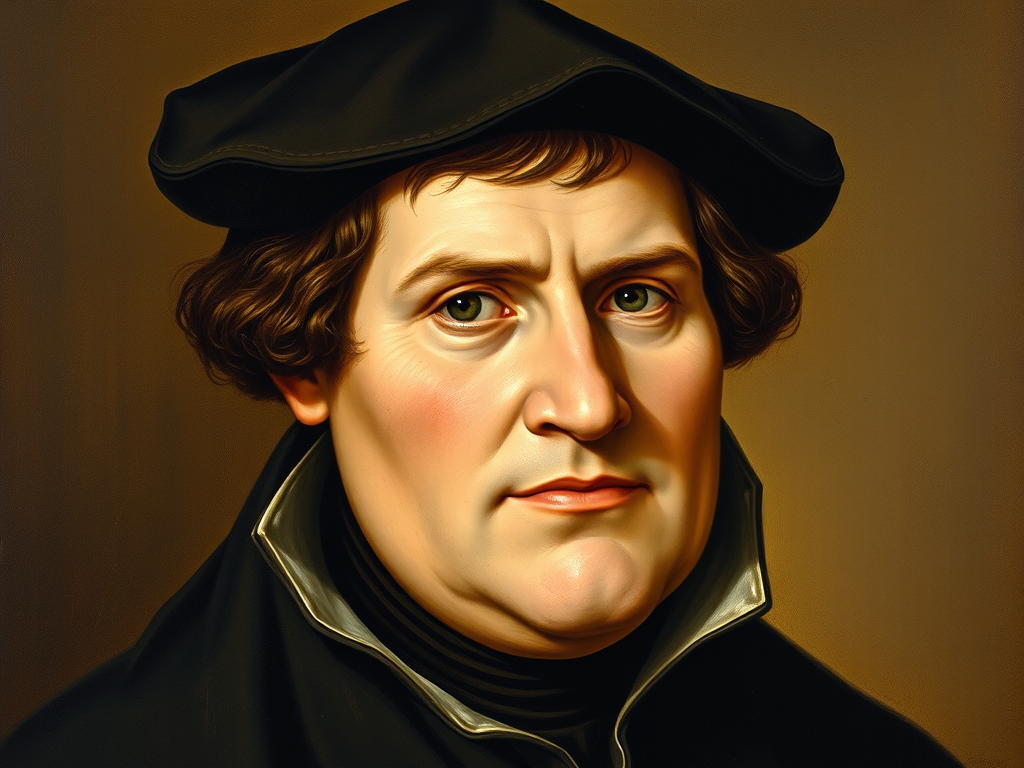
October 31st is recognized around the world as Halloween or ‘All Hallows’ Eve.’ The meaning of ‘hallows’ is ‘saints’ in the Christian tradition, All Saints Day is November 1st. However, Halloween today is nothing about Christian saints and I will leave it there. Today is Reformation Day, the day celebrated by Christians in recognizing Martin Luther’s ‘95 Theses’ nailed to the University of Wittenberg’s chapel door in 1517.
Martin Luther was a German monk and a professor of biblical studies at the University of Wittenberg who became disillusioned with the error he saw in the Catholic church, particularly the selling of indulgences. He posted his ‘95 Theses’ to spark conversation and debate among his colleagues calling for reform in the Catholic church. This, however, led to the Protestant Reformation of the 16th century.
Luther was convinced through the reading of Scripture that salvation was by the grace of God alone and faith alone in Jesus Christ. It was not by any merit or works on our part that contributes to salvation and entrance into heaven. This was in contradiction to what he had observed within the church. Luther was also a staunch believer that every person should have access to the Bible and be able to read it for themselves. He had translated the entire Bible into German.
Stephen Nichols of Ligonier Ministries writes, “The real main character in Reformation Day is not Luther. It’s the Word of God. What Luther discovered as a monk is that for centuries, the true teachings of the Word of God had been hidden by century upon century of tradition. That’s what Reformation Day is about: it’s about pulling back the cover and releasing the power of the Word of God and the beauty and the truth of the gospel. That’s why we celebrate Reformation Day.” (1)
“For by grace you have been saved through faith. And this is not your own doing; it is the gift of God, not a result of works, so that no one may boast.” Ephesians 2:8-9 ESV