“Even the wilderness and desert will be glad in those days. The wasteland will rejoice and blossom with spring crocuses. Yes, there will be an abundance of flowers and singing and joy! Say to those with fearful hearts, ‘Be strong, and do not fear, for your God is coming to destroy your enemies. He is coming to save you.’” Isaiah 35:1-2a, 4 NLT
There is an abundant need for restoration in our world today. Relationships in broken families need to be restored. Broken marriages need healing returning to health, strength, and stability. Incarcerated individuals need restoration while in prison and when released back into society. Those who have fallen into addiction of drugs, alcohol, pornography, or gambling are in dire need of restoration. Most governments around the globe have fallen far from the original intent of the law. Societal ills are the major cause of broken relationships, crime, addictions, and corrupt governments. And sin is the cause of all our societal ills including each of us who are estranged from God. But there is hope, hope for restoration.
The prophet Isaiah writes about a future day of restoration for the nation of Israel and the world during the Millennium period when Christ will rule on the earth. There will be no societal ills to worry about, no addictions, broken families, or corrupt governments. “Say to those with fearful hearts, ‘Be strong, and do not fear, for your God is coming to destroy your enemies. He is coming to save you.’” (Is. 35:4 NLT) It is a comfort to know all will be restored in the future, but what about now you may say, where is my hope for restoration?
Our hope for restoration in the here and now begins with the forgiveness of sins as we confessed them to God. “But if we confess our sins to him, he is faithful and just to forgive us our sins and to cleanse us from all wickedness.” (1 Jn. 1:9 NLT) Paul writes in 2 Corinthians, “This means that anyone who belongs to Christ has become a new person. The old life is gone; a new life has begun!” (5:17 NLT) As a new person in Christ the Holy Spirit comes upon you to assist in your struggles within your family, your temptations, and your addictions. (1 Cor. 6:19)
God is in the business of restoration, so there is your hope for restoration. “Even the wilderness and desert will be glad in those days. The wasteland will rejoice and blossom with spring crocuses. Yes, there will be an abundance of flowers and singing and joy!” (Is. 35:1-2a NLT)
This week we venture into the last days of the Great Tribulation. It is hard for us to imagine let alone understand. That is why we will look to Jesus’ words very carefully to decipher as much as we can about this upcoming day, the close of the tribulation period and the return of Christ. Jesus is still answering His disciples question as to when will these things take place. Jesus gave them the signs to look for right up to and including His physical return to rule during the millennium.
Jesus continues His Olivet Discourse, “At that time, after the anguish of those days, the sun will be darkened, the moon will give no light, the stars will fall from the sky, and the powers in the heavens will be shaken.” (Mk.13:24-25 nlt) Jesus is making note what was prophesied in the Old Testament book of Joel about the end days. (Joel 2:10, 31, 3:15) It is at this time as explained by late Dr. John MacArthur that the universe begins to disintegrate. The millions of stars within the countless galaxies begin to fall out of place, the sun is darken meaning no moonlight, indeed this is the heavens being shaken. Then Jesus says, “Then everyone will see the Son of Man coming on the clouds with great power and glory.” (Mk.13:26 nlt) Everyone on the earth at that time will see Jesus, the Son of Man, coming down on the clouds in the same manner He ascended to heaven. (Acts 1:9-11) Yes, again this is hard to imagine that everyone wherever they are in the world will see this event, but if Jesus says everyone will see Him, then everyone will see Him.
Angels will be sent out to gather His chosen ones, those who believed during the tribulation. They will be gathered from every corner of the earth. None will be missed. All the saved will enter into the millennium period with Christ as ruler. Less we forget all the saints the Lord brings back with Him in His return. Yes, all the redeemed will be there! (Rev.19:11-16)
Jesus reminds the disciples of the signs He told them to look for and equates them to the fig tree. Observing when the branches sprout and leaves begin to form they know summer is near, so then, “In the same way, when you see all these things taking place, you can know that his return is very near, right at the door.” (Mk.13:29 nlt) Jesus’ next statement is a matter as to when and who it relates to. “I tell you the truth, this generation will not pass from the scene before all these things take place. Heaven and earth will disappear, but my words will never disappear.” (Mk.13:30-31 nlt) It is best to understand this as the generation living at the time these things take place. There is also a thought this can refer to the Jewish people, as ‘generation’ can be noted as ‘race’ or ‘people.’ This would be the promise the Jewish people will survive until Jesus returns. Jesus then affirms it is impossible for God’s words to be destroyed or fade away. Heaven and earth will be destroyed, by God’s Word, never!
The Olivet Discourse concludes with Jesus telling us to be ready, be on guard, stay alert, and watch for Him. No one knows when that day will be, “not even the angels in heaven or the Son himself. Only the Father knows.” (Mk.13:32 nlt) Jesus in His humanity did not know the day of His return as He gave up His divine privileges when He came to earth in human form to save us. “Though he was God, he did not think of equality with God as something to cling to. Instead, he gave up his divine privileges; he took the humble position of a slave and was born as a human being. When he appeared in human form. (Phil.2:6-7 nlt)
Jesus’ final words on this subject is to give us the example of a man leaving on a long trip. He gives instructions to all of his servants of what he wants done and assigns a gatekeeper to guard the gate outside the house until his return. The message for us is simple, Jesus gave us work to do in His absence. May we be doing His work. And we are to be as the gatekeeper always looking for His return for we don’t know when that will be. Remember Jesus’ words, “And since you don’t know when that time will come, be on guard! Stay alert! Don’t let him find you sleeping when he arrives without warning. I say to you what I say to everyone: Watch for him!” (Mk.13:33, 36-37 nlt)
Next week we continue to look at the events of Passion Week leading up to the Last Supper. Until next week…….
“O LORD, rescue me from evil people. Protect me from those who are violent, those who plot evil in their hearts and stir up trouble all day long. Their tongues sting like a snake; the venom of a viper drips from their lips.” (Ps.140:1-3 nlt)
The above verses are a prayer of every Christian in the world today, especially those of us in America. There are evil people committing violent acts. They plan this evil for weeks, months, maybe a year. Their rhetoric reveals what is in their heart, only evil, and it is against Jesus Christ and His followers. Although they will say otherwise. The violent slander that protrudes from their lips is the venom of a conniving snake to destroy the innocent to advance their agenda. Their agenda; to rid the world from those standing in the way of a global society. The justification for this hatred towards Christians is ‘we are the cause of all the evil in the world.’
Our prayer continues, “O LORD, keep me out of the hands of the wicked. Protect me from those who are violent, for they are plotting against me. The proud have set a trap to catch me; they have stretched out a net; they have placed traps all along the way.” (Ps.140:4-5 nlt) We Christians have a target on our backs. Evil is always scouring the landscape of Christianity to find a weak spot to infiltrate and bring us down. Sadly, we have succumbed to that all to often. We do have a gracious and merciful God who will forgive us, but sometimes the damage is already done and we have lost our influence. Beware of the traps that have been set up in our daily lives. They are there and are not going away.
Our Lord God will listen to our prayers, “I said to the LORD, ‘You are my God!’ Listen, O LORD, to my cries for mercy! O Sovereign LORD, the strong one who rescued me, you protected me on the day of battle. LORD, do not let evil people have their way. Do not let their evil schemes succeed, or they will become proud.” (Ps.140:6-8 nlt) When evil people have their way and their schemes succeed, as in the assassination of Charlie Kirk, they do become proud. Celebrating the death of an innocent man for simply speaking what they disagree with is pure evil. But this shouldn’t surprise Christians. I was reminded of this fact this past Sunday of the celebration that will take place by the world at the death of the two witnesses sent by God in the end times. (Rev.11) A must read!
This prayer from the book of Psalms was first spoken by David, king of Israel, who had enemies all around him. Conspiracies and slandering were frequent in his life. David was God’s chosen king of the Jewish people. The surrounding nations hated the Jewish people and their God, therefore the constant threat towards him and Israel. Christians today are God’s chosen people, therefore the threats and slander towards us. The world hates us, because they hate Christ. Oh, they may not say it, but they do.
Let us remember Jesus’ words, “If the world hates you, remember that it hated me first. The world would love you as one of its own if you belonged to it, but you are no longer part of the world. I chose you to come out of the world, so it hates you.” (Jn.15:18-19 nlt)
And let us also remember Jesus said, “And be sure of this: I am with you always, even to the end of the age.” (Mt.28:20 nlt)
“For the law was not intended for people who do what is right. It is for people who are lawless and rebellious, who are ungodly and sinful, who consider nothing sacred and defile what is holy.” 1 Timothy 1:9 NLT
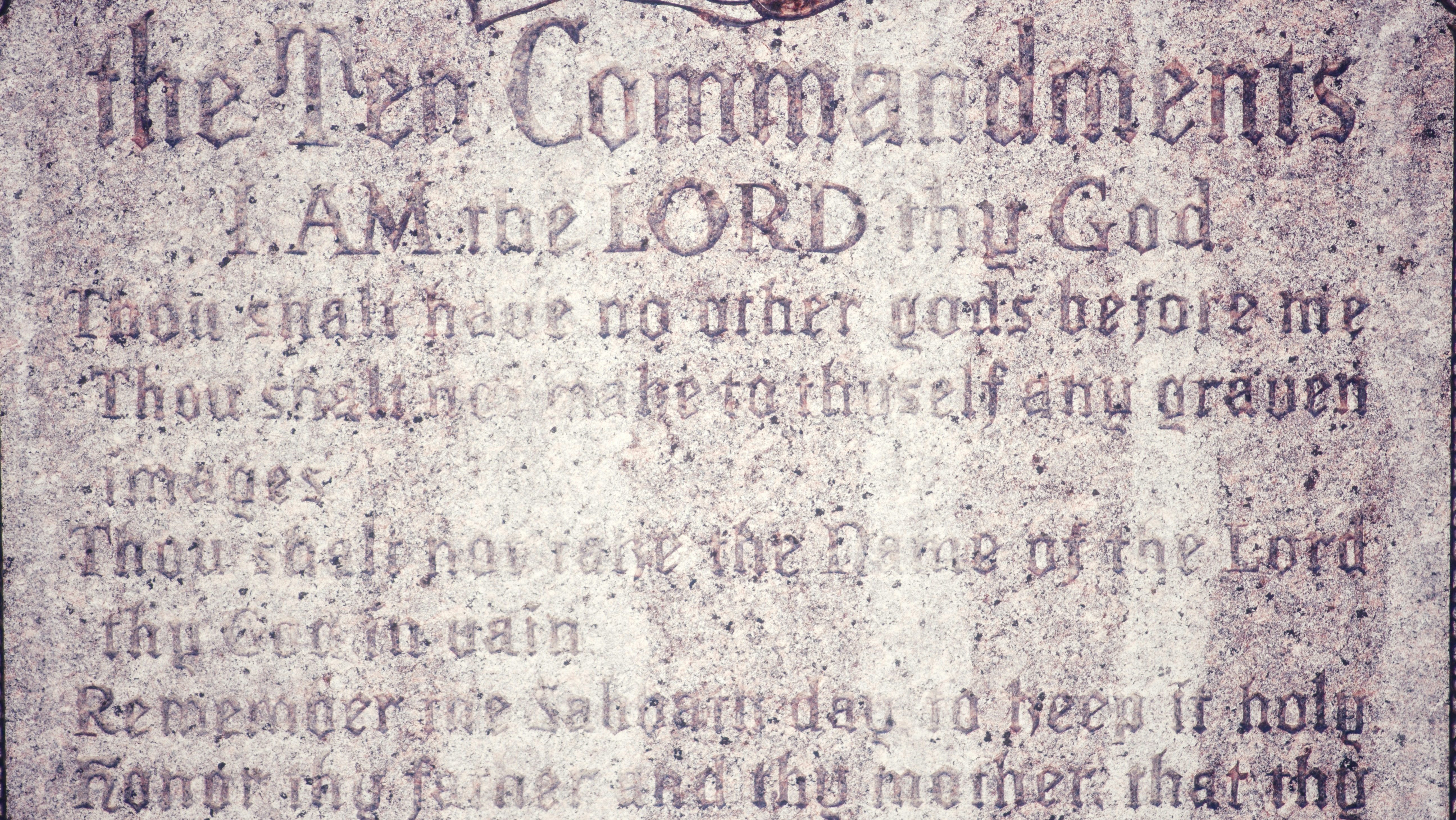
We have heard others say, ‘I have kept the Ten Commandments.’ Really? I will not go into how this is an utterly ridiculous statement except to say there is no one who has ever kept all Ten Commandments. If you find that hard to believe, just look in the mirror. Sorry! There are many laws spread out throughout the Old Testament the Jewish people were to observe. The leading Jewish rulers counted 613 of them. If people have a hard time obeying 10, I think it is safe to say that 613 is out of reach for even the noblest people.
Since none of us are able to keep the Law then what is the purpose for the Law? The Law was meant to show us just that point. None of us are capable of obeying it. The Law was meant to show us our sin and make us realize we need a savior. We have all sinned and fallen short of the glory of God. (Ro.3:23) As Chuck Swindoll says, ‘the Law is intended for the lawless.’*
Christ Jesus came not to abolish the Law or the teaching of the prophets but to fulfill it. (Mt.5:17) He is the only one capable of obeying the entire Law. By Christ’s death on the cross for our sins, rising up and defeating death, He accomplished what was needed for our salvation. “We know that the law is good when used correctly.” (1Tim.1:8 nlt) but it won’t save us, because we can’t keep it, and that is why Christ came to save sinners.
“Yes, everything else is worthless when compared with the infinite value of knowing Christ Jesus my Lord. For his sake I have discarded everything else, counting it all as garbage, so that I could gain Christ.” Philippians 3:8 NLT
The apostle Paul in his letter to the church at Philippi was expressing the value of knowing Christ in chapter 3. Paul noted all of his accomplishments starting with his pedigree as a true Jew. “I was circumcised when I was eight days old. I am a pure-blooded citizen of Israel and a member of the tribe of Benjamin—a real Hebrew if there ever was one!” (Phil.3:5 nlt) He then went on to declare his membership as a Pharisee, those who knew and kept the strictest of Jewish Laws. Paul was on top of the Pharisaical ladder and so zealous for the Law that he persecuted all who went against it, especially Christians. But Paul gave it all up for the sake of knowing Christ, by stating, “I once thought these things were valuable, but now I consider them worthless because of what Christ has done.” (Phil.3:7 nlt)
This passage deals with those, as Paul, who thought self-righteousness, doing good deeds, obeying manmade laws in religion is the way to God. Paul realized it wasn’t the way. He needed to get rid of all his self-made rules, his piousness, and his self-accomplishments which he now considers worthless. Paul needed to discard all the garbage he was counting on for salvation. Christ Jesus has done it all for him and all Paul needed to do was to accept this by faith. “I no longer count on my own righteousness through obeying the law; rather, I become righteous through faith in Christ. For God’s way of making us right with himself depends on faith.” (Phil.3:9 nlt)
So, how about you? What are you counting on to get you to heaven? It’s time to discard those fruitless efforts and rely on the only true way to heaven, faith in Jesus. Paul calls them garbage, and so they are. Time to take out the garbage!
“In Hades, where he was in torment, he looked up and saw Abraham far away, with Lazarus by his side So he called to him, ‘Father Abraham, have pity on me and send Lazarus to dip the tip of his finger in water and cool my tongue, because I am in agony in this fire.’” Luke 16:23-24 NIV
In presenting the gospel of Jesus Christ some advocate not mentioning ‘hell’ in fear of turning away people. Unfortunately even pastors in some of our most prominent churches will not preach on hell for the same reason. They would rather preach on the love of Jesus and for us to follow Jesus’ teaching on love, and well we should, but Jesus also taught about ‘hell.’ Jesus talked about hell to warn us the consequences of rejecting Him and the sacrifice He made for us on the cross of calvary.
Jesus tells a story found in the New Testament book of Luke about a rich man and the poor man, Lazarus. Most scholars consider this story one of Jesus’ parables, but if it is a parable, it is the only one He tells with an actual name of an individual. In any case, Jesus is clearly referring to hell in this story.
The rich man had all the comforts life could offer. He was rich, had fine clothing, and plenty of food, life was good. Lazarus was a poor beggar with sores covering his body. He would crave to eat what fell from the rich man’s table. One living in luxury and the other in dire poverty. Jesus says, “The time came when the beggar died and the angels carried him to Abraham’s side. The rich man also died and was buried. In Hades, where he was in torment, he looked up and saw Abraham far away, with Lazarus by his side.” (Lk.16:22-23 niv) Lazarus and the rich man both died physically, but their souls live on. Lazarus is in comfort at Abraham’s side while the rich man is suffering in torment.
Don’t miss the point here. The rich man isn’t in hell because he was rich, but because he rejected God and His plan for salvation. Lazarus isn’t alongside Abraham because he was poor in life, but because he accepted God’s plan of salvation. Jesus is confirming there are two destinations for each one of us when we die, heaven or hell. Jesus came to save us from the torments of hell if we put our trust in Him for salvation. Jesus felt it was important enough and something to talk about. We should too!
“The eyes of all look to you in hope; you give them their food as they need it. When you open your hand, you satisfy the hunger and thirst of every living thing.” Psalm 145:15-16 NLT
Have you ever thought about the ways God provides food for animals in the wild and living creatures in the sea? It is amazing to witness their instant as they prey upon their victims, their food source. We may find it hard to watch, but it is by God’s design and the victim had their own fill before that dreadful moment. The bottom line is God has a plan to provide food for every living being and that includes us as human beings.
The psalmist writes the eyes of all look to God in hope and are given food from above when needed. Animals do not possess the nature of sensing God but they have the instinct given by God that directs them in what they need to survive. When they are hungry they know where to go to find food. God does provide for them. “When you open your hand, you satisfy the hunger and thirst of every living thing.” (Ps.145:16 nlt) And that includes every animal and every fish of the sea.
Most importantly that includes every one of us. It is hard to comprehend this when we see so much starvation in the world, but that doesn’t negate God’s providential care for us. He has provided us with rich resources and the ability to feed the world. The problem lies in that the world is sinful, turning our backs on God, and going our own selfish way. This creates the current chaotic times we live in which includes undernourished people across the world. But Jesus’ hands and feet are on the earth in those who know Him. God will use us in His providential care for every person who needs help in their daily supplies. May we be willing participates in God’s providential care for every living thing.
The last two weeks in the United States have been a challenge for Christians defending their faith since the assassination of Charlie Kirk. But that hasn’t stopped them, nor should it. We are to continue to preach the gospel and be ready to give an answer to everyone who asks us about our hope in Christ.
Peter in addressing Christians scattered throughout the world suffering severe persecution wrote, “But even if you suffer for doing what is right, God will reward you for it. So don’t worry or be afraid of their threats. Instead, you must worship Christ as Lord of your life. And if someone asks about your Christian hope, always be ready to explain it.” (1Pt.3:14-15 nlt) Especially when they were suffering for doing good, Peter instructed them to always be ready to explain to those who asked about their Christian hope. Peter knew most definitely that some would be asked when people observed their demeaner during insults and ridicule. (1Pt.3:9-11)
Christ followers have always suffered ridicule and persecution. Christians today are being murdered at a faster rate as any time in history. Still, we are told to always be ready to give an answer for the hope that lies within us. You can be certain when those outside of Christ see Jesus’ light in you pursuing peace and working to maintain it during ridicule and persecution they will ask, where do you get this hope that is in you?
You can respond with Peter’s words in 1 Peter 3:18, “Christ suffered for our sins once for all time. He never sinned, but he died for sinners to bring you safely home to God. He suffered physical death, but he was raised to life in the Spirit.” (nlt) And you can conclude with ‘I am safely brought home and have eternal life.’ So, be ready!
“But when you see the ABOMINATION OF DESOLATION standing where it should not be (let the reader understand), then those who are in Judea must flee to the mountains.” Mark 13:14 NASB
Jesus is the middle of His Olivet Discourse (the end times) with His disciples. They had asked Him when these things would take place and what signs they should look for. Last week in our study Jesus warned them and us of upcoming persecution for those who believe in Him. This persecution will come from governing officials, zealous religious leaders (Mk13:9), and our own families (Mk.13:12). Jesus summed it up by saying, “And everyone will hate you because you are my followers. But the one who endures to the end will be saved.” (Mk.13:13 nlt)
Photo AI Generated wordpress
Jesus now begins His teaching on the tribulation period and His return at the end of the age. He starts out with this, “The day is coming when you will see the sacrilegious object that causes desecration standing where he should not be.” (Reader, pay attention!) “Then those in Judea must flee to the hills.” (Mk.13:14 nlt) It must first be noted that there are differences of opinion in the events of the last days and Jesus’ return. FYI, I am coming from a dispensational premillennial point of view.
Jesus refers to the abomination of desolation (sacrilegious object of desecration in the NLT) as a coming day in the future. Among the Jews, abomination was used to depict idolatry or sacrilege. Jesus was speaking of a future act profaning the Temple. This will occur during the tribulation period. The prophet Daniel wrote about this as the angel explained Daniel’s vision to him, “The ruler will make a treaty with the people for a period of one set of seven, but after half this time, he will put an end to the sacrifices and offerings. And as a climax to all his terrible deeds, he will set up a sacrilegious object that causes desecration, until the fate decreed for this defiler is finally poured out on him.” (Dan.9:27 nlt) This is a reference to the antichrist setting an image of himself to be worshiped in the Temple during the tribulation. Which, if we understand this correctly, means the Jewish Temple will be rebuilt. Something we should be looking to.
There is an event in Jewish history that foreshadows Jesus’ teaching here on the ‘abomination of desolation’ which the disciples would have been aware of. The king of Syria, Antiochus Epiphanes, invaded Jerusalem in 168 B.C. and built an altar to Zeus, a pagan god, on the Temple’s altar and sacrificed a pig on it. Surely an abomination. Another abomination of desolation will occur in the end times.
Jesus goes on to say, “(Reader, pay attention!) Then those in Judea must flee to the hills” (Mk.13:14 nlt) There will be those who will come to know the Lord during the tribulation period. These are believers who are to be prepared to when they see these things and flee to safety. This will happen at the midway point of the tribulation as prophesied by Daniel.
The urgency of the matter is stressed by Jesus. “A person out on the deck of a roof must not go down into the house to pack. A person out in the field must not return even to get a coat. How terrible it will be for pregnant women and for nursing mothers in those days. And pray that your flight will not be in winter.” (Mk.13:15-18 nlt) There is no time to retrieve clothing or pack a tote bag. The example of pregnant women and nursing mothers refer to the difficult circumstances one will be under trying to escape. If occurring in winter during the heavy rains, it would be impossible to cross the streams due to the rising waters.
This is indeed the great tribulation. Jesus declares there will be greater anguish in this time that any other time in world history and will never be again. Unless that time is shorten, Jesus says no one will survive. “ But for the sake of his chosen ones he has shortened those days.” (Mk.13:20 nlt) His chosen ones, the elect, those who are saved during the tribulation. Warning is given to beware of false messiahs rising up to deceive those fleeing to refuge. “For false messiahs and false prophets will rise up and perform signs and wonders so as to deceive, if possible, even God’s chosen ones.” (Mk.13:22 nlt) They are warned of the danger of these false messiahs and prophets. A warning for Christians today. There are plenty of false prophets in the world. False teachers flood the airwaves, social media, and churches. Witchcraft, tarot card reading, and fortune telling are prevalent today. All, believe it or not, capable of ‘performing signs and wonders’ as Jesus said to deceive us. This, of course, is from the evil one and his demons. That is why Christians are to stay far from them.
Jesus finishes His warnings with a final thrust, “Watch out! I have warned you about this ahead of time!” (Mk.13:23 nlt) As we have been learning Jesus’ warning signs of the coming days of tribulation, it is a time no one would want to go through. Christians today will not go through the tribulation as the Lord will return for His church before then. But will you be one caught up on that day or be left behind? You can make sure today by accepting Christ as your savior. We don’t know when that day will come. With that said…..
As we continue next week, Jesus continues His teaching with the closing days of the tribulation and says this, “However, no one knows the day or hour when these things will happen, not even the angels in heaven or the Son himself. Only the Father knows.” (Mk.13:32 nlt) Until next week…….
“Then Jesus said, ‘Come to me, all of you who are weary and carry heavy burdens, and I will give you rest. Take my yoke upon you. Let me teach you, because I am humble and gentle at heart, and you will find rest for your souls. For my yoke is easy to bear, and the burden I give you is light.’” Matthew 11:28-30 NLT
Photo AI Generated
Tomorrow Sunday September 21st is ‘National Back to Church Sunday.’ Recognized on the third Sunday in September, it is a drive to invite people back to church, and if one has never attended church, now is a good time. It is community, and where you will find peace, but it is so much more than that. A Bible believing, preaching church will introduce you to Jesus Christ, God the Son. He is where true peace comes from. Peace in this world and assurance of life eternal. There is the ultimate community with brothers and sisters in Christ which the world cannot match. No matter where you reside in this world, find a Bible believing church in your area and attend this Sunday. See you there!








 Word for the Soul