Bible Studies

“Be Strong and Courageous” Conquering New Territory: the book of Joshua (……through faith, courage, obedience, and devotion to the Word of God)

“Be strong and courageous, for you are the one who will lead these people to possess all the land I swore to their ancestors I would give them.” Joshua 1:6 NLT

Photo by Andrea Piacquadio on Pexels.com

            The Old Testament book of Joshua is an excellent source of reference when starting any new venture in life. Transition periods can be overwhelming and even frightening even if you are convinced it is the way to go, after all you are conquering new territory and you haven’t been this way before. Joshua was chosen by God to be Moses’s replacement in leading the nation of Israel into the Promised Land. Wandering in the wilderness desert for forty years, those about to conquer new territory only knew a life of wandering. Perhaps becoming complacent they would now be faced with the responsibility of overtaking an entire land and destroying their enemies who occupied the land. No doubt they needed to be strong and courageous, but from where will they get the strength and courage needed to be successful. The source of their strength, as we will see, is also our source needed to conquer new territory; faith, courage, obedience, and total devotion to the Word of God. So let us begin.

            Our first insight is to see that God always keeps His promises. He promised that Israel would become a great nation and that He would lead them to the Promised Land. The Lord made this promise to Abraham in the book of Genesis, “The LORD had said to Abram, ‘Leave your native country, your relatives, and your father’s family, and go to the land that I will show you. I will make you into a great nation. I will bless you and make you famous, and you will be a blessing to others…….Look as far as you can see in every direction—north and south, east and west. I am giving all this land, as far as you can see, to you and your descendants as a permanent possession.’ (Gen. 12:1-2, 13:14-15 NLT) The promise to Israel is about to be fulfilled. God always keeps His promises and you can be sure He will provide the necessary means for you and me to accomplish what He has promised us as He promised and provided for Joshua and the nation of Israel.

            The Lord gave Joshua four specific orders to carry out in his commission to service. Joshua was to go over the Jordan River with Israel, which was at flood stage at that time of year. He was to be strong and courageous. Joshua was to lead the people in conquering and possessing the Promised Land, and he was to obey all the Law of God as Moses had instructed him. The nation of Israel was about to embark on conquering new territory. Joshua was about to experience new territory as a leader for the first time. Both had the assurance that God was with them for He said, “Do not be afraid or discouraged. For the LORD your God is with you wherever you go.” (Jos.1:9 NLT)

            Life is filled with new challenges to overcome. Many of us have new territory to conquer due to family situations, health concerns, aging, financial needs, parenting, employment, and many other unexpected life events. The Lord is aware of our situations and concerns. He specifically knows of the new territory you need to conquer, and the first thing He wants us to do is to trust Him and ‘be strong and courageous.’ The phrase ‘be strong and courageous’ appears four times in the first chapter of the book of Joshua. The Lord wanted to make His point to Joshua, Israel, and to us to ‘be strong and courageous.’ We do not need to conquer new territory on our own. The Lord God is with us giving us the strength and courage we need when trust Him as He lead us and we are obedient to His Word.

             “Study this Book of Instruction continually. Meditate on it day and night so you will be sure to obey everything written in it. Only then will you prosper and succeed in all you do. This is my command—be strong and courageous!” (Jos. 1:8-9a NLT)

Read Joshua 1, Be Strong and Courageous: https://www.biblegateway.com/passage/?search=Joshua+1&version=NLT

Bible Studies

Seven Beatitudes in the book of Revelation

The most notable sermon of all time undoubtedly is Jesus’s Sermon on the Mount.  It is where we find the Beatitudes recorded for us in the gospel of Matthew. Jesus begins by saying, ‘Blessed are the poor in Spirit’ which the first of the often recited Beatitudes by many followers of Jesus. But how many of you knew there are seven beatitudes mentioned in the book of Revelation. Full disclosure; I’m sure I read them many times, but never considered them as a collection of Beatitudes (blessings) ,after all they are in the apocalyptic book of Revelation. But then again, what could be more of a blessing than the Lord’s return.

            The book of Revelation actually begins with a blessing. Beatitude #1 is; “Blessed is the one who reads aloud the words of this prophecy, and blessed are those who hear, and who keep what is written in it, for the time is near.” (Rev. 1:3 ESV) The apostle John was instructed to write to the seven churches in Asia Minor, which is modern day Turkey. This letter was to be read aloud. The one who reads it is blessed, and those who hear, pay attention, and obey it will also be blessed. Most likely, John wanted the book to read upon arrival for the time is near. It would serve as an encouragement for the church. The time is still very near, as the return of Jesus is the next great event to come. All other prophecy presented in Scripture before Christ’s coming has been fulfilled. Blessed are we when we heed with what is in this prophecy of the next event.

            Beatitude #2 comes along in chapter 14; “And I heard a voice from heaven saying, ‘Write this: Blessed are the dead who die in the Lord from now on.’ ‘Blessed indeed,’ says the Spirit, ‘that they may rest from their labors, for their deeds follow them!’” (Rev. 14:13 ESV) The believer in Christ has assurance of eternal life after this life is over in contrast to those who die rejecting Jesus Christ as Savior.

            Revelation 16 is where we find Beatitude #3; “Behold, I am coming like a thief! Blessed is the one who stays awake, keeping his garments on, that he may not go about naked and be seen exposed!” (Rev. 16:15 ESV) We are blessed when we are ready and expecting Christ’s return at any moment. A thief anticipating to break into your home is not going to announce ahead of time when to expect his arrival. Jesus encourages us to be ready as a watchful homeowner and a solider standing guard. A guard caught napping would be stripped of his clothes leaving him naked causing embarrassment. May this not be us, but let us be on guard in anticipation.

            Beatitude #4; “And the angel said to me, ‘Write this: Blessed are those who are invited to the marriage supper of the Lamb.’” (Rev. 19:9a ESV) The invitees are all believers saved before Pentecost, all tribulation believers, and those believers alive during the Millennium. John MacArthur notes, ‘this is not the bride of Christ (the church), but the guests. The bride doesn’t get invited, she invites.’ All are glorified and will reign with Christ in His Kingdom.

            A view of The Millennium Kingdom ushers in Beatitude #5, “Blessed and holy is the one who shares in the first resurrection! Over such the second death has no power, but they will be priests of God and of Christ, and they will reign with him for a thousand years.” (Rev. 20:6 ESV) All who die in Christ will inherent eternal life. Their souls are in Heaven with Him. At the Lord’s return their bodies will be resurrected and they we reign with Him for a thousand years on the earth in their new glorified physical bodies. There will be no second spiritual death; eternal separation from God in the lake of fire.

            Beatitude #6 and #1 are verily similar in this respect, to keep the words written in this book. “And behold, I am coming soon. Blessed is the one who keeps the words of the prophecy of this book.” (Rev. 22:7 ESV) This blessing also includes another admonition of Jesus’s soon return. Yes, he is coming soon for the time is near.

            It is only fitting the last chapter in the book of the Bible provides the last Beatitude. Beatitude #7 says, “Blessed are those who wash their robes, so that they may have the right to the tree of life and that they may enter the city by the gates.” (Rev. 22:14 ESV) Perhaps the best blessing saved for last. Those who have confessed and repented of their sin having trusted in Jesus Christ have been forgiven and had their sin stained robes washed and cleaned and now have access to the tree of life in the Heavenly city.

            Now that we have reviewed the ‘Seven Beatitudes’ found in the book of Revelation, may we be able to say with John the Revelator, “He who testifies to these things says, ‘Surely I am coming soon.’ Amen. Come, Lord Jesus!” (Rev. 22:20 ESV) What a Blessing!

Bible Studies

Parable of the Unmerciful Servant

“Be kind and compassionate to one another, forgiving each other, just as in Christ God forgave you.” Ephesians 4:32 NIV

            The apostle Paul writing in the New Testament book of Ephesians lays out the pattern believers in Christ are to follow. As members of Christ’s church we are to adhere to the new requirements of every child of God. Paul writes we are to walk in unity, each of us is to administer their gift God has given for the building up of the saints. We are not to grieve the Holy Spirit by walking in our former worldly conduct, and we are to have compassion for one another, willing to forgive as God, in Christ, forgave us. Paul most likely had Matthew’s account of Jesus’s instruction about forgiveness in mind. It is possible Paul was familiar with Matthew’s writing as Ephesians was written some ten years after the gospel of Matthew.   

            Jesus had been teaching His disciples that forgiveness should be always be granted to those who repent. Peter questioned Jesus by asking if there were any limits to forgiveness. Jesus simply answered forgiveness was limitless and then went on to explain why a follower of Jesus would always forgive over and over again.

            Jesus used the illustration of an earthly king who began settling accounts with governors who owed the king money through taxation. A certain governor owed a tremendous about of money he would never be able to pay back in a lifetime. The king demanded he be sold along with his wife and children, and all he possessed to make payment. The debtor begged for mercy and the king had compassion and forgave him his debt. It is an example of Jesus, the king, forgiving each of us our debt of sin which we could never pay. Being released from so great a debt should encourage every Christian to forgive others, especially our brothers and sisters in Christ.

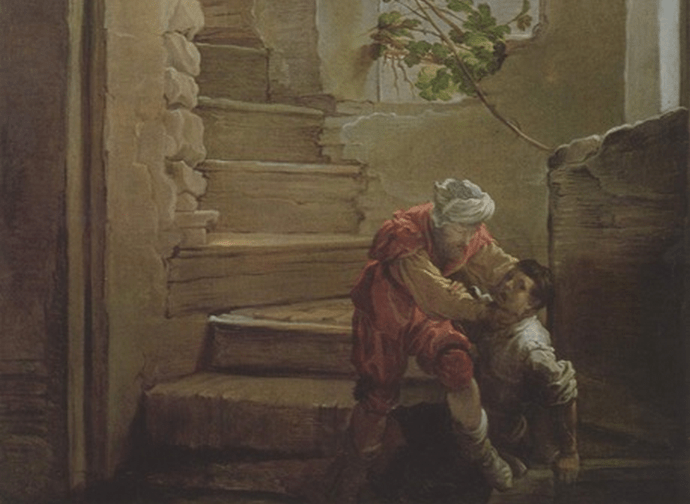
Painting entitled ‘il Mantovano’ by Domenico Fetti

            Unfortunately the forgiven debtor did not show the same mercy and compassion afforded him when he demanded payment from one who owed him money, a very small amount at that. When the king discovered the forgiven debtor’s actions he was angry and handed him over to the jailers. Although his debt was already paid, the king put him in the hands of the jailers to suffer severe discipline until he was willing to forgive others.

            Jesus paid the ultimate price for our salvation. When we, as Christians, consider the forgiveness shown to us by our Lord, how is it possible that we find it hard to forgive others? Let not our ingratitude come to the surface by not forgiving fellow believers for the little debt against us in relation to our great debt we have been forgiven by the Lord. Let us forgive each other as God forgave us.  

Read the Parable of the Unmerciful Servant: https://www.biblegateway.com/passage/?search=Matthew%2018%3A21-35&version=NIV

Bible Studies

The Lord’s Prayer, Jesus’s teaching on Prayer – 6 “Deliver us from evil”

“And lead us not into temptation, but deliver us from evil.” Matthew 6:13 KJV

            Our Lord’s final example in praying is often misunderstood by many. When Jesus taught His disciples to pray ‘And lead us not into temptation,’ He was not referring to being tempted to sin by God. God does not tempt anyone to sin. The book of James says, “Let no one say when he is tempted, ‘I am being tempted by God,’ for God cannot be tempted with evil, and he himself tempts no one.” (Ja. 1:13) The word ‘temptation’ is better translated ‘a trying, or testing,’ and there are several examples of testing in the Bible. Our Lord Jesus Himself was tested (tempted) by Satan in the wilderness, Abraham was tested by God when told to offer his son as a sacrifice, and Job was severely tested when accused by Satan.

            There are occasions when God will test us, or ‘put us to the test’ to test our faith in Him. There may be trials brought upon us by Satan permitted by God in order to prove and test our faith as in the case of Job and the apostle Paul. When we pray, ‘lead us not into temptation’ we are actually praying ‘don’t put us to the test, protect us from the test, and from Satan, the evil one.’ Our Lord does not lead us into any testing or trial in which He is not there and has not made a way of escape for us to bear it. Paul writing to the church in Corinth says, “No temptation has overtaken you that is not common to man. God is faithful, and he will not let you be tempted beyond your ability, but with the temptation he will also provide the way of escape, that you may be able to endure it.” (1 Cor. 10:13)

            Jesus teaches after praying not to be put to the test, we are to ask to be delivered from evil. This is not evil in general but from the evil one, Satan. Many versions of Scripture do reference it as the ‘evil one.’ We are to pray to be delivered from Satan’s schemes, his temptations, and his accusations against us.

            It is important to note that not all temptations (testing), trials or troubles are evil in and of itself. It was noted Jesus Himself was tempted by Satan. Our Lord passed the test and is our example in our troubled times. Abraham and Job also passed the test and were blessed for it. But when Paul asked the Lord to remove the thorn in the flesh from Satan three times, the Lord did not, but said, ’My grace is sufficient for you, for my power is made perfect in weakness.’ And Paul responded ‘Therefore I will boast all the more gladly of my weaknesses, so that the power of Christ may rest upon me.’ (2 Cor. 12:9) Paul also passed the test and serves as an example for us to follow.

            We are to pray that we be delivered from Satan’s evil temptations and not fall into sin. Jesus prayed for His disciples in His High Priestly prayer in John 17:15, “I do not ask that you take them out of the world, but that you keep them from the evil one.” A. W. Pink is quoted as saying, “To be kept from the evil of sin is a far greater mercy than deliverance from the trouble of temptation.” We may pray not to be put to the test, but the more concerning prayer is ‘deliver us from evil,’ Satan, the evil one.

Bible Studies

The Lord’s Prayer, Jesus’s teaching on Prayer – 5 “Forgiveness”

“and forgive us our sins, as we have forgiven those who sin against us.” Matthew 6:12 NLT

            Over the centurie the Bible has been translated from the original manuscripts into many different languages and it is still on-going. We also have several different versions of scripture available to us. According to the Wycliffe Global Alliance, Bible translation is currently happening in 2,846 languages in 157 countries, and there are yet 964 languages in which there are no translations, but the work has started. I open with this to remind us that whichever language text you may be reading, it may vary depending on the version it was translated from. One such example is the fifth petition in the Lord’s Prayer as taught to us by Jesus. Most versions say, ‘forgive us our debts,’ some say ‘forgive us our sins,’ and some traditional Church readings render ‘forgive us our trespasses.’ It is always most important to know the original meaning of certain words in order to apply them correctly to our lives.

            The word translated ‘debt’ in the original Greek is ‘opheilēma’ and means that which is owed, legally due, or a debt. Its secondary meaning is an offence or sin. It is easy to see why ‘debt’ is used in most versions. But a closer look considering the context and how it relates to the whole of scripture, we take note that ‘sin’ is also an appropriate translation and more to the point.

            Jesus instructs to confess our sins to God our Father and ask forgiveness as we have also forgiven those who sinned against us. What Jesus is saying is forgiveness leads to forgiveness. It’s important to note Jesus doesn’t say we ‘should’ forgive others, but that we ‘will’ forgive others. We will forgive others in response to our Father’s forgiveness of our sin when we accepted His Son Jesus as our Savior. Jesus went to the cross and bore the guilt and punishment for our sins which we could never pay. It is a debt none of us could pay. God the Father forgave our debt, he forgave our sin.

            In the fourth petition of the Lord’s Prayer Jesus teaches us to ask for our daily bread, food substances and our material needs. It is only logical Jesus now addresses our daily spiritual need of forgiveness. We have been forgiven an enormous debt and given salvation and eternal life through Jesus, however we are still fallen creatures in our sin nature who still sin daily. As we ask God daily to forgive us of our sin, we are reminded that we are pardoned sinners, and as pardoned sinners we should forgive as we have been forgiven.

            “Be kind and compassionate to one another, forgiving each other, just as in Christ God forgave you.” (Eph. 4:32 NIV)

Bible Studies

The Lord’s Prayer, Jesus’s teaching on Prayer – 4 “Our Daily Bread”

“Give us this day our daily bread.” Matthew 6:11

            The first three petitions Jesus taught His disciples to pray had an upward focus to God, His glory, His kingdom, and His will. Jesus now instructs them to ask God to care for their needs in the next four petitions. Early eighteenth century Theologian Matthew Henry, concerning our need for daily bread, writes the following, “Because our natural being is necessary to our spiritual well-being in this world…… we pray for the necessary supports and comforts of this present life, which are the gifts of God, and must be asked of him, for all the remainder of our lives.” Henry notes that it is needed daily, for it is on-going for the rest of our lives.

            The Greek word translated ‘daily’ is ‘epiousios’ which carries the meaning ‘the bread of necessity’ and ‘the bread that suffices for each day.’ It is what is needed every day to an exact amount, not too little and not too much. In Jesus’s day and in ours today, bread is a staple food item. Fresh baked bread with no preservatives will last about only one day. That was true in Jesus’s day and His point was well understood, it had to be supplied daily. We ask the Lord to meet our need daily need being careful not to ask for excess. Our Lord will supply all we need, not all we want or desire.

            Asking God to give us our daily bread does not only pertain to food in sustaining us. The daily bread we need also consists of all our daily needs to make it through this life as we serve Him. We need clothes on our backs, a place to call home, repairs to our home, transportation, viable employment, health, strength, and other physical needs. In a sense, when we pray for our daily bread, we are also praying for all that encompasses our survival now and in the future. God knows our future and He knows what our need will be before we will. (Mt. 6:8) Our complete trust in God to provide for us is built on the foundation of our faith in Him by praying to provide for our daily needs right into the future.

            Matthew Henry gives us six lessons to learn from the simple petition ‘Give us this day our daily bread.’ Adapted from the king’s English centuries ago for better understanding; First it teaches us self-restraint, to do things in moderation, and not be given to indulgence of appetite. Second, we are taught honesty and hard work through the vocation God has given us to meet our needs. Third, it teaches us not to be concerned about tomorrow, but to have continued faith in God that He will care for His children. Fourth, we ask God to give it to us, not sell it or lend it to us, but to give it. This teaches us to see the mercy of God in caring for us. Fifth, not to us only, but to others of like faith, we pray for their needs as well. Christians are to pray and fellowship together, and through this a heart of love and compassion will develop for those less fortunate. In this the Lord will use us to meet their need. And lastly, it teaches us to increase our desire towards God. As we hunger and anticipate the bread to feed us physically, our hunger to meet with God spiritually will also increase. “Give us this day our daily bread.”

Bible Studies

The Lord’s Prayer, Jesus’s teaching on prayer – 3 “Thy Name, Thy Kingdom, Thy Will”

“Hallowed be thy name. Thy kingdom come. Thy will be done in earth, as it is in heaven.”

            The Lord’s Prayer is a simple model Jesus taught His disciples when they asked Him to teach them to pray. It begins with an upward focus to the God of heaven, His glory and His will leading to the human needs of each of us. Jesus’s main focus, also His priority in prayer, is the exaltation of God. The first petition He taught His disciples to pray is ‘Hallowed be thy name.’ It may be translated as ‘holy’ be thy name. God’s name is to be treated with reverence for it is holy. This should make us aware as we approach God in our failed human state that we are about to converse with a holy God. It is our place to begin our prayer by treating His name as holy, ‘hallowed be thy name.’ It was Jesus’s first petition in His prayers and should be ours as well.

            The second and third petitions flow together with the first exalting God the Father. In all that we do, Christians are to do everything for the glory of God including our prayers. Our prayers should reflect the desire for glorifying God by honoring Him and praying for His kingdom to be established and His will be done in all things. This brings glory to God as we pray in agreement that God’s will and His kingdom will all come about according to His plans established before the foundations of the world.

            We may ask, why then should we pray? If God’s plans for His kingdom and His will are already determined, then why pray? Note the following reason on why we should pray; Prayer is not only about asking for things from God, although that is certainly an important part of prayer, but more importantly it is a time of meeting with God, your creator. It is a time to sit with Him and seek to know Him better. We need again to remember ‘who God is’ and ‘who we are’ and that the God of the universe wants to have a relationship with us. He has reached out to make that happen, for we would not do that on our own. Therefore He deserves our praise and reverence exalting His name as we sit in prayer with Him. Modern day theologian R. C. Sproul notes when asked ‘Does our prayer change God’s mind? No, prayer changes us’ and that is the basis of prayer, to know God and to be changed by Him.

            The Messianic Kingdom will indeed become a reality one day in the future. The Lord Jesus will rule from Jerusalem over the entire earth for 1,000 years. But currently this world is under the rule of Satan and his demons. Paul writing in Ephesians says the following, “For we are not fighting against flesh-and-blood enemies, but against evil rulers and authorities of the unseen world, against mighty powers in this dark world, and against evil spirits in the heavenly places.”(Eph. 6:12 NLT) Therefore as Christians we desire to see the Kingdom of God in its fullness come quickly. Until then we pray ‘hallowed be thy name, thy kingdom come,’ and for God’s will for us to be completely known that we obey His will ‘in earth as it is in heaven.’  

Bible Studies

The Lord’s Prayer, Jesus’s teaching on Prayer – 2 “Our Father”

“For all who are led by the Spirit of God are children of God. So you have not received a spirit that makes you fearful slaves. Instead, you received God’s Spirit when he adopted you as his own children. Now we call him, ‘Abba, Father.’ For his Spirit joins with our spirit to affirm that we are God’s children.” Romans 8:14-16 NLT

            The first and most important step in prayer Jesus teaches us is the address, “Our Father.” Equally important is who is able to address God as “Our Father.” There is a misconception that was brought about in the late 19th and early 20th centuries through a book by German Theologian and church historian, Adolf von Harnack, entitled ‘What is Christianity?’ His thesis was the doctrine of Christianity can be reduced to two propositions; ‘The Universal Fatherhood of God’ and ‘The Universal Brotherhood of Man.’ Simply stated, since God created man, then all are God’s children, and all are brothers and sisters. But careful study of scripture does not reveal such a hypothesis. It is true in the sense of creation, God has created all of mankind. Each one of us has God as their creator.

            The term “Our Father” is not an address seen in the Old Testament, but has significate meaning in the New Testament. It is the reality of adoption into the family of God, becoming a child of God through faith in Jesus Christ, God the Son. Scripture says, “But to all who believed him and accepted him, he gave the right to become children of God.” (Jn. 1:12) Having that right to become children of God, Christians have the right to claim God as their Father and the right to address Him properly as “Our Father.” Those who have not trusted in Jesus’s death, burial, and resurrection for the remission of sins and have not accepted Him as Savior have no valid reason to address God as Father.   

             The Lord’s Prayer is recited mostly every Sunday in churches around the world depending on the denominations and style of worship. If your church is one of many who pray the Lord’s Prayer, are you able to truly address God as “Our Father” with those in the family of God with whom you are worshiping. God desires for you to address Him properly as His child, and you can make that happen. As Paul writes in Romans chapter 8, “For all who are led by the Spirit of God are children of God. So you have not received a spirit that makes you fearful slaves. Instead, you received God’s Spirit when he adopted you as his own children. Now we call him, ‘Abba, Father.’ For his Spirit joins with our spirit to affirm that we are God’s children.”

            If you repent of your sins and accept Jesus Christ as your Savoir as the only way of salvation, you will be saved and will be able to say along with your brothers and sisters in the family of God, “Our Father which art in heaven, Hallowed be thy name. Thy kingdom come. Thy will be done in earth, as it is in heaven. Give us this day our daily bread. And forgive us our debts, as we forgive our debtors. And lead us not into temptation, but deliver us from evil.”

Bible Studies

The Lord’s Prayer, Jesus’s teaching on Prayer – 1 “How to Pray”

“Our Father which art in heaven, Hallowed be thy name. Thy kingdom come. Thy will be done in earth, as it is in heaven. Give us this day our daily bread. And forgive us our debts, as we forgive our debtors. And lead us not into temptation, but deliver us from evil.” KJV

            There are many prayers recorded in the pages of scripture. Without a doubt, the most familiar prayer is the Lord’s Prayer found in the gospels of Matthew and Luke.  It is a model prayer Jesus taught His disciples when they asked Him to teach them how to pray. The disciples evidently saw something in Jesus concerning His prayer life. He would leave them for hours spending time with His Father in prayer. They realized the importance of prayer even as John the Baptist taught his disciples to pray and now they were witnessing Jesus’s prayer habits. It was a marked influence on them, for they did not ask Him to teach them to perform miracles or anything else spectacular, but they asked Him; teach us to pray.

            In Matthew’s recording of the Lord’s Prayer notice Jesus began His teaching with how not to pray. There are many bad examples in how not to pray. The key point to remember is the Lord’s Prayer is an example to follow in praying, and it is a good one. Jesus instructs His disciples and us. “When you pray, don’t be like the hypocrites who love to pray publicly on street corners and in the synagogues where everyone can see them.” (Mt. 6:5a NLT) Praying is not a spectator sport to show others how holy you are. Jesus also said, “When you pray, don’t babble on and on as people of other religions do. They think their prayers are answered merely by repeating their words again and again.” (Mt. 6:7 NLT) This is not a condemnation towards long prayers, but of excess meaningless verbiage just to be heard. Repetition is not a bad thing when in earnest prayer, and crying out to God concerning your sorrow and needs. We need to take comfort that God knows exactly what we need. Jesus says, “Don’t be like them, for your Father knows exactly what you need even before you ask him!” (Mt. 6:8 NLT) Daniel Henderson in his book ‘Transforming Prayer’ writes the following, “Our Father is completely dialed-in and capable. He is all-knowing and sovereign. He does not need the persuasion of our words or vigorous religious performances in order to know and meet our needs.”

            Jesus’s instructions on how to pray begin with, “But when you pray, go away by yourself, shut the door behind you, and pray to your Father in private.” (Mt. 6:6a NLT) This is a reminder that God looks on the heart and not outward appearance. He will meet with us in private and not in the public square. This is not a prohibition against public prayer. Jesus Himself prayed publicly and corporate prayer within the church is vital to its existence. “Private praying is the finest training ground for public prayer.” (Wycliffe Bible Commentary)

            As we move forward in the coming weeks being taught by Jesus how to pray may we heed the two rules of prayer by R.C. Sproul, “Remember to whom you are speaking, and remember who is doing the speaking.”