What is it that’s in your heart, I mean constantly? What do you have endless thoughts about. It could be a good thing or a bad thing. Solomon tells us what’s in our heart controls everything we do. What we think about in our mind sinks into our heart and flows out by how we live our lives. Solmon tells us above everything else we do to guard our hearts. It will determine the direction our lives take.
This is like what the apostle Paul wrote to the church a Galatia. “Do not be deceived: God cannot be mocked. A man reaps what he sows. Whoever sows to please their flesh, from the flesh will reap destruction; whoever sows to please the Spirit, from the Spirit will reap eternal life.” (Gal.6:7-8 niv) If our minds are constantly on the things of God our hearts will desire to please Him in all we do. We will be sowing unto righteousness, realizing our need for salvation and accepting Christ as our savior and we will reap eternal life.
It is a sure thing we will reap what we sow. With the spring planting season upon us, if you plant tomatoes in your garden you’ll get tomatoes, not corn and vice versa. Whether we sow seeds in our mind to please ourselves or to please God they will make their way down to heart and grow as we continually nurture them by our hearts desire through our actions. At the end of the season, the fruit will be evident. Everything we do will be the result of what is in our heart. So, what is it that’s in your heart. It’s not too late to dig up those seeds of destruction and plant seeds of righteousness, the things of God. I urge you, ‘Above all else, guard your heart.’
“Jesus and his disciples left Galilee and went up to the villages near Caesarea Philippi. As they were walking along, he asked them, ‘Who do people say I am?’ ‘Well,’ they replied, ‘some say John the Baptist, some say Elijah, and others say you are one of the other prophets.’ Then he asked them, ‘But who do you say I am?’” Mark 8:27-29 NLT
FreeBibleimages.org
We ended last week’s Biblical Insights with Jesus on another trip across the Sea of Galilee, and once again teaching the disciples what they didn’t get the first time. From this point on, Jesus’ teaching will be direct and plainly spoken not speaking in parables or using comparison examples. The disciples will be given a clearer understanding of Jesus’ teaching but will still have some trouble as we will see.
Jesus and His disciples arrived at Bethsaida, a fishing town and home to Peter, Andrew, and Philip. Soon after arriving some people brought a blind man to Jesus begging to heal him. Once again Jesus led him out of town not to draw attention to the miracle He was about to perform. The Bible says Jesus spit on the man’s eyes and laid His hands on him asking, ‘Can you see anything now?’ The man responded he could, but not clearly for the people he saw looked like trees. “Then Jesus placed his hands on the man’s eyes again, and his eyes were opened. His sight was completely restored, and he could see everything clearly.” (Mk.8:25 nlt) This was gradual healing. Sceptics may say Jesus failed the first time, or didn’t quite have it that day. But it was his method in this case. Jesus healed a blind man once again. Jesus then told the man to return to his home and not go back into the town.
Jesus then left Galilee with His disciples for Caesarea Philippi, twenty-five miles to the north, a town at the foot of Mount Hermon. Along the way Jesus asked, ‘Who do people say I am?’ The disciples said some say Jesus was John the Baptist, or Elijah, and others said He was one of the prophets of old who had come back. Jesus then asked them who do they say He is. At this point, Jesus was more concerned what His disciples believed than the public. Peter answered for the group by saying, ‘You are the Messiah’ (or Christ). This is the first time ‘Christ’ is used in the book of Mark, and it marks a turning point in Jesus’ ministry. Jesus hardly used the name ‘Christ’ in reference to Himself due to the association with the political and national interests at the time. But He will now teach His disciples the mission of the Messiah, the anointed one, the Christ. Jesus will begin to tell of His forthcoming suffering, His death, and His resurrection as they travel down to Jerusalem.
FreeBibleimages.org
Jesus did warn His disciples not to tell anyone He was the Messiah as He told those that He healed not say anything to not attract a crowd. But in this case, it was more than that, Jesus did not want the political nature of the promised Messiah to take away from His true mission. The Christ will establish an earthly kingdom and rule from Jerusalem, but that time is not now. Jesus’ mission can only be understood through the cross, something His disciples did not yet fully understand, as we will see. Jesus now begins to explain the true meaning of the ‘Christ’ and His mission.
“Then Jesus began to tell them that the Son of Man must suffer many terrible things and be rejected by the elders, the leading priests, and the teachers of religious law. He would be killed, but three days later he would rise from the dead.” (Mk.8:31 nlt) This is another first. Jesus is predicting His suffering, death, and resurrection for the first time and he is speaking clearly. He is speaking it as a matter of fact using the word ‘must.’ These things ‘must’ happen. They were prophesied in the Old Testament and must take place as part of God’s plan of salvation for sinners. The Messiah will suffer and die on a cross for sinners but will be raised to life defeating death and guaranteeing eternal life for all who believe in Him.
But again, we see, the disciples fell short, well at least Peter did, by reprimanding Jesus that this would never happen on his watch. To be fair, Peter didn’t get it, but his reaction does show his deep love he had for Jesus. What is so damaging in Peter’s actions is his thinking being contrary to God’s plan. Peter could not visualize His Messiah dying on a cross, and in attempting to persuade Jesus away from the cross is line with Satan’s past attempts. This explains Jesus’ words to Peter, ‘“Get away from me, Satan!’ he said. ‘You are seeing things merely from a human point of view, not from God’s.’” (Mk.8:33 nlt)
“Then, calling the crowd to join his disciples, he said, ‘If any of you wants to be my follower, you must turn from your selfish ways, take up your cross, and follow me.’” (Mk.8:34 nlt) Jesus explains the criteria for following Him. It really comes down to this in simple terms, anyone unwilling to deny himself can’t be a true follower of Jesus. To take up your cross is a willingness to suffer and die for Christ. A man who was already condemned to death was forced to carry his cross. When Jesus says, ‘follow me’ He is indicating ‘in His death.’ Tough words. Jesus says in trying to hang on to your life, you will lose it. The Wycliffe Bible Commentary notes, the person so focus on the protection of this life will miss the second. You can save your physical life by denying Christ, but eternal life will be lost.
Jesus then asks a question to all those around Him, “And what do you benefit if you gain the whole world but lose your own soul? Is anything worth more than your soul?” (Mk.8:36-37 nlt) No monetary value can be placed on one’s soul. Acquiring all the wealth the world has to offer and achieving success beyond measure cannot match the value of a soul. The soul is the real you! Don’t lose it to the influences of this world. In closing Jesus predicts His coming back again. He notes, those who care more for this present generation by denying Him will find no place in the kingdom of God upon His return. “If anyone is ashamed of me and my message in these adulterous and sinful days, the Son of Man will be ashamed of that person when he returns in the glory of his Father with the holy angels.” (Mk.8:38 nlt) So, we all need to answer Jesus’ question. ‘But who do you say I am?’
“The answer every person gives to this question will determine his or her eternal destiny.” John MacArthur
I enjoy sitting on our front porch during a late afternoon summer thunder and lightening storm. Yes, I know it’s not the safest thing to do, but it doesn’t stop me. Witnessing God’s all-powerful force in nature He created is fascinating. His hand is the storm from the dark clouds forming in the west making its way east as I watch the radar on my phone seeing it making its approach. Soon I’m able to feel the wind and hear the thunder in the background. It won’t be long until our neighborhood experiences God’s tremendous power.
The children of Israel stood on the banks of the Red Sea with an approaching storm about to come upon them, the army of Pharoah’s soldiers and chariots. After freeing the Israelites, Pharoah had a change of heart and had his army pursue them. With their backs against the wall at the Red Sea, the children of Israel saw a much more powerful storm on the horizon, the power of the living God. The Bible says, “Then Moses raised his hand over the sea, and the LORD opened up a path through the water with a strong east wind. The wind blew all that night, turning the seabed into dry land.” (Ex.14:21 nlt) All of Israel had a front row seat for that incredible experience. A storm with winds so powerful that it blew back the water in the middle of the sea and created a clear dry path for them to escape the Egyptian army. “When the Red Sea saw you, O God, its waters looked and trembled! The sea quaked to its very depths.” (Ps.77:16 nlt)
The Lord’s power is unmeasurable. The most violate storm we will ever see or go through is nothing compared to His ultimate power. Sometimes we need to sit through an afternoon thunderstorm to remember we serve an awesome and powerful God.
“As Gabriel approached the place where I was standing, I became so terrified that I fell with my face to the ground……While he was speaking, I fainted and lay there with my face to the ground. But Gabriel roused me with a touch and helped me to my feet.” Daniel 8:17-18 NLT
Photo AI Generated wordpress
When you think of angels, what is the first thing that comes to your mind? Is it ‘fear’? Most of us would say no. How about ‘terrified’? No, again. Would you faint at their voice? Probably not. But the prophet Daniel experienced all three all three of these as the angel Gabriel approached him to give the interpretation his vision concerning future events. The fact that Daniel in his righteous and moral character would react this way in seeing one of God’s angels emphasizes the deep chasm between earthly beings and the holy beings of heaven.
The magnificent splendor of these heavenly beings and the reaction from earthly creatures when they meet are noted in Scripture. Zechariah, the priest, encounter the angel Gabriel one day in the Temple as he was serving before the Lord and Scripture says he was shaken and overwhelmed with fear. (Lk.1:12) Gabriel told Mary not to be afraid when he appeared before her to announce Jesus’ birth. (Lk.1:30) When Jesus was born, an angel of the Lord brought the good news first to the shepherds, and they too were terrified. “Suddenly, an angel of the Lord appeared among them, and the radiance of the Lord’s glory surrounded them. They were terrified.” (Lk.2:9 nlt)
Not all appearances of angels in Scripture are met by fear, but their presence does emphasize the divide between heaven and earth. Holy beings of heaven separate from the world who stand before a holy God bring just a portion of His radiance on this earth. One day all of us who have accepted Christ as savior will experience that radiance for eternity with the angels.
“We demolish arguments and every pretension that sets itself up against the knowledge of God, and we take captive every thought to make it obedient to Christ.” 2 Corinthians 10:5 NIV
When it comes to spiritual matters and the things of God, the world has its endless thoughts on the truth of the matter. The world will inform us what is and what is not truth, or it will tell us it’s inside us and we will discover it by searching within ourselves. Just be yourself and love yourself. Then there are so called minsters of the gospel preaching a feel-good message of positivity and good works. The apostle Paul needed to defend his ministry against some of the same things we witness in our world today. False prophets were doing their work during Paul’s day as in ours. Paul, himself, was accused of being a false prophet and only in it for money. The thoughts about God in the world are many, and all are against the truth and His salvation message.
Paul was unrelenting in the defense of his ministry and the gospel. He stated, “We demolish arguments and every pretension that sets itself up against the knowledge of God, and we take captive every thought to make it obedient to Christ.” (2Cor.10:5 niv) Anything that slightly resembled an alternative view of the gospel pitting itself against the Lord God, Paul demolished those arguments. They cannot be allowed to stand. Paul knew those distorted thoughts about God lead to confusion and heartache. That is why he took every one of those thoughts and conformed them to Christ.
Christians today need to rally behind Paul’s example of boldness in demolishing the false narratives of God in our culture. Sitting silent on the sidelines while the world is scoring points does not advance the kingdom of God. The Lord has given us all we need to inform the world of the truth, His Word, the Bible. It’s time we use it boldly to explain the truth about God.
“How then shall they call on Him in whom they have not believed? And how shall they believe in Him of whom they have not heard? And how shall they hear without a preacher?” Romans 10:14 NKJV
The Christian church has local congregations of all sizes. We have mega churches with thousands of members within their building and satellite locations. Mid-size churches with a few hundred people seems to be norm, at least in the United States. Then you have very small congregations with a hundred people or less. Whatever the size of the church, most pastors take on more responsibilities than are necessary but try to tell them that! Their efforts are commendable, and we appreciate their service, but there are times when we, the congregates, need to step up mostly in some of our smaller churches. You may have heard it said, the pastor can’t do everything. That’s true, he can’t.
One main area a pastor needs our help is presenting the gospel message to others. You are probably thinking, ‘well isn’t that his job.’ Well, yes, it is, but it is also our job. We’re fed the word of God each week through sound teaching to equip us to go out and do the Lord’s work. A major part of that work is to tell others about Jesus Christ. Paul, writing in Romans, is explaining the very important and simple way of salvation, “For Everyone who calls on the name of the LORD will be saved.” (Ro.10:13 nlt) but then he adds, “But how can they call on him to save them unless they believe in him? And how can they believe in him if they have never heard about him?” (Ro.10:14 nlt) So, how are they going to hear about the one who is offering salvation? They need a preacher, not ‘the preacher,’ as in a better translation, “And how can they hear about him unless someone tells them?” (Ro.10:14b nlt) That someone is you and me, along with our pastor.
No, the pastor can’t do everything. So, may we be willing, energetic, and enthusiastic in sharing the gospel with others. Then let us help him set up the tables and chairs for the family fellowship and maybe mow the lawn.
To procrastinate is to put off doing something until later. Unless it’s for a good reason, procrastination could be disastrous even deadly. When knowing there is a need and we do not respond looking out for our interests first, a callous attitude towards others and the things of God will quickly develop. We’ll start making excuses and getting very astute in them. Soon it becomes all about us and only if we have time then we will help others and seek what God has for us to do for Him.
The returning exiles in Judah had gone back to their land after seventy years of captivity and were to rebuild the Temple in Jerusalem. They encountered some push back from people who had settled in the land and soon the work stopped. Over time the work of rebuilding God’s Temple was no longer important to them, but building their own homes and neighborhoods were. People started saying that it wasn’t time yet to get back to work. Perhaps the hostilities were still there, or we still have work to do securing our homes and farmland, or the economy may not be strong enough to support the effort, were likely excuses to procrastinate. The actual reason was they were selfish and did not care about the things of God.
As Christians when a need arises that the Lord God is directing our hands to the work, may we not procrastinate and say ‘it’s not time yet’ for I have things to do first. God knows our responsibilities and He will not direct us to a work we have no time for or incapable to perform. When the Lord calls, it is always time.
The prophet Ezekiel prophesied to the exiled Jews who were in Babylon before the destruction of Jerusalem. Ezekiel himself was taken captive in the second invasion by Nebuchadnezzar in 597 B.C… His message was ‘repentance is the way to life.’ Ezekiel prophesied the future destruction of the Temple in Jerusalem was coming. Those who were already in exile would not be going back anytime soon and others would be joining them after the third invasion of Judah. So, Ezekiel’s message was to repent.
Ezekiel relayed the Lord’s message of judgment upon them for their past sins, urging them to repent as they are already in exile. “Cast away from you all your transgressions which you have committed and make yourselves a new heart and a new spirit! For why will you die, O house of Israel?” (Ez.18:31 nasb) The Lord God did not want any individual of the house of Israel to die in their sins, but to repent and get a new heart.
The Lord God does not want anyone alive today to die in their sins, that includes you and me. The Lord says He takes no pleasure in the death of anyone who dies. Here, He is referring to those dying without receiving forgiveness for their sins. Therefore, God is telling us as He told Israel, ‘Repent and live.’ To repent and live means to give up your old way of living which may lead to an early physical death, and more importantly to save you from eternal punishment to eternal life. “The Lord is not slow about His promise, as some count slowness, but is patient toward you, not wishing for any to perish but for all to come to repentance.” (2Pt.3:9 nasb) Yes, repentance is the way to life!
“As they were crossing the lake, Jesus warned them, ‘Watch out! Beware of the yeast of the Pharisees and of Herod.’” Mark 8:15 NLT
FreeBibleimages.org
Continuing with our series in the book of Mark on Sunday’s Biblical Insights this week we see Jesus on the move again. After miraculously feeding another large crowd of almost 16,000 with seven loaves of bread and a few fish, Jesus leaves the Decapolis region and heading back across the sea to the region of Dalmanutha.
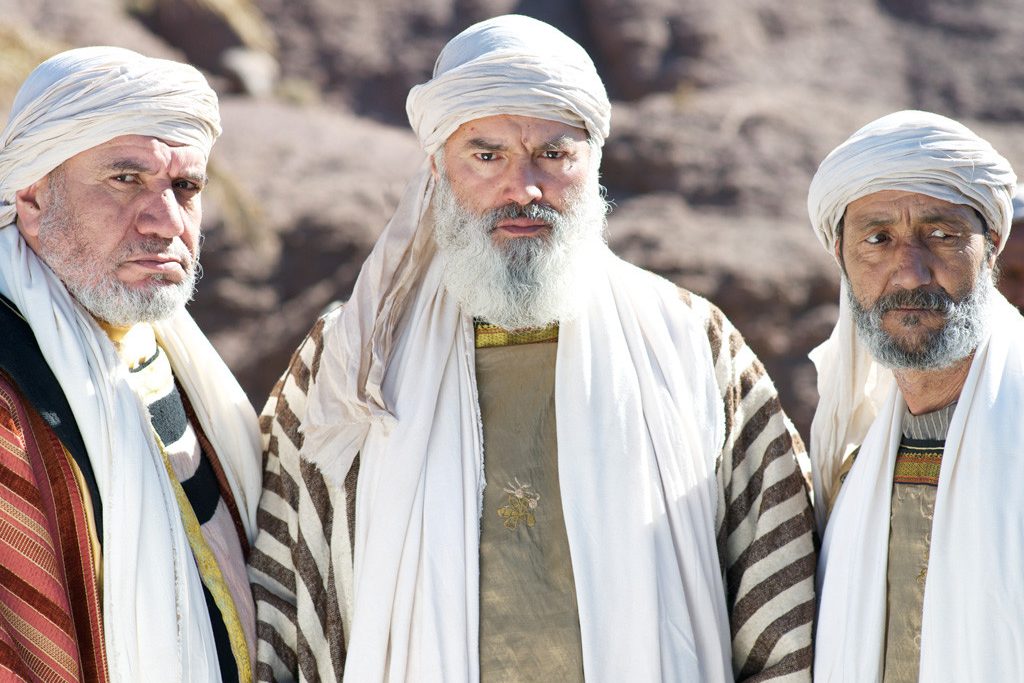
Once again people are waiting for His arrival. This time it is the Pharisees who have not given up questioning Jesus but continue to harass Him demanding proof of His deity. They were demanding Jesus show them a sign to prove the divine authority He is claiming. The Pharisees have seen His previous miracles but wanted more. They were looking for a convincing celestial event to prove His power over the heavens and the earth. When Jesus heard this, he sighed deeply. Last week we noted Jesus’ compassion by sighing at the healing of the deaf and mute man, this week He sighs in grief for their refusal to believe. Jesus refused to give in to their demand knowing that the Pharisees really didn’t believe He could perform such a miracle. Their intent was to keep on trying to discredit Jesus and deflate His popularity.
FreeBibleimages.org
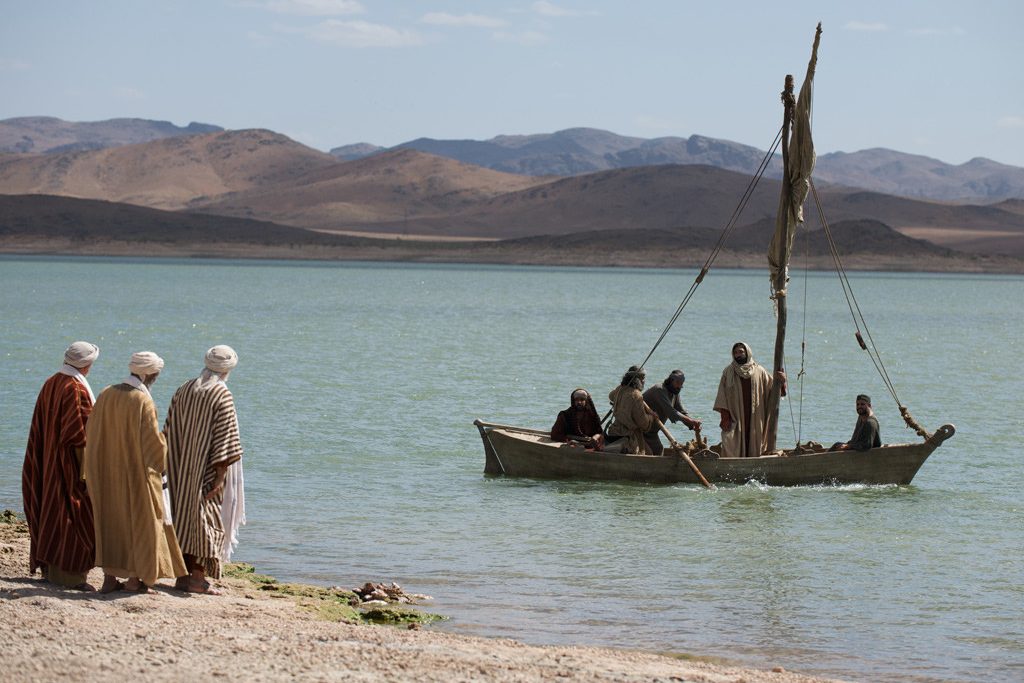
Jesus left Dalmanutha after this confrontation with the Pharisees. “So he got back into the boat and left them, and he crossed to the other side of the lake” (Mk,8:13 nlt) Jesus went back to the eastern side of the Sea of Galilee arriving at the fishing town of Bethsaida on the northern shore, the home to Peter, Philip, and Andrew. During the trip Jesus’ disciples were taught an important truth, although they were unaware of it at the time. ‘Beware of Persuasive Influences of Sin.’ “As they were crossing the lake, Jesus warned them, ‘Watch out! Beware of the yeast of the Pharisees and of Herod.’” (Mk.8:15 nlt) The disciples’ minds instantly went to the fact they forgot to take food along for the trip. Whether they thought Jesus was referring to this or something else is not clear, but “At this they began to argue with each other because they hadn’t brought any bread.” (Mk.8:16 nlt) How often we’re quick to jump to conclusions thinking we know why something is occurring. It’s usually not the case, just our minds feeding our self-serving attitude. These were the disciples on the boat that day.
What Jesus told His disciples went right over their heads. Jesus was referring to the yeast as a symbol of evil or corruption. A tiny amount of yeast can ferment a large amount of dough. A little yeast of sin in our lives will ferment into a large lump of uncontrollable sin leading to disaster. The Pharisees had the yeast of hypocrisy. This was seen by their earlier demand for Jesus to perform a sign when they didn’t believe He could perform one. Herod’s yeast was secularism and worldliness. A little influence in these areas is all that is needed to quickly rise the temptation of sin. This is what Jesus was telling His disciples back then and to us in our day. Beware of persuasive influences of sin.
Jesus knew the disciples didn’t get it and knew what they were arguing about. They were missing a vital spiritual point because they were focusing on their material needs, namely food. “Why are you arguing about having no bread? Don’t you know or understand even yet? Are your hearts too hard to take it in?……Don’t you remember anything at all?” (Mk.17-18 nlt) The disciples witnessed Jesus feeding 4,000 men plus women and children just days before and saw Him feed 5,000 men plus women and children before that, and yet they’re worried about what they will eat when the miracle worker is right in front of them. So concerned they were that they missed His important teaching about the influences of sin.
Christians today have the same problem of deciphering what to beware of in all the influences in our lives. Herod’s yeast of secularism is likely the most influential to beware of. Living in the world and not being part of the world is a daily struggle. It’s easy to succumb, that is why Jesus gave us the warning, beware. The Pharisees yeast of hypocrisy should not be dismissed as if it can’t be applied to us. It can. It’s too easy to say one thing and do another. We live in a world where it is very easy to be persuaded by all that is around us. We should not be naive in thinking we can always discern if the persuasive influences in our lives are of a sin nature or not without the help of the Holy Spirit. Jesus tells to beware, and He has sent His Holy Spirit to help us beware and live a life free from giving in to the persuasive influences of sin.
“Praise the Lord, who is my rock. He trains my hands for war and gives my fingers skill for battle.” Psalm 144:1 NLT
FreeBibleimages.org
The Bible contains a lot of tough verses we wrestle with. Several publications are offered with the sole purpose of answering questions and explaining these tough verses. Our key verse today is one tough verse. “Praise the Lord, who is my rock.” That’s not tough to comprehend, in fact it’s quite refreshing. What follows confuses us. Training for war? “He trains my hands for war and gives my fingers skill for battle.” (Ps.144:1 nlt) Many Christians have a passivist view of war for many reasons. I’m not going to stir the pot of debate on the world’s wars, but I am going to state that every Christian is in a war whether we agree with it or not. So, my question is, are you trained for war?
King David, the author of Psalm 144, was the king in the theocratic government of Israel. The Lord God empowered David to overcome his enemies, all who were against the God of heaven and His people. This was war against unholy idol worshipers with no regard for the true God and who continually fought against Israel. The Lord God thoroughly trained David in every way to fight against the enemies of the Lord. Ultimately David knew God was his rock and fortress. “He is my loving ally and my fortress, my tower of safety, my rescuer. He is my shield, and I take refuge in him. He makes the nations submit to me.” (Ps.144:2 nlt) But he was still trained to subdue the enemies of the Lord.
King David had the nations’ armies against him, and Christians today have Satan’s armies against us. The apostle Paul instructs us to put on the full armor of God to stand against the devil. (Eph.6:11-17) The one major difference here is we’re not to fight but be trained in putting on the armor. Once on, we stand! No matter your view on war, Christians are in a war as Paul states, “For we are not fighting against flesh-and-blood enemies, but against evil rulers and authorities of the unseen world, against mighty powers in this dark world, and against evil spirits in the heavenly places.” (Eph.6:12 nlt) Paul then tells us to ‘stand our ground.’ Having on the full armor of God we are now fully trained for war by standing firm.










 Word for the Soul