The Lord Jesus calls us His friends. If you have accepted Him as your Lord and savior you could not ask for a better, closer friend. Jesus gave His disciples an example of great love and true friendship when He said to them, “Greater love has no one than this, that someone lay down his life for his friends.” (Jn.15:13 esv) History has provided us with stories of people who have sacrificed their lives to save someone from harm or even death. We thank God for their selflessness and remember them for the true heroes they are. They were a true friend when a true friend was in need.
Jesus lived out that example of a true friend while He was on earth right up to the end of His earthly life. Jesus laid down His life for all of us He calls friends, all of us who are in desperate need of saving grace only He can provide by taking our punishment at the cross. No, we couldn’t ask for a better friend. Of all the friends we have in this world, none can compare with Jesus who saved us from eternal damnation and separation from Him and heaven forever. He can help us like no other friend is able with the problems and concerns we have in this world. Jesus is taking care of the here and now and has secured our eternal destiny for those who believe in Him. Jesus has taken care of everything for us. That’s what friends are for!
What a Friend we have in Jesus, All our sins and griefs to bear! What a privilege to carry Everything to God in prayer! O what peace we often forfeit, O what needless pain we bear, All because we do not carry Everything to God in prayer!
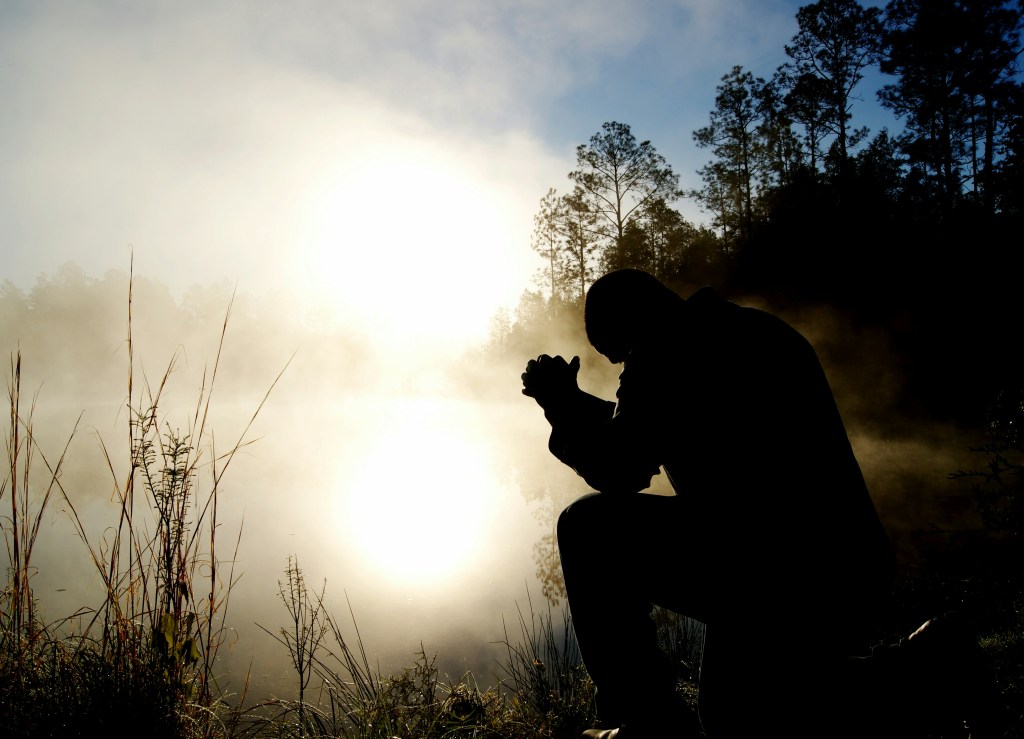
“But when Daniel learned that the law had been signed, he went home and knelt down as usual in his upstairs room, with its windows open toward Jerusalem.” Daniel 6:10 NLT
Christians struggle today as to when is it appropriate to disobey the government. What would be a legitimate reason to ignore certain laws and encourage others to do the same. I’m sorry, I’m not about to give you an approved list which enables you to defy the government, but I will give us all an example of what is right when the time is right.
The prophet Daniel lived his entire adult life in captivity. Captured as a teenager and brought to Babylon during the destruction of Jerusalem, Daniel proved to be an example of one who completely trusted and obeyed God whatever the circumstances. He never wavered, and the Lord used Daniel to work out and reveal His purposes. Now in his eighties, and still well respected by those who now held him captive, Daniel was about to put his faith and obedience on display.
Daniel was one of the top officials in the new kingdom of Medo-Persia serving Darius the king. Darius’ favoritism of his highly regarded official brough envy among his colleagues so much they concocted a plan to get rid of him. They convinced the king to sign a law stating that “for the next thirty days any person who prays to anyone, divine or human— (except Darius the king)—will be thrown into the den of lions.” (Dan.6:7 nlt) They knew Daniel would not comply, seeing him three times a day praying towards Jerusalem, they got him, well, sort of.
If you’re familiar with the story of ‘Daniel in the lions’ den’ you know it has a happy ending. Daniel knew that if he obeyed the king’s law, he would be disobeying God. So, he did what he always did, he reached out to God for help in his daily prayers. Daniel had no assurance that God would deliver him, but he knew that He could, and he was not going to disobey the Lord God who had blessed him all his life. Let the same be said of us.
“He said: ‘In my distress I called to the LORD, and he answered me. From deep in the realm of the dead I called for help, and you listened to my cry.’” Jonah 2:2 NIV
Photo by u041fu0430u0432u0435u043b u0413u0430u0432u0440u0438u043au043eu0432 on Pexels.com
A ‘distress call’, also known as a distress signal, is an internationally recognized call for help. The calls are communicated through radio signals over medium to high frequencies across land or sea. The signals alert emergency units that a watercraft, aircraft, or other vehicle is in imminent danger and in need of rescue. Other forms of distress signals include an emergency aerial or handheld flare, sending morse code S.O.S., showing flames on a vessel, a continuing sound of fog-signaling devices, and firing a gun at one-minute intervals. All are forms of communication with the sole purpose of crying out for help in a desperate situation.
The prophet Jonah sent out his own distress call from the belly of a great fish. He no doubt needed a rescue. Although he was in that desperate spot due to his own disobedience to God, he cried out to the only one who could save him. Jonah had a change of heart after God kept him alive after his attempt to take his own life by having his crew mates throw him overboard. Jonah refused to follow where God told him to go and what he was to do. In fact, he went in the opposite direction.
You may find yourself in a similar situation today. You’re not where God was leading you and told you go. You’ve been running in the opposite direction doing your own thing, and it’s not working out for you. You may not be far away from danger, or perhaps you are already there needing to send out that distress call. Jonah said the Lord listened to his cry; He will listen to yours. It’s never too late to turn around and go where God is calling you and do what He has planned for you. Don’t hesitate, send out that distress call!
“So Peter was kept in prison, but the church was earnestly praying to God for him….and when they opened the door and saw him, they were astonished.” Acts 12:5, 16 NIV
Have you ever experienced the resolution of a problem that occurred unexpectedly. It may have been a major concern you thought was not possible to resolve, or something minor that was just an annoyance. Then you come to realize and say to yourself, ‘Hey, I prayed about that!’ We pray about many things, and it seems that none of our prayers are being answered. Then out of the blue comes an answer to a prayer and we don’t realize it until later. It may have been a prayer we put on the burner, but God did not forget. He heard and answered. If we put our minds to it, there will be many answers to the prayers we made revealed to us. Yes, God did answer those prayers, and it could have been not in the way we desired. Perhaps that is why we forget, but He did answer.
The early church in the book of Acts had been praying for Peter who was in prison and about to be executed. King Herod was beginning to arrest Christians and had put the apostle James to death. When he saw his actions pleased the Jewish rulers, he preceded to arrest Peter also, planning to kill him after the Passover. When the people in the church heard of it, they immediately started praying earnestly for Peter’s release. Their prayers were answered. An angel of the Lord appeared before Peter waking him up, his chains fell off, and the angel led him out of the prison.
However, when Peter went to the home where the church people were praying and knocked on the door, they didn’t believe it was him, except for a servant girl named Rhoda. Finally, they were convinced after they were astonished that God answered their prayer. The Lord does what seems impossible. He answers quickly, as in Peter’s case. Sometimes He answers slowly as in our case, but He always answers. When we eventually do remember, let us rejoice, thanking Him for answering prayer and not forgetting.
“Then Daniel went home and told his friends Hananiah, Mishael, and Azariah what had happened. He urged them to ask the God of heaven to show them his mercy by telling them the secret.” Daniel 2:17-18a NLT
One of the blessings of belonging to a Church is the prayer support provided by the church family. Close Christian friends outside your church family are also a blessing with their prayers. Even those we don’t know but have received our requests for prayer from another source are God’s blessings to us in our time of need. Prayer to the Lord God is our only hope when we have an urgent need. What a comfort it is to be supported by prayer with our friends and church family.
Daniel had an urgent need. He had just returned from asking King Nebuchadnezzar for time to reveal the king’s dream. Daniel’s pagan counterparts failed the king by not being able to fulfill his request by telling him his dream. Nebuchadnezzar had ordered the death of all the wise men in his service, including Daniel, for their failure. Upon returning home, Daniel confided in his three best friends what had happened and what would happen if the king’s request was not fully answered. Daniel asked his prayer partners to support him in prayer.
Whatever our need, especially the urgent, may we not neglect to seek others for prayer. It doesn’t need to be a whole congregation; a few close friends will do. Jesus says, “For where two or three gather together as my followers, I am there among them.” (Mt.18:20 nlt) Daniel asked his three friends to support him in prayer, they prayed, and the Lord answered their request that night. May we not hold back in asking others God has placed in our lives to support us in prayer.
“Jesus and his companions went to the town of Capernaum. When the Sabbath day came, he went into the synagogue and began to teach. So he traveled throughout the region of Galilee, preaching in the synagogues and casting out demons.” Mark 1:21, 39 NLT
FreeBibleimages.org
The Good News of Jesus Christ is about to be told from Jesus Himself, for that is why he came. “We must go on to other towns as well, and I will preach to them, too. That is why I came. For even the Son of Man came not to be served but to serve others and to give his life as a ransom for many.” (Mk.1:38, 10:45 nlt) Jesus’ ministry is now in in full operation after His baptism, forty days in the wilderness being tempted by Satan, and choosing four fishermen to be His disciples. “Jesus and his companions went to the town of Capernaum. When the Sabbath day came, he went into the synagogue and began to teach.” (Mk.1:21 nlt)
Jesus begins His first of three tours through Galilee. The first stop Jesus made was to visit the local synagogue in Capernaum. It was where the Scriptures were read and studied, and God was worshiped. Jesus took advantage of the custom of having a visiting teacher speak and participate in teaching. As He began to speak, the people were amazed at His teaching compared to the local Rabbis. Jesus taught not as the other Rabbis who referred to and quoted previous Rabbinical teaching, but Jesus taught with authority, His own authority. It was not only His authoritative style, but the content of His teaching that impressed those in attendance. Jesus, the Son of God, certainly knew the Scriptures.
Satan and his demons also knew the Scriptures and who Jesus is as was evident by the demon-possessed man among them. “Suddenly, a man in the synagogue who was possessed by an evil spirit began shouting, ‘Why are you interfering with us, Jesus of Nazareth? Have you come to destroy us? I know who you are—the Holy One of God!’” (Mk.1:23-24 nlt) This demon-spirit knew Jesus was God the Son and was terrified at Jesus’ power. Jesus stopped the demon’s ranting immediately and ordered him to come out of the man. He didn’t want His identity known at this time. The demon left the man, and the people were yet in more amazement to what they just witnessed. They reasoned among themselves, ‘what kind of teaching is this, that even the demons obey Him?’ At this point, the news about Jesus spread quickly throughout Galilee.
Jesus’ act of confronting the evil spirit drew much attention which is now going to escalate even further as He is beginning to heal all those who are sick and diseased. Jesus begins by healing Simon’s mother-in-law after the meeting at the synagogue. Jesus and His disciples go to Simon’s and Andrew’s home. Finding Simon’s mother-in-law sick with a high fever, Jesus touched her, healing her. After sunset when the Sabbath was over many people from all over converged on Simon’s and Andrew’s home. “That evening after sunset, many sick and demon-possessed people were brought to Jesus. The whole town gathered at the door to watch.” (Mk.1:32-33 nlt) Jesus is ministering as He predicted, ‘the Son of Man came not to be served, but to serve.’
As is often the case today, we call upon Jesus to help us in our time of need. He will not deny our request but will hear us and answer in accordance with His will. How sad it is so many of us only call upon the Lord only in the case of an emergency. He is our Lord and savior when things are bad and when all is well. Jesus came to sacrifice His life to give us the ultimate healing, a soul set free, and eternal life with Him. He desires for us to have constant fellowship with Him throughout our lives here on earth and not wait until we’re with Him in glory.
Jesus valued His time in prayer with His heavenly Father. After a long day of teaching, healing, and casting out demons, Jesus rose early the next morning, probably between 3-4 am going to a secluded place to pray. It was where Jesus, the man, met His spiritual battles. Satan and his demons constantly opposed Jesus all throughout His ministry. It was also where Jesus prepared Himself with conversations with His Father for the day’s work in ministry. If Jesus needed to do this, do we have any excuse for not doing it? We need it a lot more.
While traveling through Galilee preaching in the synagogues Jesus is met by a leper who knelt before Him begging to be healed. ‘“If you are willing, you can heal me and make me clean,’ he said. Moved with compassion, Jesus reached out and touched him. ‘I am willing,’ he said. ‘Be healed!’” (Mk.1:40b-41 nlt) Leprosy was one of the most dreadful diseases during Jesus’ day. We should take note of the leper’s faith in Jesus that He could heal him. This is a testimony in Jesus’ power to heal such a terrible disease. Jesus then instructed the man to show himself to the priest to be declared clean so he could resume social contact. The priest could not deny the man was healed, and that only God had the power to cure leprosy. Afterward the man went out and told everyone about his healing. Quickly it was impossible for Jesus to continue His ministry in the towns but needed to move out into the nearby fields around the cities. Jesus’ ministry is off to a fast start and will continue at a fast pace, for His time in preaching, teaching, healing, and casting out evil spirits is relatively short, three- and one-half years. We will pick it up next week.
“The LORD helps the fallen and lifts those bent beneath their loads. The eyes of all look to you in hope; you give them their food as they need it. When you open your hand, you satisfy the hunger and thirst of every living thing.” Psalm 145: 14-16 NLT
You may have heard of the theological term ‘common grace’ and wondered of its meaning. Simply put, common grace is God’s blessings bestowed upon every person regardless of whether one is a believer or unbeliever. Blessings in nature of abundant rain or sunshine. Blessings of divine providence in near misses of dangerous storms or potential accidents. Blessings of food sources given to us from our creator, and the advances in modern technology and medical treatment are a blessing given to every individual. It is undeserved grace given to everyone. It is common grace.
David writing in the 145th Psalm of praise includes a thought or two about God’s common grace. God helps those who have fallen. He helps those with heavy burdens. His eye is always on us providing the food we need. If God grants common grace for all in time of need, how much more will He do so for believers. The apostle John wrote, “And we are confident that he hears us whenever we ask for anything that pleases him. And since we know he hears us when we make our requests, we also know that he will give us what we ask for.” (1Jn.5:14-15 nlt)
We should all be in the habit of continually going to God in all things. There will come a time when we have a need, usually when we least expect it. It is in these days of sudden confusion when we feel helpless that most of us look to God. What a blessing it is to have the confidence that He hears and will answer according to His will. And what a blessing it is to know God bestows more than common grace to His children to ask Him. Continue to look to God in your in time of need, and your next time of need when you least expect it.
“But when Daniel learned that the law had been signed, he went home and knelt down as usual in his upstairs room, with its windows open toward Jerusalem. He prayed three times a day, just as he had always done, giving thanks to his God.” Daniel 6:10 NLT
There are many verses in Scripture that refer to giving thanks. Jesus Himself set an example in giving thanks to His Father while on earth. The angels expressed thanks to God and to His Son. Thanks are to be given in private and public worship to God and for all things, and especially as a part of our daily prayers.
One of the greatest examples recorded in the Bible of giving thanks in private worship and daily prayer is found in Daniel chapter 6. The very familiar story of Daniel in the lions’ den comprises this 6th chapter of Daniel. Daniel was faced with certain death if he continued praying to God, praising Him and giving thanks. King Darius inadvertently signed an edit that sealed Daniel’s fate. Any person found praying to any divine object or human, except the king would be thrown into the lions’ den. It was Daniel’s daily routine to pray with his windows opened towards Jerusalem three times a day giving thanks to God.
Paul wrote, “pray without ceasing, in everything give thanks.” (1Thess.5:17-18a) Daniel is indeed an example of Paul’s words. He prayed continually and although it must have been hard to give thanks for his situation, the Bible said he gave thanks to God. Yes, it is sometimes hard for us to see pass our circumstances thanking God for them. But God does not allow anything to come into our lives He hadn’t ordained to happen. We need to thank Him, for He knows all things and what is best for us.
So let us not be saving up our thanks for Thanksgiving Day, but may we be like Daniel, praying and giving thanks to God daily and in everything.
Jesus tells us in Scripture that His return is certain, He is coming back. He is coming back for His bride, the church. The only drawback is, He doesn’t tell us when that will occur. So, Jesus gives us a warning to “take heed, watch and pray; lest, coming suddenly, he find (us) sleeping.” (Mk.13:33a, 36 nkjv)
Whenever there is an upcoming event in our lives, we get excited, perhaps counting the months, weeks, and days. We have a date we can focus on for any preparation needed to be done beforehand. The excitement builds with anticipation of that coming day. For all intents and purposes, the event usually occurs, but there is always a chance that it doesn’t come off or something goes wrong. Anticipation that had been building suddenly falls flat with our disappointment.
The greatest future event you and I will ever have will be the return of Jesus Christ. It will be an event that will not fall flat. We should be anxiously anticipating His return as we follow Jesus’ words to watch and pray. Jesus gives us an illustration of this in the gospel of Mark, “It is like a man going to a far country, who left his house and gave authority to his servants, and to each his work, and commanded the doorkeeper to watch.” (13:34 nkjv) The Lord has given us work to do in His absence which we are to be engaged in. He also commands us to keep watch for His return for we do not know when it will be.
Keeping watch for Jesus’ return is a hard thing to do with our busy lives. Even in our quiet moments we could lose sight of this glorious upcoming event. That is why Jesus tells us to ‘watch and pray.’ Temptations and the activities of the world will dull our senses in the things of God. Jesus had to reprimand His disciples in the garden, “Watch and pray, lest you enter into temptation. The spirit indeed is willing, but the flesh is weak.” (Mk.14:38 nkjv)
We must keep our hearts and minds on Christ and His return. Distractions and temptations are part of this world we live in, that is why we must watch and pray with anticipation for Jesus’ return.
“The people responded, ‘In view of all this, we are making a solemn promise and putting it in writing. On this sealed document are the names of our leaders and Levites and priests.’ The document was ratified and sealed with the following names: The governor: Nehemiah son of Hacaliah, and also Zedekiah.” Nehemiah 9:38-10:1 NLT
The walls and gates around Jerusalem were completed, the enemies of the Jews have backed off, the city has been repopulated, worship was restored, and the festivals commanded by the Lord were taking place, but there was some unfinished business to take care of. The people were deeply convicted of their sin as we learned last week in chapter 8, but there was no formal acknowledgement and confession. Nehemiah chapter 9 opens with, “On October 31 the people assembled again, and this time they fasted and dressed in burlap and sprinkled dust on their heads.” (Neh.9:1 nlt) Christians at times resemble the Jews here in Nehemiah. We are convicted of sin but continue to go along without dealing with it or we just go through the motions hoping that feeling will go away. It needs to be dealt with, and the people of Israel understood this and the leaders to action in leading them.
The Levites led the reading of God’s Word for three hours followed by three hours of confessing their sins and worshiping God. Confession of sin is an act of worship to a holy God, praising Him, as we confess, for His forgiveness and restoring us as if we have never sinned. Coming before Him with the right attitude, humbling ourselves is a manner of worship. The Jews had fasted beforehand and covered themselves with dust dressing in burlap. They had shown their distress over their sin. We don’t need to go that far today, but that same attitude can and should be expressed through prayer and fasting.
The Jews separated themselves from all foreigners as they confessed their sins, which was a very hard thing to do. Some of these foreigners were heathen women which God had commanded not to intermingle with. They were now married to them and possibly had children. Sin has a way of complicating our lives in a way we never thought possible. There is an old saying, ‘Sin will take you further than you wanted to go, keep you longer than you wanted to be kept, and cost you more than you wanted to spend.’ Once entangled in sin, the only way out is complete confession and repentance to the Lord.
The Levites led a prayer to God on behalf of the people. (Neh.9:5-37) The prayer begins by acknowledging God’s greatness and majesty, a good place for us to start when we pray. They continued with reciting Israel’s history from the Abrahamic covenant to their time in Egypt and the wandering in the wilderness, through the conquest and settlement of the Promised Land, through the judges, the prophets, and up to the present situation. God’s on-going goodness to Israel is noted along with each time throughout history their fathers disobeyed and sinned against God and now the present generation has done the same.
The people were yearning for that same goodness God had shown to their father’s generation by responding, “In view of all this, we are making a solemn promise and putting it in writing.” (Neh.9:38a nlt) They were making an appeal for a new covenant agreeing to follow God’s Laws. The leaders, priests, and Levites signed the document, “On this sealed document are the names of our leaders and Levites and priests The document was ratified and sealed with the following names: The governor: Nehemiah son of Hacaliah, and also Zedekiah.” (Neh.9:38b 10:1 nlt) The godly leaders took the first step and put their names on the document of confession and promised repentance. It is sad, but some of them were also guilty of the same sins, but they led in a godly manner of confession and repentance before the people.
Godly leaders today can fall into sin as we are often reminded. Their true character will come to light even more so in how they respond to their downfall. Is there full confession and repentance or are there excuses and cover-ups that eventually cause them to disappear from the scene? Our pastors and spiritual leaders need our constant daily prayers. Satan does not rest but is continually scheming to bring them down.
The leaders in Jerusalem set an honest godly example for the people who “joined their leaders and bound themselves with an oath. They swore a curse on themselves if they failed to obey the Law of God as issued by his servant Moses. They solemnly promised to carefully follow all the commands, regulations, and decrees of the LORD our Lord.” (Neh.10:29 nlt) They agreed not to intermarry with non-Jewish people. They agreed to keep the Sabbath free from commercial activity, support the Sabbatical year, and to support the needs of the Temple.
The book of Nehemiah is filled with examples of godly leadership, all in which are applicable for our day, but as mentioned above some of them did fall. They led the people into sin by either ignoring the sins they had seen being committed or the people followed their lead. Either way, we need to remember we are all sinners. That is not a reason to excuse the sin or dismiss the sinner, but to pray for confession and repentance. May godly leaders continue to lead the way.











 Word for the Soul