Webster’s New World dictionary defines ‘sovereignty’ as, “the status, rule, etc. of a sovereign (above all others), supreme and independent political authority.” There is only one sovereign, the Lord God, and one book in the Bible that describes it as none other is the Old Testament book of Daniel. The book ‘Daniel’ was written 2,500 years ago describing the events of that day with many similarities to our day.
God was in control with the state of His people living in a foreign land after being carried off to Babylon during the destruction of Jerusalem. Although they were there due to their sin, God did not forget them but worked out His purposes and shown His sovereignty through them. Christians today living in oppressed countries against Christianity face the same circumstances as the Jews living in Babylon. But God still shows His sovereignty in the events of nations including our own.
The book of Daniel is an encouragement for all believers who find themselves in uncomfortable situations in knowing the Lord God put us there, whether due to our sin or not. He is in control, God is sovereign. Indeed, God controls the events of lives and the status of the nations today and into the future. We as Christians need not worry how things will turn out in our individual lives or in world affairs. God has it planned, and it will turn out for our good as He is in control.
God’s sovereignty is on display in Daniel’s writing bringing us encouragement for the future. Daniel was a prophet who also wrote the words of Lord God concerning what we call today ‘the end times.’ We may not be able to understand it all, but it is good news for all who trust God and have accepted His Son as savior. Yes, God is in control, and He is sovereign. The book of Daniel is a book of encouragement for every believer. I encourage you to read through it with the Holy Spirit’s guidance and see how God’s sovereignty is working in your life.
“But when Daniel learned that the law had been signed, he went home and knelt down as usual in his upstairs room, with its windows open toward Jerusalem. He prayed three times a day, just as he had always done, giving thanks to his God.” Daniel 6:10 NLT
The United States has had its share of civil disobedience since its independence. Defined by Merrian-Webster as “refusal to obey governmental demands or commands especially as a nonviolent and usually collective means of forcing concessions from the government” has been used by people over the years for a vast range of issues. Some examples of civil disobedience in the United States include, Susan B. Anthony arrested for illegally voting in the 1872, Rosa Parks refused to give up her seat to a white man on an Alabama bus in 1955, the Vietnam war period had many protests resulting in civil disobedience, and the pro-life movement has been actively involved in similar demonstrations having led to civil disobedience. Is all civil disobedience legitimate disobedience? Being obedient to holy God, the ultimate ruler and authority, in standing up for the truth spelled out in His word is what is expected from every Christian.
Our study in the book of Daniel presented us with an example of ‘legitimate disobedience’ in chapter 3. Shadrach, Meshach, and Abednego refused to bow down and worship the golden stature King Nebuchadnezzar set up. These three were notable officials in the king’s court and yet took the stand of refusing to worship anything or anyone other than the true God. Legitimate disobedience to those in authority has its consequences as Shadrach, Meshach, and Abednego found out. The Lord God delivered them from harm in the fiery furnace, however they did not know that would in fact be the case. They still took a righteous stand for God.
As we approach chapter 6, we have another encounter of ‘legitimate disobedience.’ Darius the Mede was king who divided his kingdom into 120 provinces with officials over each one and three administrators over all the officials. Daniel was one of the three administrators and soon to be promoted to the top position in the empire due to expertise and work ethic. His two colleagues and some of the officials resented a Jewish captive holding such a high position and tried to find some dirt on him. “Then the other administrators and high officers began searching for some fault in the way Daniel was handling government affairs, but they couldn’t find anything to criticize or condemn. He was faithful, always responsible, and completely trustworthy.” (Dan. 6:4nlt) When their efforts failed, they devised a plan to get rid of him.
Daniel’s conspirators came up with a foolproof plan guaranteed to bring him down. They were aware of Daniel’s work ethic and loyalty to Darius the king, but they were also aware of his devotion to the God of heaven he prayed to three times a day as was his practice. The officials brought a proposal to the king in the guise of total agreement of all of them (note Daniel wasn’t there) “……that the king should make a law that will be strictly enforced. Give orders that for the next thirty days any person who prays to anyone, divine or human—except to you, Your Majesty—will be thrown into the den of lions.” (Dan. 6:7nlt) Laws passed in the Medo-Persian empire were unchangeable and could not be reversed even by himself once he signed it, and he signed this one. They had him, or so they thought.
Living in Babylon today is not much different than Daniel’s day. Our conspirators today use the same tactics to overthrow us and bring us down. Authentic Christianity today lived out is guaranteed to upset those who hold to a secular worldview. Secularists despise those of faith in authority. They will expose a conviction held by Christians in a negative light, even pursing legal action to remove and discredit them. Unfortunately, there are many who cave and compromise.
Daniel is an example needed in our world today. He did not cave. His enemies knew he wouldn’t. Their plan was foolproof for they knew of Daniel’s integrity and convictions. “Then the officials went together to Daniel’s house and found him praying and asking for God’s help. So they went straight to the king and reminded him about his law.” (Dan. 6:11-12a nlt) King Darius also knew Daniel would not give in when the officials reported Daniel’s continued prayer habits. “Hearing this, the king was deeply troubled, and he tried to think of a way to save Daniel. He spent the rest of the day looking for a way to get Daniel out of this predicament.” (Dan. 6:14 nlt) Darius realized he was used by those who wanted Daniel dead, the most competent and loyal administrator he had.
We know the rest of the story. The king had no choice but to have Daniel thrown into the lion’s den but had hope that Daniel’s God would save him. (Dan. 6:16) We know God did indeed save him by sending an angel to shut the lion’s mouths, but again as with Daniel’s three friends thrown into the fiery furnace, he did not know if God would save him, but knew that He could. Daniel took a courageous stand of ‘legitimate disobedience’ for he was not about to let any authority prevent him from praying to the Lord God. A foolproof plan today only works against us if we become a Daniel and hold to our convictions, not cave, or compromise trusting God for the outcome in whether He will deliver us. Do we have the courage to do more than civil disobedience, but to stand for God in ‘legitimate disobedience?’
“So they brought these gold cups taken from the Temple, the house of God in Jerusalem, and the king and his nobles, his wives, and his concubines drank from them. While they drank from them they praised their idols made of gold, silver, bronze, iron, wood, and stone.” Daniel 5:3-4 NLT
FreeBibleimages.org
The statement ‘Those who cannot learn from history are doomed to repeat it’ is attributed to American philosopher George Santayana. To quote him in ‘The Life of Reason: Reason in Common Sense’ he wrote, “Those who cannot remember the past are condemned to repeat it.” The Babylonian empire had a rich history which was well-known within and outside the empire. But George Santayana’s statement rings true for King Belshazzar, he did not learn from history, and he was about to repeat it in a big way. Doom is sure to follow.
As we approach chapter 5 in the book of Daniel, we find a new king as head of the Babylonian empire. Nebuchadnezzar died in 562 B.C. and the events of chapter 5 take place 23 years later in 539 B.C. Babylon had been under siege by the armies of Medo-Persia who were just outside the walls of the city. King Belshazzar, to boost morale for his nobles, gave a great feast for them to enjoy. During the feast he gave orders to bring in the cups of gold and silver that were captured from the temple in Jerusalem to be used to drink from. Perhaps a part of his strategy was to flout the destruction of Jerusalem years earlier presenting the cups as evidence of a mighty conquest. But his real objective was to use them to praise their idols made of gold, silver, bronze, iron, wood, and stone in hopes of being delivered from the Medo-Persians. Belshazzar mocked the God of heaven as his predecessor Nebuchadnezzar had done years earlier.
Living in Babylon today there are plenty of leaders who are mocking God praising and leaning on their idols of power, money, idealism, greed, military strength, the cultural revolution, and the three ‘isms’, fascism, socialism, and communism. These leaders fail to accept there is a God in heaven who is the ultimate authority, and He has entrusted them to governed in order that we may live peaceful lives. Even those who believe there is a God are far from governing in line with the pages of scripture. I’m afraid my own country, the United States, is sadly among them.
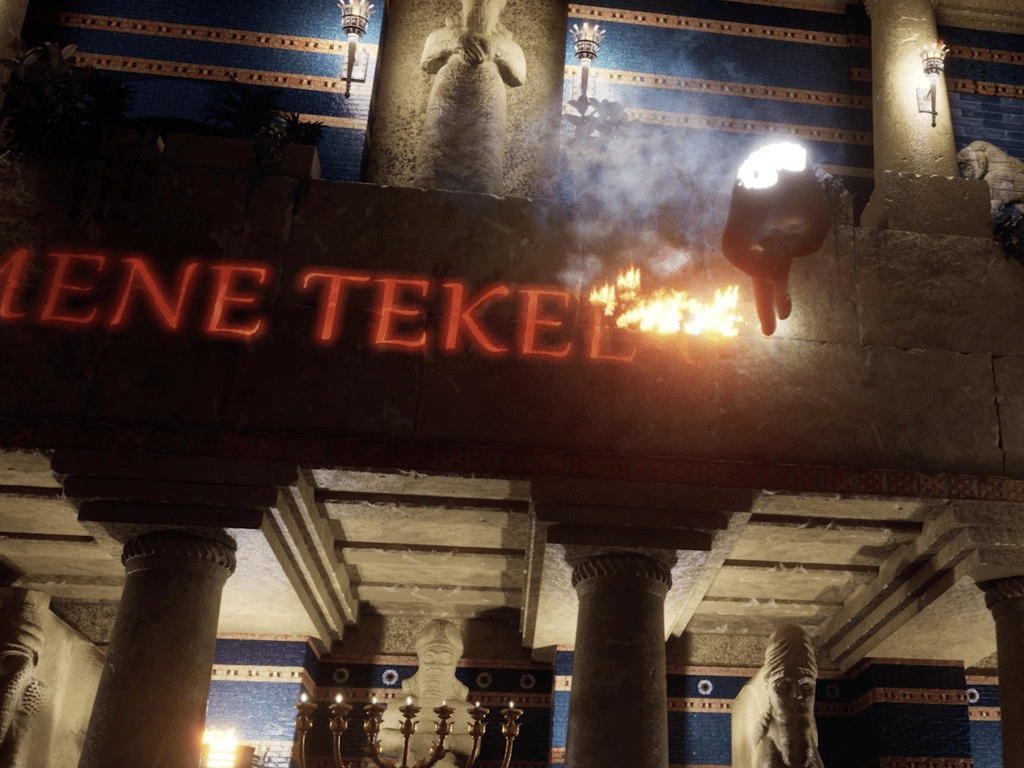
This gala event was in full swing, perhaps at the height of the party, when “Suddenly, they saw the fingers of a human hand writing on the plaster wall of the king’s palace, near the lampstand. The king himself saw the hand as it wrote.” (Dan. 5:5 NLT) You’ve heard of ‘the handwriting on the wall’, well this is it right from the pages of the Bible. The mighty King Belshazzar turned white with fright. His knees knocked together and he nearly collapsed immediately calling for his wise men to read the writing and explain what it means. Again, as in Nebuchadnezzar’s Day they were of no help to him for they were deceivers themselves worshiping the same idols. “So the king grew even more alarmed, and his face turned pale. His nobles, too, were shaken.” (Dan. 5:9 NLT) It was time once again to call in Daniel, the only one who worshiped the God of heaven.
This may have been the first encounter the king had with Daniel. It appeared Belshazzar didn’t even know Daniel when the queen mother persuaded the king to call him based on her previous knowledge of Daniel’s dealings with Nebuchadnezzar. Daniel wasted no time in responding to the king, but first gave him a history lesson. Daniel began by saying, “Your Majesty, the Most High God gave sovereignty, majesty, glory, and honor to your predecessor, Nebuchadnezzar. But when his heart and mind were puffed up with arrogance, he was brought down from his royal throne and stripped of his glory.” (Dan. 5:18, 20 NLT) Daniel proceeded to tell the king in detail of Nebuchadnezzar’s demise and then let Belshazzar know, “O Belshazzar, and you knew all this, yet you have not humbled yourself…..……you have not honored the God who gives you the breath of life and controls your destiny!” (Dan. 5:22, 23b NLT) He didn’t learn from history the consequences of not giving the God of heaven praise for the kingdom He had given him or even for his own life.
FreeBibleimages.org
What was written was straight to the point; ‘MENE, MENE, TEKEL, and PARSIN.’ Mene means your days are numbered. Tekel means you have been weighed on the balances and have not measured up. Parsin means your kingdom has been divided and given to the Medes and Persians. It happened quickly. “That very night Belshazzar, the Babylonian king, was killed. And Darius the Mede took over the kingdom at the age of sixty-two.” (Dan. 5:30-31 NLT)
The Lord God of heaven does not share His glory and He is not mocked. (Gal. 6:7) King Belshazzar found that out and world leaders today also will find it out for themselves if they do not change their ways. But this is not just a lesson for world leaders. It applies to each of us living in today’s Babylon. Being outnumbered as Daniel had been requires Christians to be on guard and faithful to the Lord God of heaven. We are to know all that we have is from God, and He is the one who receives all the glory and the praise!
“As he looked out across the city, he said, ‘Look at this great city of Babylon! By my own mighty power, I have built this beautiful city as my royal residence to display my majestic splendor.’” Daniel 4:30 NLT
A godless society provides the right environment for seeds of pride to grow. Without having God to answer to, it becomes all about me. All my accomplishments are of my doing. The successes I enjoy are through the skill sets I have developed over the years. They are the product of hard work securing a vast education and using that knowledge and experience along with my natural abilities and keenness. Such rationalization is applauded nowadays. There is nothing wrong with being successful. Higher education should be pursued, and a good strong work ethic is a positive trait and is looked upon favorably. But Christians need to be careful in developing skill sets to remember where our natural abilities come from, and who is guiding, leading, and helping us along the way. Jesus reminds us, “For apart from me you can do nothing.” (Jn. 15:5)
In our continued weekly ‘Living in Babylon’ series, we come now to chapter 4 of the book of Daniel where see the insanity of human pride. Last week in chapter 3, Nebuchadnezzar erected a statue representing himself to be worshiped. When Shadrach, Meshach, and Abednego refused, the king had them thrown into the fiery furnace. To Nebuchadnezzar’s amazement the Lord God sent His angel to deliver them from the flames. Nebuchadnezzar had a change of heart saying, “Praise to the God of Shadrach, Meshach, and Abednego! He sent his angel to rescue his servants who trusted in him. They defied the king’s command and were willing to die rather than serve or worship any god except their own God.” (Dan. 3:28 NLT) He then made a decree that no one is to speak a word against the God of Shadrach, Meshach, and Abednego. But in a pagan culture, a change of heart is centered on the power of a god and not recognition of the true God. Nebuchadnezzar had another change of heart.
Nebuchadnezzar praises God again in chapter 4 by saying, “I want you all to know about the miraculous signs and wonders the Most High God has performed for me. How great are his signs, how powerful his wonders! His kingdom will last forever, his rule through all generations.” (Dan. 4:2-3 NLT) The king has another dream that troubled him and calls for the wise men to interpret it. These are the same men who couldn’t help the king in chapter 2 and cannot help him now by interpreting his dream. Nebuchadnezzar then calls for his ace in the hole, Daniel, who has accurately interpreted his dream concerning the statue with the head of gold. Daniel does indeed give the king an accurate interpretation to his latest dream, one that troubles Daniel as well.
I’m sure we have all heard the saying, ‘pride comes before a fall.’ Perhaps some of us witnessed such a disaster. Daniel was not only going to witness one, but he would be the one to inform the king that it would happen to him and in the most humiliating way. Although the king had praised God’s wonderful signs; the seeds of pride within Nebuchadnezzar’s mind have been sprouting and growing now for some time. The Lord would tell the king through the dream Daniel interpreted that he would be disposed from his kingdom by a period of insanity that would come upon him due to his pride. He would be driven out into fields and live like a wild animal for seven years until he came to senses and acknowledges that God rules over all the kingdoms of world. And so it happened, “As he looked out across the city, he said, ‘Look at this great city of Babylon! By my own mighty power, I have built this beautiful city as my royal residence to display my majestic splendor.’ While these words were still in his mouth, a voice called down from heaven, ‘O King Nebuchadnezzar, this message is for you! You are no longer ruler of this kingdom.’” (Dan. 4:30-31 NLT) The king was driven out by his pride.
Living in modern day Babylon has its challenges for Christians. The sin of pride is certainly evident in our society. But we must also acknowledge that pride is at the root of all sin. Christians must be careful not be influenced by the culture and allow the seeds of pride to find fertile soil in our hearts and minds ready for planting. Lest we join in the insanity of human pride.
“But Daniel was determined not to defile himself by eating the food and wine given to them by the king. He asked the chief of staff for permission not to eat these unacceptable foods.” Daniel 1:8 NLT
During the next seven weeks in our Biblical Insights of Word for the Soul, we will be looking at the Old Testament book of Daniel. Our theme will be ‘Living in Babylon.’ There are many insights we can glean from pages of the book of Daniel which correspond to our day and age for Christians. In 605 B.C. Jerusalem was besieged by the Babylonian empire under the hand of Nebuchadnezzar. Most of the residents of the city were taken captive and carried off to Babylon, their new home for the next seventy years.
The Jewish people were now living in captivity in a pagan culture due to their rebellion and sin against the Lord their God, but God had not abandoned them. The Lord told them to have families, raise crops and seek the welfare of the people and the city of Babylon while they were there. Life for the Jews was difficult in Babylon for there was no mention of the God of the Bible, as many foreign pagan gods were the subject of worship. The culture was anti the true God with reminders of that at every turn, however this was now their home, and the Lord said He would be with them. Christians around the world, particularly in the United States, are living today in Babylon, a culture which is also anti God of the Bible. But as the Jews in Babylon, God has not abandoned us either.
Nebuchadnezzar took full advantage of the strong, healthy, intelligent, and gifted young men among the captives. He ordered they be trained in the language, literature, and customs of Babylon to serve in the king’s royal palace. Doing so would wash away any reminders of their homeland or the God of heaven, or so they thought. The first phase of the brainwashing was to assign them new names to represent the gods of the Babylonians. The book of Daniel specifically lists four young men taken into training for the king’s service. Daniel, Hananiah, Mishael, and Azariah are their Hebrew names, we know them better as Belteshazzar, Shadrach, Meshach, and Abednego, their pagan Babylonian names.
An insight for us to see is the effort to remove any remaining thought of previous life and to assimilate into a new culture. Our current secular world culture is the modern-day Babylonian empire forcing their way into the lives of God-fearing people to assimilate to the culture. Daniel and his friends experience this firsthand at the very beginning of living in their new surroundings and cemented an example for us to follow.
Naturally the newly acquired students in training for the king’s service were fed proper meals to ensure continued health and strength. They were given prepared meals from the king’s own kitchen and the best wine from his table. But there was one problem for Daniel, Hananiah, Mishael, and Azariah, the food and wine were offered to pagan gods. The Mosaic Law forbidden the consumption of food or wine sacrificed to a pagan god. Participating in eating this food would go against God’s holy standards for His people. The Bible says Daniel took a stand and was determined he was not going to defile himself with this pagan food and drink.
So, what are Christians to do when faced in compromising positions to assimilate to the culture when accepted is a violation of God’s standards. Daniel determined he would not defile himself with what he knew was sinful against the Lord God. Daniel and his three companions assimilated to their surroundings in every way that was not in violation of God’s laws. They were very successful in the service of the king and the government in Babylon for obeying God.
The Lord does not want us to hide ourselves disengaging from the culture but to assimilate for the progress and welfare of those around us. But Christians are not to compromise by assimilating to and accepting sinful practices as the current culture demands. The Lord will not abandon us, as He did not leave His people in Babylon to fend for themselves but honored their commitment to Him with blessings of fruitfulness in a land and culture not their own. We can experience the same today by being determined not to defile ourselves with the king’s food.
“in everything give thanks; for this is God’s will for you in Christ Jesus.” 1 Thessalonians 5:18 NASB
As Thanksgiving Day is rapidly approaching, have you thought about what are you thankful for? Perhaps you need a moment or two to collect your thoughts? Perhaps you have already prepared a long list for all the things you are thankful for. It could be you have a short list with one or two very special items of thanksgiving. What constitutes an item making your thanksgiving list? I’m sure all the blessings and good fortune that you have accumulated throughout the year would make the list such as recovery from serious illness, along with those special blessings and incidents that have protected you from harm. But have you ever thought of making it simple by being thankful for everything? In everything give thanks and that means everything!
The Old Testament prophet Daniel demonstrates what it looks like to give thanks for everything. Daniel lived most of his life in captivity after being captured as a teenager by the Babylonians. He was schooled and trained in the culture of his new surroundings in order to serve in the government by order of the king. During his lifetime, Daniel never wavered from his commitment to his God, the Lord God of Israel. The Lord blessed Daniel over the years due to his faithfulness and preserving his identity as a Jew as he worked in an ungodly government. In his old age Daniel was serving Darius the Mede as one of three commissioners over the kingdom. His two colleagues wanted to get rid of him as he was about to be promoted. They devised a plan that would see his end not only in the administration, but his life. A law was put into effect that anyone who prayed to any god, divine or human, besides King Darius would be thrown into the lion’s den. Daniels co-workers knew he would be found guilty. They knew they would find him praying, and they did.
There is so much more to this story, but the point here is Daniels’s attitude in prayer and being thankful for all things in all circumstances. It is written in the book of Daniel, “Now when Daniel knew that the document was signed, he entered his house (now in his roof chamber he had windows open toward Jerusalem); and he continued kneeling on his knees three times a day, praying and giving thanks before his God, as he had been doing previously.” Daniel 6:10 NASB Daniel faced certain death by being obedient to God and yet gave thanks to Him. Are we able to do the same, In Everything Give Thanks?






 Word for the Soul